
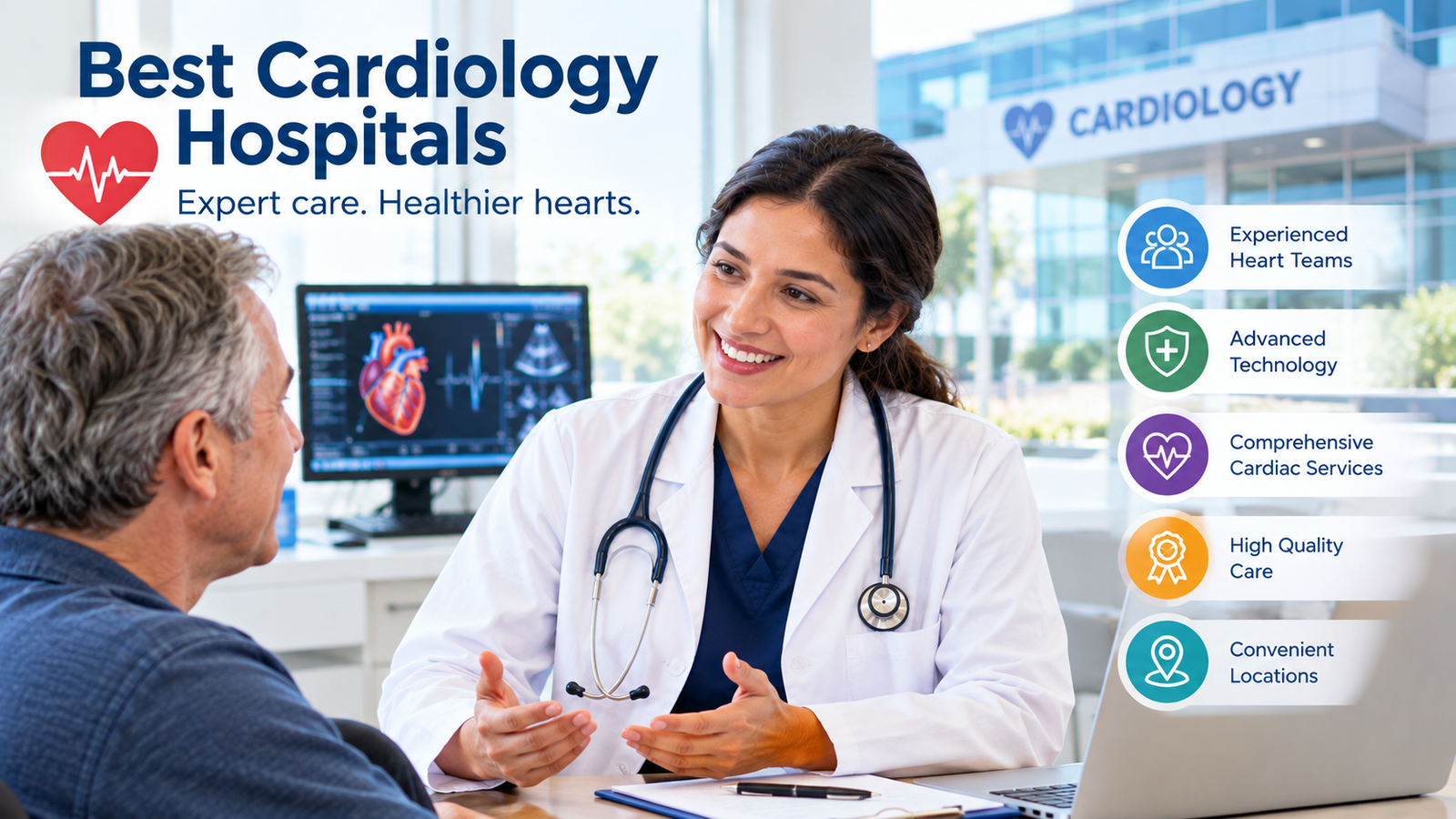

Best cardiology hospitals are centers with strong heart teams, modern testing, and quality care. They often treat complex heart problems and offer many cardiac services.
❤️ Introduction
Choosing a hospital for heart care can feel like a big decision.
You may need care for chest pain, heart failure, or an irregular heartbeat.
You may also need surgery, a heart transplant, or a special test.
The best cardiology hospitals can offer many levels of heart care.
These centers often have cardiologists, heart surgeons, nurses, and other experts.
But a famous hospital may not fit every patient’s needs.
Your condition, location, insurance, and treatment needs all matter.
This guide explains what makes a heart hospital strong.
It also covers hospital services, tests, treatments, and safety signs.
You will learn about leading U.S. centers and global heart hospitals.
You will also learn how to compare hospitals before choosing care.
Current 2025–2026 U.S. rankings place several major centers near the top.
These include NYU Langone, Mount Sinai, Cleveland Clinic, and Mayo Clinic.
🏥 What Makes the Best Cardiology Hospitals?
A strong heart hospital needs more than a famous name.
Good cardiac care depends on trained teams and organized systems.
It also depends on testing, treatment, follow-up, and emergency care.
The American Heart Association offers several cardiac hospital certifications.
These programs focus on evidence-based care and better systems.
The American College of Cardiology also has hospital accreditation programs.
Its HeartCARE Center designation recognizes ongoing quality improvement.
What should you look for?
Consider these features when comparing hospitals:
- Experienced heart team: Look for cardiologists and cardiac surgeons.
- Emergency heart care: Check if the center handles heart attacks.
- Heart surgery: Ask about bypass and valve surgery.
- Heart rhythm care: Check for electrophysiology services.
- Heart failure care: Look for advanced heart failure programs.
- Imaging: Ask about echocardiograms, CT, MRI, and other tests.
- Cardiac rehabilitation: Check for recovery and exercise programs.
- Quality data: Review available hospital performance information.
- Insurance: Confirm that your health plan covers the hospital.
A hospital may have excellent care in one area.
Another center may have stronger services for a different condition.
For example, a patient may need a complex valve procedure.
That patient may need a hospital with strong valve expertise.
Another patient may need routine blood pressure care.
A nearby cardiology clinic may provide the needed service.
This is why hospital choice should match your medical needs.
🌎 Best Cardiology Hospitals in the United States
There is no single hospital that fits every patient.
Hospital rankings also change from year to year.
Different groups use different methods to compare hospitals.
For 2025–2026, U.S. News ranked NYU Langone Hospitals first.
Mount Sinai Hospital ranked second in the same specialty list.
Cleveland Clinic ranked third, followed by Mayo Clinic Rochester.
Other highly recognized centers include several major academic hospitals.
| Hospital | City | Known cardiac areas |
| NYU Langone Hospitals | New York, NY | Cardiology and vascular care |
| Mount Sinai Hospital | New York, NY | Heart and vascular medicine |
| Cleveland Clinic | Cleveland, OH | Cardiology and heart surgery |
| Mayo Clinic | Rochester, MN | Cardiology and heart surgery |
| Cedars-Sinai Medical Center | Los Angeles, CA | Cardiac and vascular care |
| Massachusetts General Hospital | Boston, MA | Heart and vascular medicine |
| Stanford Health Care | Palo Alto, CA | Advanced heart care |
| Houston Methodist Hospital | Houston, TX | Cardiology and heart surgery |
These names come from recent national hospital rankings.
They should not be treated as a universal list for every patient.
Mayo Clinic reports a fourth-place cardiology ranking for 2025–2026.
A patient with heart failure may need different services.
Another patient may need rhythm care or valve treatment.
Ask which hospital has the right program for your specific problem.
A simple patient example
Imagine a patient named Sarah with severe heart valve disease.
Her doctor recommends a valve procedure.
Sarah may compare hospitals with strong valve programs.
She can ask about procedure volume and specialist experience.
She can also ask about recovery care and follow-up visits.
The goal is not simply finding a famous hospital.
The goal is finding appropriate care for her condition.
🌍 What About the Best Cardiology Hospitals in the World?
Global hospital lists can help people find major heart centers.
However, rankings differ by country and by organization.
There is no single worldwide ranking that defines the best hospital.
Patients should compare services, outcomes, specialists, cost, and access.
In the United Kingdom, Royal Brompton and Harefield hospitals provide specialist heart care.
The center treats complex cardiac conditions and performs heart surgery.
Its services include valve surgery and coronary bypass surgery.
It also provides care for congenital heart disease.
In Asia, Asan Medical Center has a large Heart Institute.
Its heart services include cardiology, surgery, and vascular surgery.
The institute has centers for several heart conditions.
These include heart failure, valve disease, rhythm problems, and coronary disease.
Fortis Escorts Heart Institute in New Delhi also provides advanced cardiac care.
Its services include TAVR, electrophysiology, LVAD, and heart surgery.
These examples show why location alone does not define quality.
What should international patients check?
Patients traveling abroad should review several practical points.
- Confirm the hospital treats your exact condition.
- Ask about the doctor’s experience with your procedure.
- Review expected treatment costs.
- Check travel and visa needs.
- Ask about language support.
- Confirm medical record requirements.
- Plan follow-up care after returning home.
- Check emergency care during your stay.
A hospital can have strong specialists but still be hard to access.
Travel may also add cost and stress.
Your local specialist can help decide if travel makes sense.
🩺 What Heart Problems Do These Hospitals Treat?
Large cardiac centers treat many types of heart disease.
Common conditions include coronary artery disease and heart failure.
They may also treat valve disease and abnormal heart rhythms.
Some centers provide care for congenital heart disease.
This means heart problems present from birth.
Common cardiac services
| Condition or need | Possible hospital service |
| Coronary artery disease | Angioplasty, stents, bypass surgery |
| Heart failure | Medicines, devices, advanced heart care |
| Valve disease | Valve repair, replacement, TAVR |
| Rhythm problems | Ablation, pacemakers, defibrillators |
| Heart attack | Emergency cardiac treatment |
| Congenital disease | Adult and pediatric heart programs |
| Severe heart failure | LVAD and transplant programs |
A patient with an irregular heartbeat may need an electrophysiology team.
That team focuses on heart rhythm problems.
Another patient may need a pacemaker.
A hospital with strong device services may be helpful.
Some advanced centers also treat cardiogenic shock.
This means the heart cannot pump enough blood for the body.
The ACC launched a new cardiogenic shock designation in 2026.
It supports organized care across emergency and cardiac teams.
A second patient example
John develops worsening shortness of breath and leg swelling.
His doctor suspects a heart problem and sends him for testing.
The hospital checks his heart function and blood tests.
His care team then creates a treatment plan.
The plan may include medicines, monitoring, and follow-up.
This example shows the value of coordinated heart care.
📋 How Do Hospitals Check Heart Problems?
Heart hospitals use different tests based on symptoms.
Your doctor may start with a medical history and physical exam.
The doctor may also check blood pressure and heart rate.
Common heart tests
- ECG: Records the heart’s electrical activity.
- Echocardiogram: Uses sound waves to create heart images.
- Stress test: Checks how the heart responds to activity.
- Blood tests: Look for signs linked with heart problems.
- CT scan: Creates detailed images of the heart and blood vessels.
- Cardiac MRI: Creates detailed pictures of heart structure.
- Heart monitor: Records heart rhythm over time.
- Cardiac catheterization: Uses a thin tube to examine blood flow.
The exact tests depend on the patient’s symptoms.
A person with chest pain may need urgent testing.
Someone with fainting may need a heart rhythm check.
A person with valve disease may need an echocardiogram.
That test can show valve movement and heart pumping.
Large centers may also offer advanced imaging services.
Mayo Clinic reports specialized cardiovascular imaging and heart testing services.
The right test depends on the clinical question.
More testing does not always mean better care.
Your doctor should explain why each test is needed.
💊 What Treatments Do Heart Hospitals Offer?
Treatment depends on the heart problem and its severity.
Some patients only need lifestyle changes and medicines.
Others may need a procedure or surgery.
Common treatment options
Medicines can help control blood pressure and heart rhythm.
They can also help reduce symptoms from heart failure.
Angioplasty opens a narrowed heart artery.
Doctors may place a stent to help keep it open.
Bypass surgery creates a new route around blocked arteries.
It can improve blood flow to the heart.
Valve treatment repairs or replaces a damaged heart valve.
Some patients may receive a catheter-based treatment.
Ablation treats certain abnormal heart rhythms.
Doctors use heat or cold to target abnormal electrical signals.
Pacemakers help control some slow heart rhythms.
Defibrillators can treat certain dangerous heart rhythms.
Some patients with severe heart failure need advanced care.
This may include mechanical heart support or transplantation.
The treatment choice depends on many factors.
These include symptoms, test results, age, and other health problems.
A third patient example
Maria has severe aortic valve disease.
Her cardiology team reviews her symptoms and imaging results.
The team discusses surgery and catheter-based options.
Maria asks about recovery time and possible risks.
She also asks which hospital has experience with her procedure.
This helps her make an informed choice with her care team.
🌿 How Can You Choose the Right Hospital?
Choosing a heart hospital should involve more than online rankings.
Start with your diagnosis or suspected heart problem.
Then look for hospitals with strong services in that area.
The American Heart Association provides public hospital quality information.
Its database includes measures for heart failure, heart attack, and other conditions.
The AHA says its public data can help patients understand hospital performance.
It also advises patients to discuss hospital options with their doctors.
Questions to ask before choosing
Ask your doctor:
- What heart problem needs treatment?
- Which hospitals treat this problem often?
- Does the hospital offer the needed procedure?
- Does my insurance cover the hospital?
- How long could I wait for care?
- Where will follow-up care happen?
- Can my local doctor work with the hospital team?
You can also check hospital accreditation.
ACC accreditation programs focus on measurable quality improvement.
AHA cardiac certifications also cover different levels of cardiac care.
These include heart attack and advanced heart failure programs.
Location also matters
The nearest hospital may be the right choice during an emergency.
Do not delay emergency care to reach a distant hospital.
Call 911 for serious heart symptoms.
For planned care, you may have more time to compare centers.
Ask about travel, lodging, cost, and family support.
These factors can affect the overall care experience.
⚠️ When Should You Go to a Heart Hospital?
Some heart symptoms need emergency care.
Call 911 for severe or sudden symptoms.
Do not drive yourself during a possible heart emergency.
Emergency warning signs
- Severe chest pressure or pain
- Serious trouble breathing
- Fainting or sudden collapse
- Sudden severe weakness
- New confusion
- Signs of a stroke
- Severe sudden heart symptoms
Heart attacks can cause chest pressure, sweating, nausea, or breathing trouble.
Symptoms can vary from person to person.
Women and older adults may have less typical symptoms.
People with diabetes may also have unusual symptoms.
Do not wait for an appointment when symptoms feel severe.
The AHA’s hospital quality site also warns against using its search during emergencies.
It advises calling 911 for critical situations.
For planned care, speak with your doctor about hospital choices.
❓ Frequently Asked Questions
Q: What are the best cardiology hospitals in the United States?
A: Recent 2025–2026 rankings list several leading U.S. heart centers.
These include NYU Langone, Mount Sinai, Cleveland Clinic, and Mayo Clinic.
The right hospital still depends on your condition and treatment needs.
Q: What is the best hospital for heart problems near me?
A: The best nearby hospital depends on your heart problem and urgency.
Your doctor can help identify an appropriate local center.
The AHA also offers hospital quality information by location.
Q: Are the best cardiology hospitals always the best choice?
A: Not always.
A highly ranked hospital may not offer the exact service you need nearby.
Insurance, travel, wait times, and specialist experience also matter.
Q: What are some leading heart hospitals in Europe?
A: Royal Brompton and Harefield hospitals are major specialist heart centers in the UK.
They provide care for complex heart conditions and heart surgery.
European hospital rankings can change by organization and year.
Q: What are some leading heart hospitals in Asia?
A: Asan Medical Center has a major Heart Institute in South Korea.
Fortis Escorts Heart Institute also provides advanced cardiac care in India.
Patients should compare services for their specific condition.
Q: How do I compare heart hospitals?
A: Compare specialist experience, services, quality data, and insurance coverage.
Also check emergency care and follow-up services.
Your cardiologist can help you review these factors.
Q: Should I travel to a major heart hospital for treatment?
A: Sometimes, travel may help when special expertise is needed.
However, travel can add cost and delay.
Discuss the benefits and risks with your healthcare team.
Conclusion
Finding the right heart hospital takes careful planning.
The best cardiology hospitals often provide experienced teams and advanced services.
But rankings alone should not decide your hospital choice.
Look for a center that treats your specific heart condition.
Check its services, quality information, insurance coverage, and follow-up care.
Major U.S. centers include NYU Langone, Mount Sinai, Cleveland Clinic, and Mayo Clinic.
Strong heart centers also exist across Europe and Asia.
Royal Brompton, Asan Medical Center, and Fortis Escorts are examples.
During an emergency, choose fast access to emergency care.
For planned treatment, compare hospitals with your doctor’s help.
Talk to a cardiologist if you have any heart concerns.
Medically reviewed for accuracy. Always consult a licensed cardiologist for personal advice.