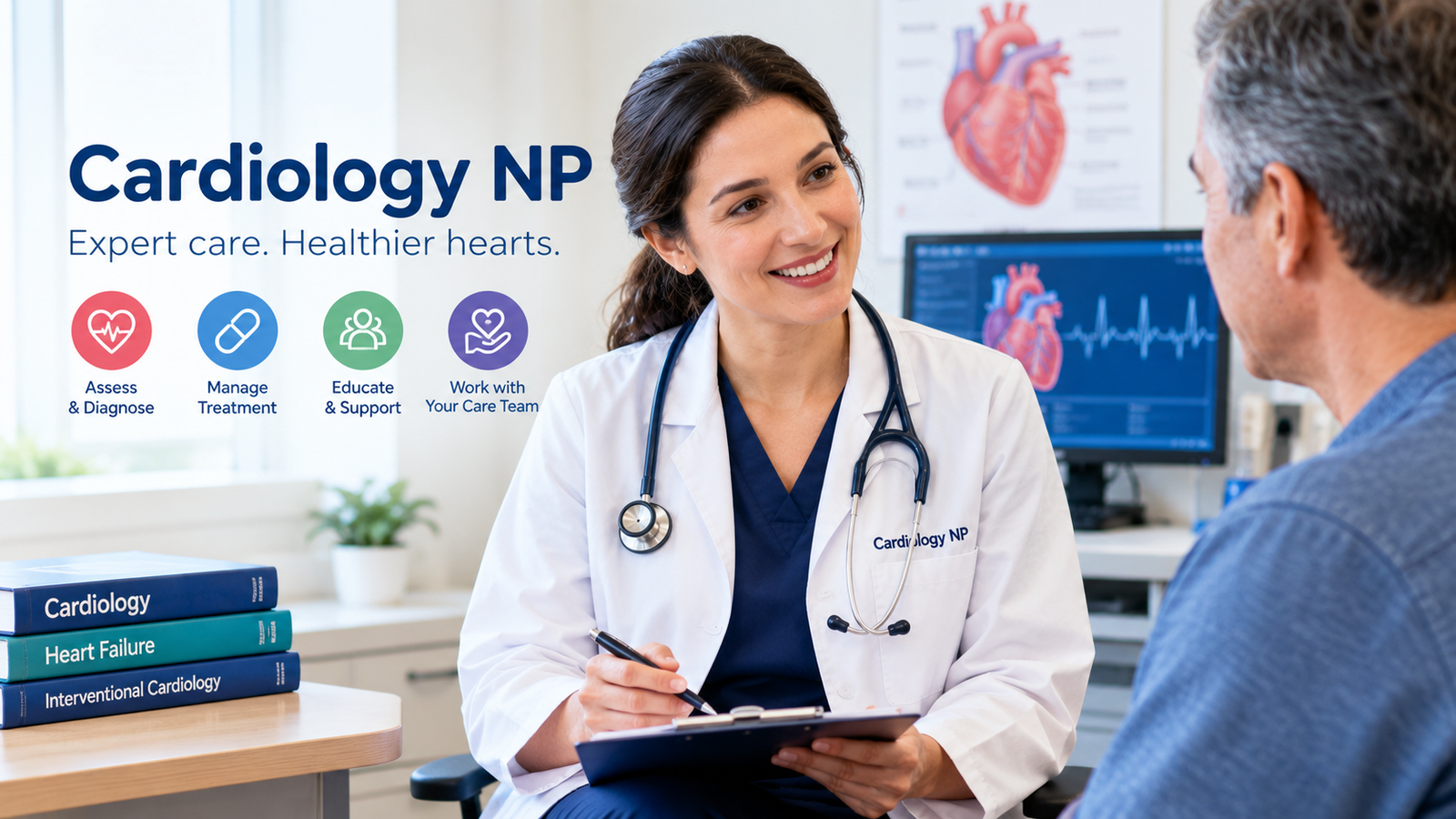

A cardiology NP is a nurse practitioner who provides advanced care for people with heart problems. They assess patients, order tests, manage treatment, and work with cardiologists when needed.
Have you ever wondered who helps care for patients between cardiology visits?
A cardiology NP can play an important role in heart care. NP means nurse practitioner. NPs have advanced nursing education and clinical training.
They can provide care in clinics, hospitals, heart centers, and other settings. Their work can include heart tests, medicines, follow-up visits, and patient education.
The American College of Cardiology has defined skills for NPs in adult heart care. These skills cover areas such as heart failure and rhythm problems.
People also search for cardiology NP jobs, salary, programs, and certification. Many students also ask about fellowship training.
The path can vary by state and by employer. Education, certification, licensure, and clinical experience all matter.
This guide explains the role in simple terms. It also covers training, daily work, salary data, jobs, and career options.
🩺 What Does a Cardiology NP Do?
A cardiology NP is an advanced practice nurse who focuses on heart care. The NP may work with a cardiologist or other heart care team members.
NPs can assess health problems and help manage acute and long-term conditions. They may also order and interpret tests, prescribe medicines, and educate patients.
The exact role depends on the NP’s training and state rules. Some NPs work mainly in outpatient clinics. Others work in hospitals or specialty heart units.
Common duties
A cardiology NP may:
- Review a patient’s medical history
- Perform a physical exam
- Check blood pressure and heart rate
- Order blood tests
- Review ECG results
- Help manage heart failure
- Help manage high blood pressure
- Follow patients after heart procedures
- Teach patients about medicines
- Explain heart health and lifestyle changes
- Work with cardiologists on treatment plans
- Help coordinate care between specialists
An ECG records the heart’s electrical activity. An echocardiogram uses sound waves to create heart images.
Some NPs also work with patients who have rhythm problems. Others focus on heart failure, prevention, or hospital care.
The ACC lists 11 cardiovascular practice areas for NP and PA competencies. These include heart failure, rhythm care, and critical care.
For example, a patient may visit a heart clinic after leaving the hospital. The NP may review medicines and check for new symptoms.
The NP can also explain when the patient should call the care team. This close follow-up can help patients understand their care plan.
📚 Cardiology NP Requirements and Education
Becoming a cardiology NP starts with becoming a registered nurse. The usual path includes nursing education, RN licensure, graduate NP education, and national certification.
The American Association of Nurse Practitioners says NPs need graduate education. Programs include master’s and doctoral options.
Basic education path
The common steps include:
- Earn a nursing degree.
- Pass the NCLEX and become an RN.
- Gain nursing experience as needed.
- Complete an accredited graduate NP program.
- Choose the proper population focus.
- Pass a national NP certification exam.
- Apply for NP licensure in your state.
- Complete required continuing education.
AANP describes BSN education as a common entry point for graduate NP programs. Some nurses may use other approved education paths.
Cardiology itself is usually a specialty focus. It does not replace the main NP population focus.
For example, an adult-gerontology acute care NP may work in inpatient cardiology. A family NP may work in an outpatient heart clinic.
State laws also affect NP practice. Rules can differ for prescribing, diagnosis, and independent practice.
Students should check their state board before planning their career path.
A student named Alex may want to work in a cardiac intensive care unit. Alex may first build strong RN experience before graduate school.
That experience can help with heart rhythms, medications, patient monitoring, and hospital care. Employers may also have their own experience requirements.
❤️ Cardiology NP Programs, Certification, and Fellowship
Students often search for cardiology NP programs. Most NP programs prepare nurses around a population focus.
Cardiology training usually comes through clinical rotations, work experience, specialty education, or post-graduate training.
AANP states that NP programs include classroom learning and clinical rotations. National board certification also follows graduate education.
What can specialty training include?
Cardiology-focused training may cover:
- Heart failure
- Coronary artery disease
- Heart rhythm problems
- Valve disease
- Blood pressure care
- Heart attack care
- Cardiac imaging
- Preventive heart care
- Hospital-based heart care
A cardiology NP fellowship may offer structured training after graduate school. Programs can provide supervised clinical learning in a specialty setting.
Not every NP needs a fellowship. Requirements depend on the employer and the role.
Some new graduates enter cardiology jobs with strong related RN experience. Others may complete a fellowship before taking a specialty position.
The ACC also offers a cardiovascular knowledge examination for experienced NPs and PAs. The current eligibility rules include 2,000 cardiovascular practice hours during three years.
That exam is different from basic NP board certification. It assesses cardiovascular knowledge for experienced clinicians.
For example, Maya may finish an acute care NP program after working in a cardiac ICU. She may apply directly for an inpatient heart care role.
Another new graduate may choose a structured fellowship. Both paths can provide different types of learning.
The best training route depends on education, experience, goals, and employer needs.
📋 What Does a Cardiology NP Check?
A cardiology NP may assess many signs linked with heart health. The exact exam depends on the patient’s symptoms and medical history.
The NP may ask about chest discomfort, breathing trouble, swelling, dizziness, or fainting. They may also review current medicines and past heart problems.
Common tests
| Test | Main purpose |
| ECG | Checks heart rhythm and electrical activity |
| Echocardiogram | Shows heart structure and pumping |
| Blood tests | Checks blood and organ health |
| Stress test | Checks heart response during activity |
| Heart monitor | Tracks heart rhythm over time |
| Cardiac imaging | Shows heart and blood vessel details |
The NP may order tests within their legal scope and workplace rules. They then review results and decide what needs follow-up.
Some NPs help manage patients before and after heart procedures. These may include catheter-based procedures or surgery.
A real-world example
A patient may return after a hospital stay for heart failure. The NP checks weight, swelling, breathing, and medicine use.
The NP may also review recent lab results. They may contact the cardiologist if the patient needs a change in care.
This role can help connect hospital care with home care.
The ACC competency framework includes ambulatory care, acute coronary syndromes, heart failure, rhythm care, and vascular medicine.
The exact duties still depend on training and local practice rules.
💼 Cardiology NP Jobs and Work Settings
Cardiology NP jobs can appear in many healthcare settings. Employers may include hospitals, private practices, academic centers, and large health systems.
Some positions focus on outpatient visits. Others involve inpatient rounds, consultations, or heart failure programs.
Common job settings
| Setting | Possible focus |
| Outpatient clinic | Follow-ups and long-term heart care |
| Hospital | Acute heart problems and consultations |
| Heart failure clinic | Symptoms, medicines, and monitoring |
| Electrophysiology | Heart rhythm conditions |
| Cardiac surgery | Pre- and post-surgery care |
| Cardiac intensive care | High-acuity hospital patients |
Job requirements can vary widely. Some employers ask for prior cardiology experience.
Others may accept strong acute care or critical care experience. Some organizations offer formal training for new hires.
Online discussions from NPs also show wide differences between cardiology roles. Reported duties vary between outpatient, inpatient, and hybrid jobs.
Those reports are personal experiences, not official salary or job data. Job seekers should review each employer’s current posting.
A cardiology NP may also work regular weekday hours. Hospital jobs may include nights, weekends, or call.
Before accepting a job, ask about schedule and patient volume. Also ask about training, procedures, call duties, and supervision.
💰 Cardiac Nurse Practitioner Salary
Salary is one of the most common career questions. There is no single national salary for cardiology NPs.
The U.S. Bureau of Labor Statistics reports data for nurse practitioners as a broader occupation. In May 2025, the median NP wage was $132,300 per year.
That figure does not represent cardiology NPs alone. Pay can change based on location, experience, employer, schedule, and specialty.
| Factor | Why it can affect pay |
| Location | Local wages and living costs differ |
| Experience | More experience may support higher pay |
| Setting | Hospital and clinic roles may differ |
| Schedule | Call and extra shifts can affect earnings |
| Specialty | Specialty needs can affect offers |
| Benefits | Insurance and retirement add value |
The BLS reports a median annual wage of $132,300 for NPs in May 2025.
Online NP salary discussions also show wide differences between offers. Reddit users have reported different cardiology offers across states and settings.
These reports should not replace official wage data. They can show why job offers should be compared carefully.
Look at total compensation instead of salary alone. Benefits may include health insurance, retirement plans, paid time off, and education funds.
Also review call pay, bonuses, licensing costs, and malpractice coverage. These details can change the value of an offer.
🌿 Skills and Career Growth
Strong communication is important in heart care. Patients may feel scared when they hear new heart terms.
A good NP explains each step in plain language. They also listen to patient concerns and family questions.
Useful skills for this field
A cardiology NP may build skills in:
- Heart rhythm assessment
- Heart failure care
- ECG review
- Medication management
- Patient education
- Clinical decision-making
- Team communication
- Procedure support
- Care coordination
- Emergency assessment
The ACC competency framework also emphasizes communication, professionalism, patient care, and lifelong learning.
Career growth can take many forms. An NP may move into heart failure care, electrophysiology, critical care, or cardiac surgery.
Some NPs take leadership roles. Others focus on education, research, quality improvement, or clinical care.
Continuing education remains important. Heart care changes as new research and treatments develop.
For example, Daniel may start in an outpatient heart clinic. After gaining experience, he may move into an advanced heart failure team.
His career path can change as his skills grow. There is no single route that every NP must follow.
⚠️ When Should You Ask a Cardiology NP or Doctor?
Patients should seek medical advice when heart symptoms change. New chest pain, severe breathing trouble, or fainting can need urgent evaluation.
A cardiology NP can often help with routine heart concerns. They can also guide patients toward a cardiologist or emergency service when needed.
Seek urgent help for serious symptoms
Call 911 for symptoms such as:
- Severe chest pain or pressure
- Severe trouble breathing
- Fainting
- Sudden severe weakness
- New confusion
- Signs of stroke
- Severe or sudden heart symptoms
Do not wait for a routine appointment during a medical emergency.
For less urgent concerns, contact your healthcare team. Tell them when symptoms started and how they changed.
A patient may notice new swelling after starting a heart medicine. The NP can review the symptoms and medicine list.
The NP may order tests or discuss the issue with a cardiologist. This team approach can help patients receive the right level of care.
The role of an NP can differ by state. State boards set rules for NP licensure and scope of practice.
❓ Frequently Asked Questions
Q: What is a cardiology NP?
A: A cardiology NP is an advanced practice nurse who focuses on heart care. They may assess patients, order tests, manage treatment, and provide education. They can work with cardiologists in many care settings.
Q: How long does it take to become a cardiology NP?
A: The time varies based on your nursing education and career path. Most people first become RNs, then complete graduate NP education. Specialty cardiology training may add more time.
Q: Do cardiology NPs need a special cardiology certification?
A: No single cardiology NP certification is required for every role. NPs need national certification in their population focus. Some experienced cardiovascular NPs may also pursue additional cardiovascular credentials or exams.
Q: Can a cardiology NP diagnose heart problems?
A: Yes, NPs may diagnose conditions within their education and legal scope. State laws can differ on NP practice authority. Employers may also set additional requirements.
Q: Are cardiology NP jobs available in hospitals?
A: Yes, hospitals employ NPs in many cardiovascular care areas. Jobs can include inpatient cardiology, heart failure, surgery, and critical care. Job duties vary by employer and state.
Q: Is a cardiology NP the same as a cardiologist?
A: No, they are different healthcare roles. A cardiologist is a physician who completes medical school and specialty physician training. An NP follows an advanced nursing education and certification pathway.
Q: What is the salary for a cardiology NP?
A: There is no single national salary for cardiology NPs. The BLS reported a $132,300 median annual wage for NPs in May 2025. Specialty-specific pay can differ by location and employer.
Conclusion
A cardiology NP provides advanced care for people with heart conditions. The role can include exams, tests, medicines, education, and follow-up care.
The career path usually starts with RN education. Graduate NP education, national certification, and state licensure follow.
Cardiology specialty training can happen through clinical work, extra education, or fellowship programs. The best path depends on your goals and experience.
Jobs can exist in clinics, hospitals, heart failure teams, surgery, and other settings. Salary also varies by location, experience, and employer.
The BLS reported a $132,300 median annual wage for NPs in May 2025.
A cardiology NP can also grow into many areas of heart care. Talk to a licensed professional or school advisor about your career goals.
Medically reviewed for accuracy. Always consult a licensed cardiologist for personal advice.