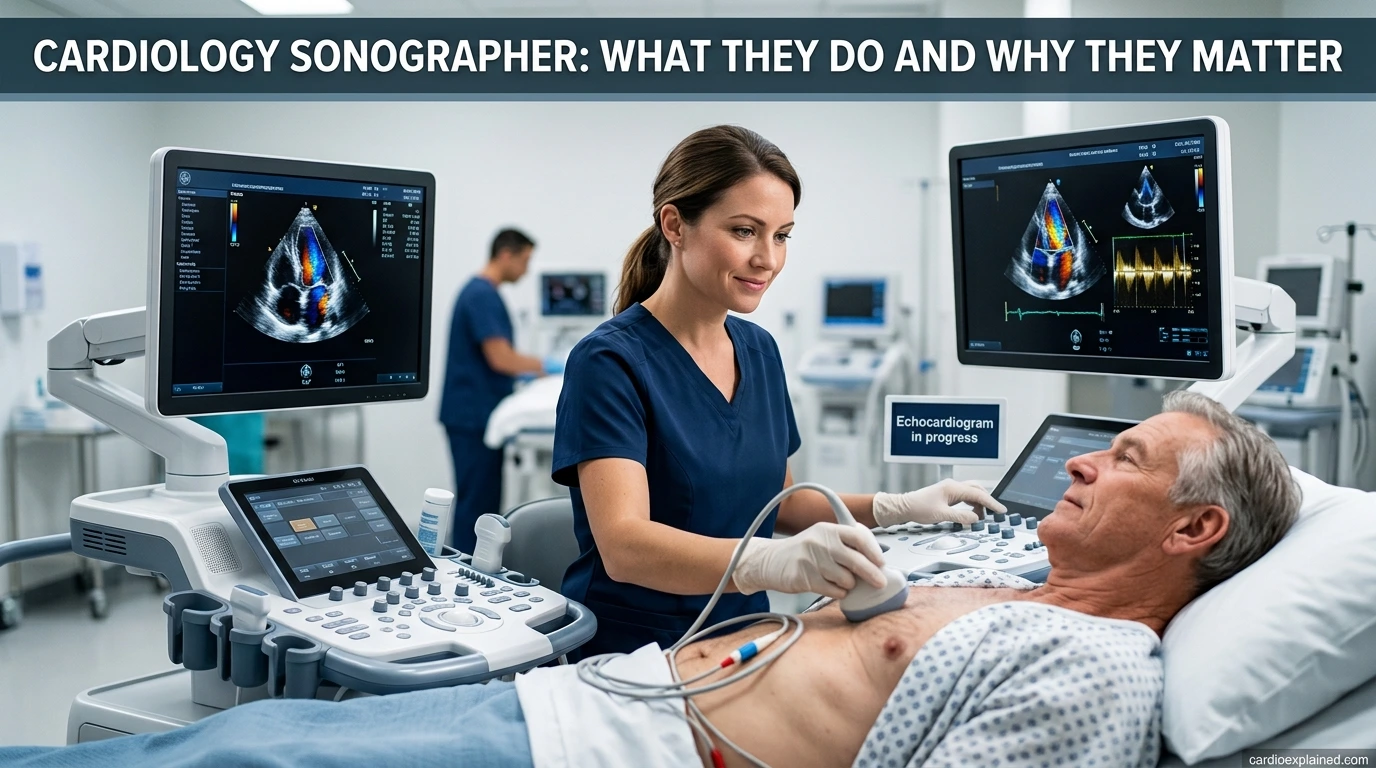

A cardiology sonographer is a trained healthcare professional who uses sound waves to create pictures of your heart. These images help doctors check how your heart looks and works. A cardiology sonographer plays an important role in finding heart problems early and guiding the next steps in care.
Heart tests can feel scary. Many people worry before a heart visit. A cardiology sonographer helps make the process easier. This skilled professional uses a safe test called an echocardiogram, or heart ultrasound. The test does not use radiation. It creates moving pictures of your heart with sound waves. Those pictures help doctors learn how your heart pumps and how your heart valves work. You may meet a cardiology sonographer if you have chest pain, shortness of breath, a heart murmur, or a family history of heart disease. Students also explore this career because it offers meaningful work and strong job growth. Learning about this role can help you feel calm before a test and understand how heart care works.
❤️ What Is a Cardiology Sonographer?
A cardiology sonographer is a healthcare worker with special training in heart imaging. Many people also call this professional a cardiac sonographer or echocardiographer.
This expert creates clear pictures of the heart. Doctors use these pictures to look for many heart problems.
What does a cardiology sonographer do?
A cardiology sonographer works closely with heart doctors, called cardiologists.
Their daily work may include:
- 🩺 Explaining the heart test in simple words.
- 🩺 Helping patients lie in the right position.
- 🩺 Placing warm gel on the chest.
- 🩺 Moving a small handheld device called a transducer.
- 🩺 Taking detailed images of the heart.
- 🩺 Saving images for the cardiologist to review.
- 🩺 Keeping patients comfortable during the exam.
The sonographer does not usually make the final diagnosis. Instead, the cardiologist studies the images and explains the results.
How does an echocardiogram work?
An echocardiogram uses sound waves. These sound waves bounce off the heart. A computer changes those waves into moving pictures.
The test shows:
- ❤️ Heart size
- ❤️ Heart muscle movement
- ❤️ Heart valves
- ❤️ Blood flow
- ❤️ Heart pumping strength
The test is painless for most people. Many exams take about 30 to 60 minutes.
Where do cardiology sonographers work?
Most work in:
| Workplace | What They Do |
| Hospitals | Perform heart imaging for many patients |
| Heart clinics | Help cardiologists diagnose heart disease |
| Outpatient imaging centers | Perform scheduled heart scans |
| Emergency departments | Assist with urgent heart evaluations |
Some also help with research or teach future sonographers.
A real-life example
Many patients feel nervous before their first heart scan. Maria, age 58, worried she had done something wrong after hearing she needed an echocardiogram. The cardiology sonographer explained every step before starting. After the test, Maria said she felt much calmer because she knew what to expect.
Small moments like this help patients feel safe during heart testing.
🩺 How Someone Becomes a Cardiology Sonographer
People often wonder how professionals learn this job. Becoming a cardiology sonographer takes education, practice, and hands-on training.
Education
Most students finish:
- 📋 An associate degree
- 📋 Or a bachelor’s degree
- 📋 Clinical training in hospitals
Many programs include anatomy, heart function, patient care, and ultrasound imaging.
Certification
Many employers prefer certified professionals.
Common certifications include those offered through recognized organizations such as:
- American Registry for Diagnostic Medical Sonography (ARDMS)
- Cardiovascular Credentialing International (CCI)
Certification often requires education, clinical experience, and passing an exam.
Skills needed
A good cardiology sonographer should have:
- ✅ Good communication skills
- ✅ Attention to detail
- ✅ Patience
- ✅ Steady hands
- ✅ Basic computer skills
- ✅ Interest in helping people
They also need strong teamwork skills because they work closely with doctors and nurses.
Job outlook
Heart disease remains common in the United States. More people need heart imaging every year.
Because of this need, trained sonographers may find many job opportunities across hospitals and clinics.
Salary overview
Pay depends on experience, education, and location.
| Experience Level | Typical Pay Trend | Common Workplace |
| Entry level | Lower starting salary | Clinics and hospitals |
| Mid-career | Higher pay | Hospitals and specialty centers |
| Experienced | Highest earning potential | Advanced heart centers |
Many students choose this career because it combines patient care with medical technology.
📋 When Might You Need a Cardiology Sonographer?
Doctors order heart ultrasounds for many reasons. The sonographer performs the imaging that helps answer important questions.
Common reasons for a heart ultrasound
Your doctor may request this test if you have:
- 🩺 Chest pain
- 🩺 Shortness of breath
- 🩺 Swollen legs
- 🩺 Fast or uneven heartbeat
- 🩺 Heart murmur
- 🩺 High blood pressure
- 🩺 A family history of heart disease
These symptoms do not always mean heart disease. The images help doctors understand what may be happening.
Checking known heart problems
Doctors also repeat echocardiograms after a diagnosis.
The test may help watch:
- Heart valve disease
- Heart failure
- Enlarged heart
- Congenital heart disease, or heart problems present at birth
Regular imaging helps doctors compare changes over time.
Before and after treatment
A cardiology sonographer may perform scans before surgery or after treatment.
Doctors compare the images to see how well the heart responds.
For example, someone receiving medicine for heart failure may have repeat scans every few months. The new pictures help show whether the heart pumps better than before.
A patient story
James began feeling tired after climbing stairs. His doctor ordered an echocardiogram. The cardiology sonographer completed the scan and collected detailed images. The cardiologist later found a leaking heart valve. James started treatment early because the test found the problem before it became worse.
Children also need heart ultrasounds
Babies and children sometimes need heart imaging too.
Doctors may order an echocardiogram if a child has:
- ❤️ A heart murmur
- ❤️ Poor growth
- ❤️ Blue skin color
- ❤️ Trouble breathing
- ❤️ A known heart condition
The same sound wave technology helps doctors examine hearts of all ages.
Parents often worry before the visit. Most children complete the test without pain. The sonographer explains each step and helps the child stay relaxed.
⏱️ How Doctors Use the Images
After the heart scan, the cardiologist studies every image. The doctor combines the images with your symptoms, medical history, and physical exam.
The scan helps answer many important questions.
Cardiology sonographer and heart imaging
A cardiology sonographer takes images from several angles. Clear images help the cardiologist make better decisions.
The scan may show:
- 📋 How well the heart pumps
- 📋 Whether the heart valves open and close well
- 📋 Blood flow through the heart
- 📋 Fluid around the heart
- 📋 Changes in heart size
If one image is not clear, the sonographer may take another. This step helps improve accuracy.
Common heart tests
Doctors sometimes order more than one heart test.
| Test | Purpose | What It Shows |
| Echocardiogram | Uses sound waves | Heart structure and movement |
| Electrocardiogram (ECG) | Records electrical signals | Heart rhythm |
| Stress test | Checks the heart during activity | Blood flow during exercise |
| Cardiac MRI | Uses magnets and radio waves | Detailed heart images |
The doctor chooses the best test for each person.
During the appointment
Most people do not need special preparation.
Your visit often follows these steps:
- Change into a gown.
- Lie on an exam table.
- Warm gel goes on your chest.
- The sonographer moves the transducer gently.
- The exam ends after enough images are collected.
Many patients feel nervous before the test. Most say the exam feels easier than expected.
How doctors use the results
Doctors may use the images to:
- Compare past heart scans
- Plan treatment
- Decide if more tests are needed
- Check recovery after surgery
- Watch long-term heart conditions
The American Heart Association (AHA) and the American College of Cardiology (ACC) support imaging as an important part of heart care when it fits a patient’s needs.
✅ Treatment and Care After the Test
The heart scan itself does not treat disease. It gives doctors helpful information.
Your treatment depends on what the images show.
Common treatment plans
Your doctor may suggest:
- ❤️ Healthy eating
- ❤️ Regular physical activity
- ❤️ Medicine
- ❤️ More testing
- ❤️ A heart procedure
- ❤️ Surgery for some heart problems
Many people only need regular checkups and repeat imaging.
Watching heart health over time
Heart problems can change slowly.
Doctors may repeat an echocardiogram to see if:
- A valve problem changes
- Heart failure improves
- Medicine works well
- The heart stays stable
The same safe test can often be repeated without radiation exposure.
Another patient example
Linda had high blood pressure for many years. Her doctor ordered routine heart scans.
The images showed mild changes in her heart muscle. Her doctor adjusted her medicine and encouraged daily walks. Later scans showed her condition stayed stable.
This example shows how heart imaging can help guide care over time.
Working as a team
Good heart care often includes:
- Primary care doctors
- Cardiologists
- Nurses
- Cardiology sonographers
- Dietitians
- Physical therapists
Each person supports a different part of your care.
❤️ Healthy Habits That Protect Your Heart

Many heart problems cannot be fully prevented. Still, healthy habits can lower your risk.
Small changes often make a big difference.
Eat heart-friendly foods
Choose foods like:
- 🥗 Fruits
- 🥗 Vegetables
- 🥗 Whole grains
- 🥗 Fish
- 🥗 Beans
- 🥗 Nuts
Limit foods high in salt, added sugar, and unhealthy fats.
Stay active
Most adults benefit from regular movement.
Walking, swimming, or cycling can support heart health.
Ask your doctor before starting a new exercise plan if you have heart disease.
Keep medical visits
Regular checkups help doctors find problems early.
Your doctor may check:
- Blood pressure
- Blood sugar
- Cholesterol
- Weight
These numbers help guide treatment.
Avoid tobacco
Smoking harms the heart and blood vessels.
Quitting can improve heart health at almost any age.
Manage stress
Long-term stress may affect overall health.
Helpful ideas include:
- Deep breathing
- Time outdoors
- Talking with family
- Good sleep
- Relaxing hobbies
Healthy habits work best when practiced every day.
⚠️ When to See a Doctor
Do not ignore heart symptoms.
Some symptoms need medical attention soon.
Schedule a medical visit if you notice:
- Chest discomfort
- Shortness of breath
- Fast heartbeat
- Swollen feet
- Frequent dizziness
- Unusual tiredness
These symptoms have many possible causes.
Only a healthcare professional can determine the reason.
Seek emergency care right away if you have:
- Severe chest pain
- Trouble breathing
- Fainting
- Sudden weakness
- Trouble speaking
- Pain spreading to the arm, jaw, or back
Call 911 if you think someone has a heart attack or stroke.
Quick treatment can save lives.
Do not drive yourself if symptoms are severe.
❓ Frequently Asked Questions
Q: What does a cardiology sonographer do?
A: A cardiology sonographer performs heart ultrasound exams. They create detailed images that help cardiologists evaluate heart structure and function. They do not usually make the final diagnosis.
Q: Is an echocardiogram painful?
A: No. Most people feel little or no discomfort. The test uses sound waves instead of needles or radiation.
Q: How long does a heart ultrasound take?
A: Most exams last between 30 and 60 minutes. Some may take longer if extra images are needed.
Q: Does a cardiology sonographer tell you the results?
A: Usually no. The sonographer collects the images. A cardiologist reviews them and explains the findings during a follow-up visit.
Q: Do I need to prepare for an echocardiogram?
A: Most standard echocardiograms need little preparation. Your healthcare team will tell you if your test has special instructions.
Q: Is becoming a cardiology sonographer a good career?
A: Yes. Many people enjoy helping patients while working with medical imaging technology. The career also offers opportunities for growth and continued learning.
Q: Can children have an echocardiogram?
A: Yes. Doctors safely use heart ultrasound for babies, children, and adults. The test does not use radiation.
Conclusion
A cardiology sonographer helps doctors see how the heart works without surgery or radiation. Their skill supports early detection, treatment planning, and long-term heart care. Many patients feel less worried after learning how simple and safe an echocardiogram can be.
Healthy habits, regular checkups, and timely heart testing may help protect your heart for years to come. If you notice new heart symptoms or have concerns about your heart health, talk with a cardiologist. Early care often leads to better outcomes.