
Cardiology vs cardiovascular mainly compares a medical specialty with a broader term. Cardiology focuses on heart and blood vessel health, while cardiovascular describes the heart and blood vessel system. Doctors use both terms when discussing heart care, disease, tests, and treatment.
Have you ever wondered why doctors use both heart and cardiovascular terms?
The words sound similar, but they do not mean the same thing.
Cardiology vs cardiovascular can be confusing for patients and students.
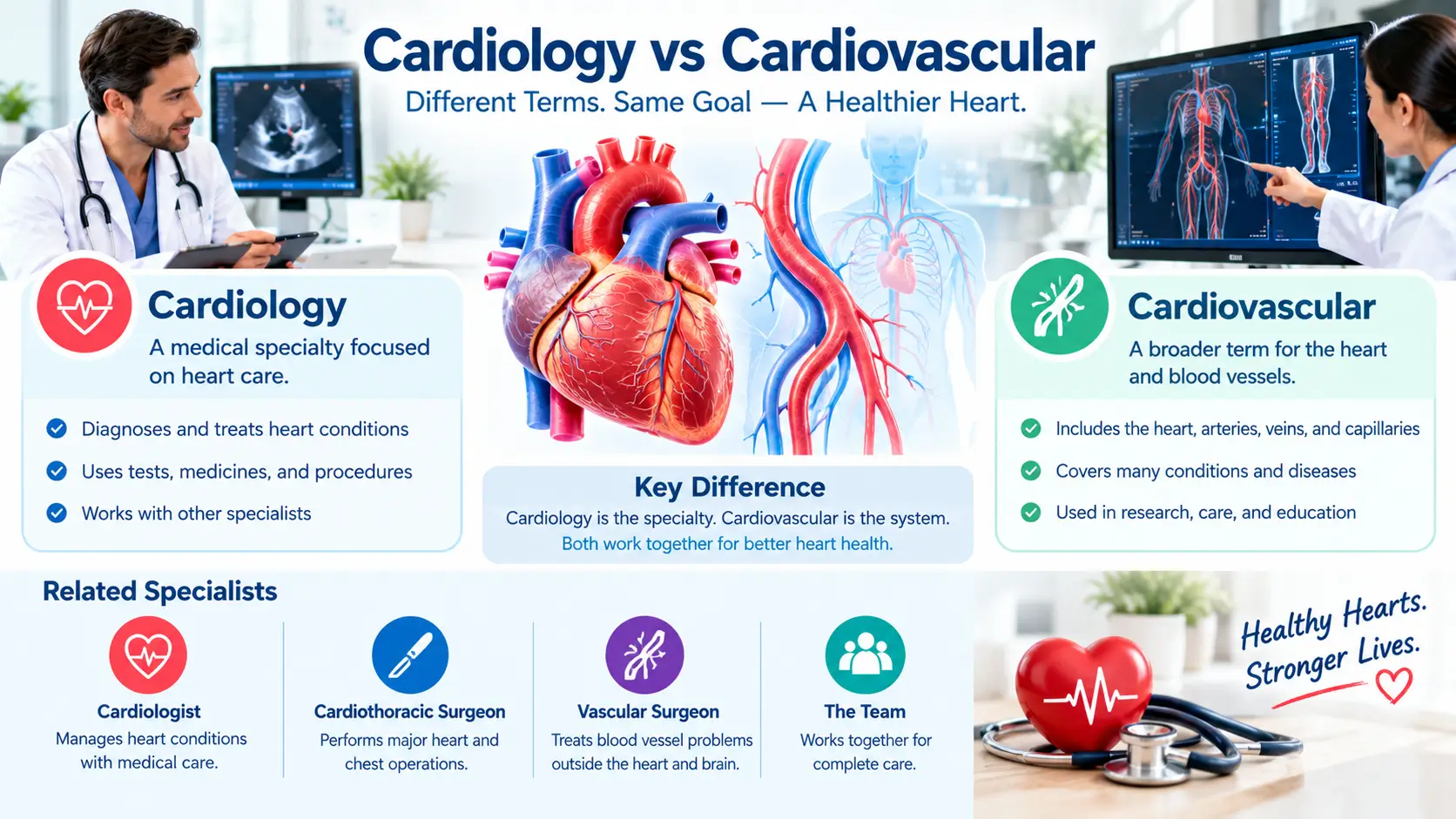
Cardiology is a medical specialty.
Cardiovascular is a term that describes the heart and blood vessels.
The American College of Cardiology describes cardiology as a field focused on heart health.
It also covers many problems involving blood vessels. (American College of Cardiology)
This difference matters when you search for a doctor or medical service.
You may see cardiologist, cardiovascular doctor, vascular surgeon, or cardiothoracic surgeon.
These doctors can have different roles and training paths.
Some use medicines and tests to manage heart problems.
Others perform procedures or major surgery.
This guide explains these terms in simple language.
You will also learn about symptoms, tests, treatments, training, and doctor types.
What Do Cardiology and Cardiovascular Mean?
Cardiology is the medical field that studies and treats heart problems.
It also covers many conditions involving the blood vessels.
The heart pumps blood through a large network of vessels.
Arteries carry blood away from the heart.
Veins carry blood back toward the heart.
Cardiologists diagnose and manage many heart conditions.
These include heart rhythm problems, heart failure, and coronary artery disease. (American College of Cardiology)
The word cardiovascular works differently.
It usually describes something related to the heart and blood vessels.
For example, cardiovascular disease includes many different conditions.
These can affect the heart, arteries, veins, or blood flow.
The American Heart Association uses cardiovascular disease as a broad term.
It includes heart disease and several blood vessel conditions. (www.heart.org)
Simple example
Think about a school and its teachers.
Cardiology is like a specific school department.
Cardiovascular is like a wider description of the whole system.
This helps explain why you see both terms on medical websites.
A hospital may have a cardiovascular center or cardiology department.
The terms can overlap in everyday medical language.
However, they are not always exact substitutes.
| Term | Simple meaning | Common use |
| Cardiology | Medical specialty for heart care | Diagnosis and treatment |
| Cardiovascular | Related to heart and blood vessels | Diseases, care, tests |
| Cardiologist | Doctor who treats heart conditions | Medical heart care |
| Cardiothoracic surgeon | Surgeon for heart and chest organs | Heart and chest surgery |
| Vascular surgeon | Specialist for blood vessels | Artery and vein care |
A cardiologist may work with many other specialists.
This teamwork can help patients with complex heart and blood vessel problems.
How Do Cardiovascular Conditions Develop?
Heart and blood vessel problems can develop for many reasons.
Some risks come from daily habits.
Others come from age, genes, or existing health problems.
Atherosclerosis is one common cause of cardiovascular disease.
It happens when plaque builds up inside artery walls. (www.heart.org)
Plaque can make an artery narrower.
This can reduce blood flow to body tissues.
Common risk factors
Several factors can raise cardiovascular risk.
- High blood pressure
- High cholesterol
- Smoking
- Diabetes
- Excess body weight
- Physical inactivity
- Unhealthy eating patterns
- Older age
- Family history
Some risk factors cannot be changed.
Age and family history are examples.
Other factors can often improve with proper care.
Doctors may suggest exercise, diet changes, medicines, or smoking support.
A patient example
Imagine a 58-year-old patient with high blood pressure.
The patient also has high cholesterol and rarely exercises.
The doctor may review these risks together.
The doctor may then suggest lifestyle changes and medicines.
This approach looks beyond one symptom.
It focuses on the patient’s overall heart and blood vessel health.
Cardiologists also manage conditions that are not caused by blocked arteries.
These include rhythm problems and heart muscle disorders.
Some cardiovascular problems can affect blood vessels outside the heart.
These may need care from a vascular specialist.
For example, peripheral artery disease can affect blood flow to the legs.
A vascular specialist may evaluate these problems.
The Society for Vascular Surgery explains that vascular surgeons treat many vessel conditions.
Their work includes both surgical and non-surgical care. (Vascular.org)
What Symptoms Should You Watch For?
Symptoms depend on the condition and the body area involved.
Some heart problems cause clear symptoms.
Others may cause few symptoms at first.
Common heart-related symptoms include:
- Chest pressure or pain
- Shortness of breath
- Unusual tiredness
- Fast or irregular heartbeat
- Dizziness
- Fainting
- Swelling in the legs
Chest discomfort can have many causes.
Not every chest symptom comes from the heart.
However, new or severe chest pain needs urgent attention.
Especially when it comes with breathing trouble or fainting.
Blood vessel symptoms
Vascular problems can cause different signs.
A person with poor leg blood flow may develop leg pain while walking.
The pain may improve after resting.
Some people may have cold feet or slow-healing wounds.
Others may have changes in skin color.
A vascular surgeon may evaluate these symptoms.
The Society for Vascular Surgery lists several conditions involving arteries and veins. (Vascular.org)
A real-world example
A 67-year-old patient may report repeated calf pain during walks.
The pain disappears after a few minutes of rest.
The doctor may suspect a blood flow problem.
Further testing can help identify the cause.
This example shows why symptoms need proper evaluation.
A symptom alone does not confirm a specific disease.
Heart symptoms can also differ between people.
Some patients may have mild symptoms.
Others may have sudden and severe symptoms.
Women, older adults, and people with diabetes may have less typical symptoms.
Doctors consider the full health history before choosing tests.
Never ignore symptoms that feel new, severe, or unusual.
Urgent symptoms need prompt medical care.
How Do Doctors Check Heart and Blood Vessel Problems?
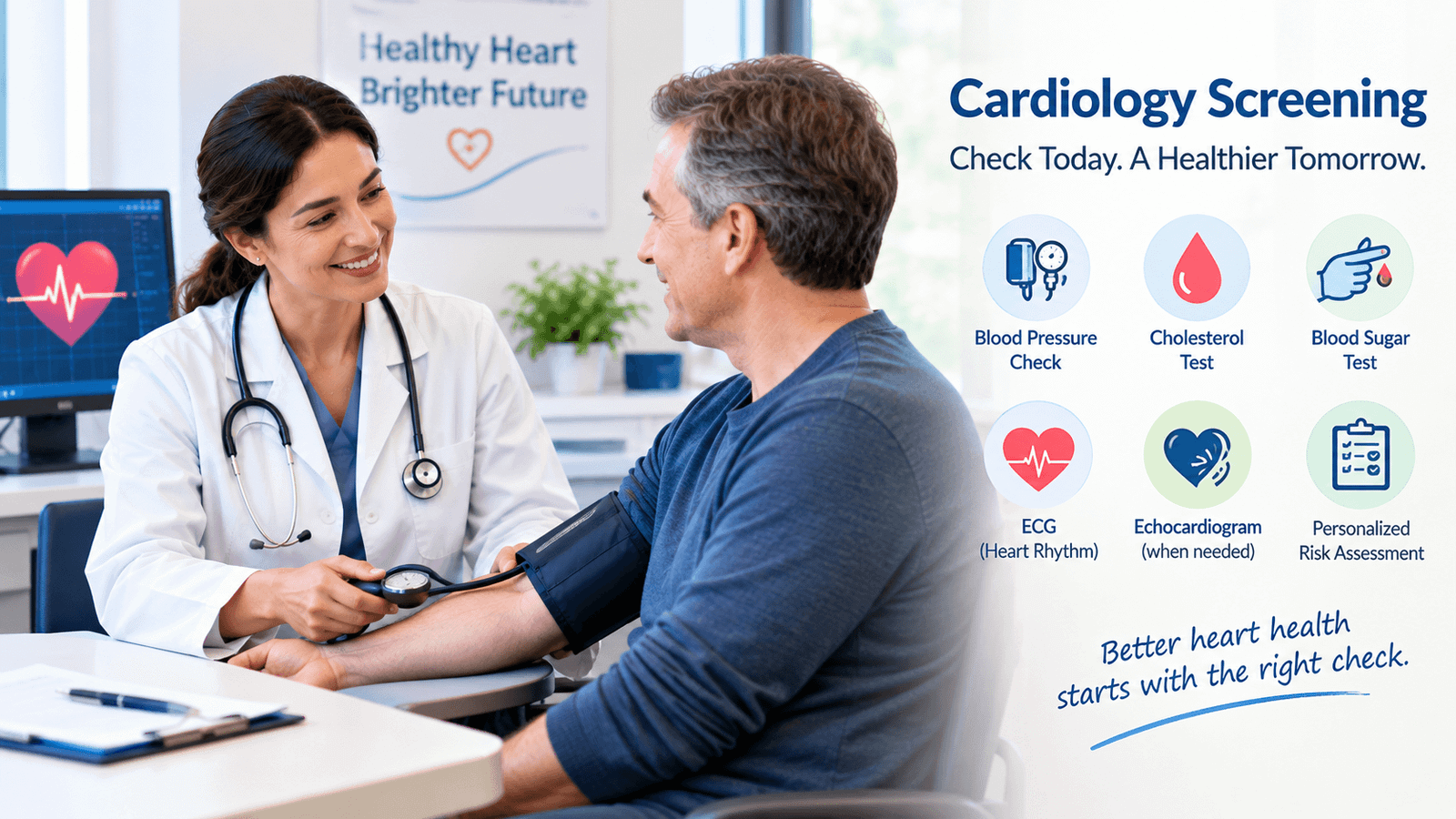
Doctors start with your medical history and physical exam.
They may ask about symptoms, medicines, family history, and lifestyle.
The doctor may also check your blood pressure and heart rate.
Blood tests can measure cholesterol, blood sugar, and other markers.
Several heart tests may follow when needed.
Common heart tests
An electrocardiogram, or ECG, records the heart’s electrical activity.
It can help doctors identify certain rhythm or heart problems.
An echocardiogram uses sound waves to create heart images.
It can show heart structure and movement.
A stress test checks how your heart responds during activity.
Some patients exercise while doctors monitor their heart.
Doctors may also use cardiac imaging.
Examples include CT scans and cardiac MRI.
Some patients need cardiac catheterization.
This test uses a thin tube to examine blood vessels around the heart.
The exact test depends on the symptoms and medical history.
Doctors do not use every test for every patient.
Blood vessel tests
Vascular doctors may use ultrasound to check blood flow.
This test does not require a surgical cut.
CT or MRI scans can also show blood vessel problems.
The choice depends on the body area and suspected condition.
The ACC describes cardiovascular testing as part of cardiovascular disease training.
This includes choosing and using appropriate diagnostic tests. (American College of Cardiology)
A patient example
A patient may visit a doctor because of repeated shortness of breath.
The doctor may start with an exam and ECG.
The next step depends on those findings.
The doctor may order an echocardiogram or another test.
This step-by-step process helps avoid unnecessary testing.
It also helps doctors focus on the most likely causes.
What Treatments Are Available?
Treatment depends on the condition, symptoms, test results, and overall health.
Doctors may use one treatment or several together.
Many patients start with lifestyle changes and medicines.
Some patients may need procedures or surgery.
Medical treatment
Doctors may prescribe medicines for several cardiovascular conditions.
Common medicine groups include:
- Blood pressure medicines
- Cholesterol-lowering medicines
- Medicines for abnormal heart rhythms
- Blood-thinning medicines
- Medicines for heart failure
Each medicine has a specific purpose.
Patients should take medicines exactly as prescribed.
Never stop a heart medicine without medical advice.
Stopping some medicines suddenly may cause serious problems.
Procedures
Some heart conditions need procedures instead of open surgery.
For example, doctors may use catheter-based treatments.
An interventional cardiologist performs certain minimally invasive heart procedures.
These procedures use small tubes rather than large surgical cuts.
A stent can help open some narrowed heart arteries.
Doctors choose this treatment only when appropriate.
Surgery
Cardiothoracic surgeons handle major operations involving the heart and chest.
Their training includes cardiovascular surgery and thoracic surgery. (Abts)
Examples include some heart valve operations and bypass surgery.
A cardiologist and surgeon may work together.
The cardiologist may diagnose the problem and discuss treatment options.
The surgeon may perform an operation when surgery becomes appropriate.
Who treats what?
Cardiologist: Manages many heart conditions using medicines and procedures.
Interventional cardiologist: Performs catheter-based heart procedures.
Cardiothoracic surgeon: Performs major operations involving the heart and chest.
Vascular surgeon: Treats blood vessel problems outside the heart and brain. (Vascular.org)
These roles can overlap in team-based care.
Your primary doctor can help guide you to the right specialist.
What Does Training Look Like?
People often search cardiology vs cardiovascular when researching medical careers.
The training terms can create even more confusion.
In the United States, cardiovascular disease is a formal medical subspecialty.
ABIM requires certification candidates to complete approved fellowship training. (Abim)
A physician usually completes medical school first.
Most then complete internal medicine training before cardiovascular disease fellowship.
The Accreditation Council for Graduate Medical Education lists cardiovascular disease as a fellowship specialty. (acgme.org)
Cardiology fellowship training includes patient care and cardiovascular testing.
It also includes procedures and management of heart disease. (prod2.acgme.org)
Cardiothoracic surgery follows a different training path.
The American Board of Thoracic Surgery lists several certification pathways. (Abts)
One pathway uses general surgery training followed by thoracic surgery training.
Another pathway uses a six-year integrated thoracic surgery residency.
Cardiology and cardiothoracic surgery are different careers
A cardiologist is a medical doctor focused on heart disease.
A cardiothoracic surgeon is a surgical specialist.
This difference matters when choosing a medical career.
Students should compare training length, daily work, procedures, and career goals.
The two fields also work closely together.
Patients may receive care from both specialists during one treatment plan.
Cardiologist vs Cardiothoracic Surgeon vs Vascular Surgeon
These doctor types can sound similar.
Their main focus areas are different.
Cardiologist
A cardiologist focuses mainly on medical heart care.
They diagnose and manage many heart conditions.
Some cardiologists also perform catheter-based procedures.
Others focus on rhythm care, heart failure, imaging, or prevention.
Cardiothoracic surgeon
A cardiothoracic surgeon performs operations involving the heart and chest.
The field includes adult cardiac and thoracic surgery.
The American Board of Thoracic Surgery tracks operative training and case experience. (Abts)
Vascular surgeon
A vascular surgeon focuses on blood vessels outside the heart and brain.
They treat arteries and veins throughout much of the body. (Vascular.org)
They may use medicine, exercise plans, minimally invasive procedures, or surgery.
Surgery is not always needed.
What is a cardiovascular doctor called?
There is no single doctor title for every cardiovascular problem.
A cardiologist is the common doctor for heart disease.
A vascular surgeon treats many blood vessel conditions.
A cardiothoracic surgeon treats certain heart and chest conditions surgically.
Your condition determines which specialist may be involved.
Who Earns More: Cardiologist or Cardiac Surgeon?
Salary comparisons can be difficult because job categories differ.
The US Bureau of Labor Statistics does not list cardiac surgeons separately.
For May 2025, BLS reported a median wage of $496,010 for cardiologists. (Bureau of Labor Statistics)
BLS reported $414,010 for the broader “surgeons, all other” category. (Bureau of Labor Statistics)
That category does not represent cardiac surgeons alone.
Therefore, those figures cannot provide a direct cardiologist-versus-cardiac-surgeon comparison.
Actual physician income can vary for many reasons.
These include location, practice type, experience, work hours, and procedures.
Students should avoid choosing a specialty from salary alone.
Training, daily work, patient care, and personal goals also matter.
How Can You Protect Your Cardiovascular Health?
Heart and blood vessel health often depends on several daily habits.
Small changes can support better long-term health.
Focus on basic habits
- Eat more vegetables, fruits, and whole foods.
- Limit excess salt and added sugar.
- Stay physically active as your doctor advises.
- Avoid smoking and tobacco products.
- Keep regular medical visits.
- Take prescribed medicines as directed.
- Monitor blood pressure when advised.
- Ask about cholesterol and blood sugar checks.
Your doctor can help set safe goals for your health.
Your plan may change as your health needs change.
Why prevention matters
Cardiovascular disease can develop over many years.
Risk factors may also exist before symptoms appear.
The American College of Cardiology includes disease prevention and risk control.
This includes managing related health problems and risk factors. (American College of Cardiology)
Another patient example
A 45-year-old patient may feel healthy during daily life.
A routine visit may show high blood pressure.
The patient may not feel any symptoms.
The doctor can still address the risk early.
This is why routine care matters.
Prevention does not require waiting for chest pain.
Your doctor can help decide which screenings fit your age and risks.
When Should You See a Doctor?
You should seek medical advice for new or ongoing heart symptoms.
Your primary doctor can start the evaluation.
You may need a cardiologist when symptoms or test results suggest heart disease.
A referral may also help when you have several cardiovascular risk factors.
Seek emergency help for serious symptoms
Call 911 for severe or sudden symptoms such as:
- Strong or persistent chest pressure
- Severe trouble breathing
- Fainting with chest symptoms
- Sudden weakness on one side
- Sudden trouble speaking
- Sudden severe symptoms with sweating or nausea
The American Heart Association notes that blocked blood flow can cause heart attacks.
It also describes stroke as another major cardiovascular emergency. (www.heart.org)
Do not drive yourself during a suspected emergency.
Emergency teams can begin care while transporting you.
When to ask about a specialist
Ask your doctor about specialist care if you have:
- Repeated chest discomfort
- New irregular heartbeats
- Unexplained shortness of breath
- Swelling with other heart symptoms
- Abnormal heart test results
- Leg pain during walking
- Slow-healing foot or leg wounds
A vascular specialist may help with artery or vein problems.
The Society for Vascular Surgery notes that many vascular conditions need specialized care. (Vascular.org)
Getting the right specialist starts with understanding the problem.
Your primary care doctor can help guide that process.
Frequently Asked Questions
Q: Is cardiology the same as cardiovascular medicine?
A: They are closely related, but the terms are not identical. Cardiology is a medical specialty. Cardiovascular describes the heart and blood vessel system.
Q: What is the difference between cardiology and cardiothoracic surgery?
A: Cardiology mainly focuses on medical heart care and catheter procedures. Cardiothoracic surgery focuses on operations involving the heart and chest.
Q: Is cardiovascular disease fellowship the same as cardiology fellowship?
A: In US internal medicine training, cardiovascular disease is the formal fellowship name. Doctors often call this field cardiology in everyday language. ABIM recognizes cardiovascular disease as an internal medicine subspecialty. (Abim)
Q: What is a cardiovascular doctor called?
A: A doctor who treats heart disease is usually called a cardiologist. Other cardiovascular specialists include vascular surgeons and cardiothoracic surgeons.
Q: What is the difference between a cardiovascular and vascular surgeon?
A: Vascular surgeons mainly treat blood vessels outside the heart and brain. Cardiovascular surgery may involve operations on the heart and related structures.
Q: Who earns more, a cardiologist or cardiac surgeon?
A: There is no single reliable national comparison for these exact two groups. BLS reports cardiologist wages separately but does not list cardiac surgeons as their own category. (Bureau of Labor Statistics)
Q: When should I see a cardiologist instead of a vascular surgeon?
A: A cardiologist usually evaluates heart-related concerns. A vascular surgeon evaluates many artery and vein problems outside the heart and brain. (Vascular.org)
Conclusion
Understanding cardiology vs cardiovascular becomes easier with one simple idea.
Cardiology is a medical specialty focused on heart care.
Cardiovascular describes the heart and blood vessel system.
Cardiologists manage many heart conditions with tests, medicines, and procedures.
Cardiothoracic surgeons perform certain major heart and chest operations.
Vascular surgeons treat many blood vessel conditions outside the heart and brain.
These specialists often work together as part of one care team.
The right doctor depends on your symptoms and medical needs.
Do not ignore new or serious heart symptoms.
Seek emergency help for severe or sudden warning signs.
Talk to a cardiologist if you have any heart concerns.
Your primary doctor can also help guide your next step.
Medically reviewed for accuracy. Always consult a licensed cardiologist for personal advice.