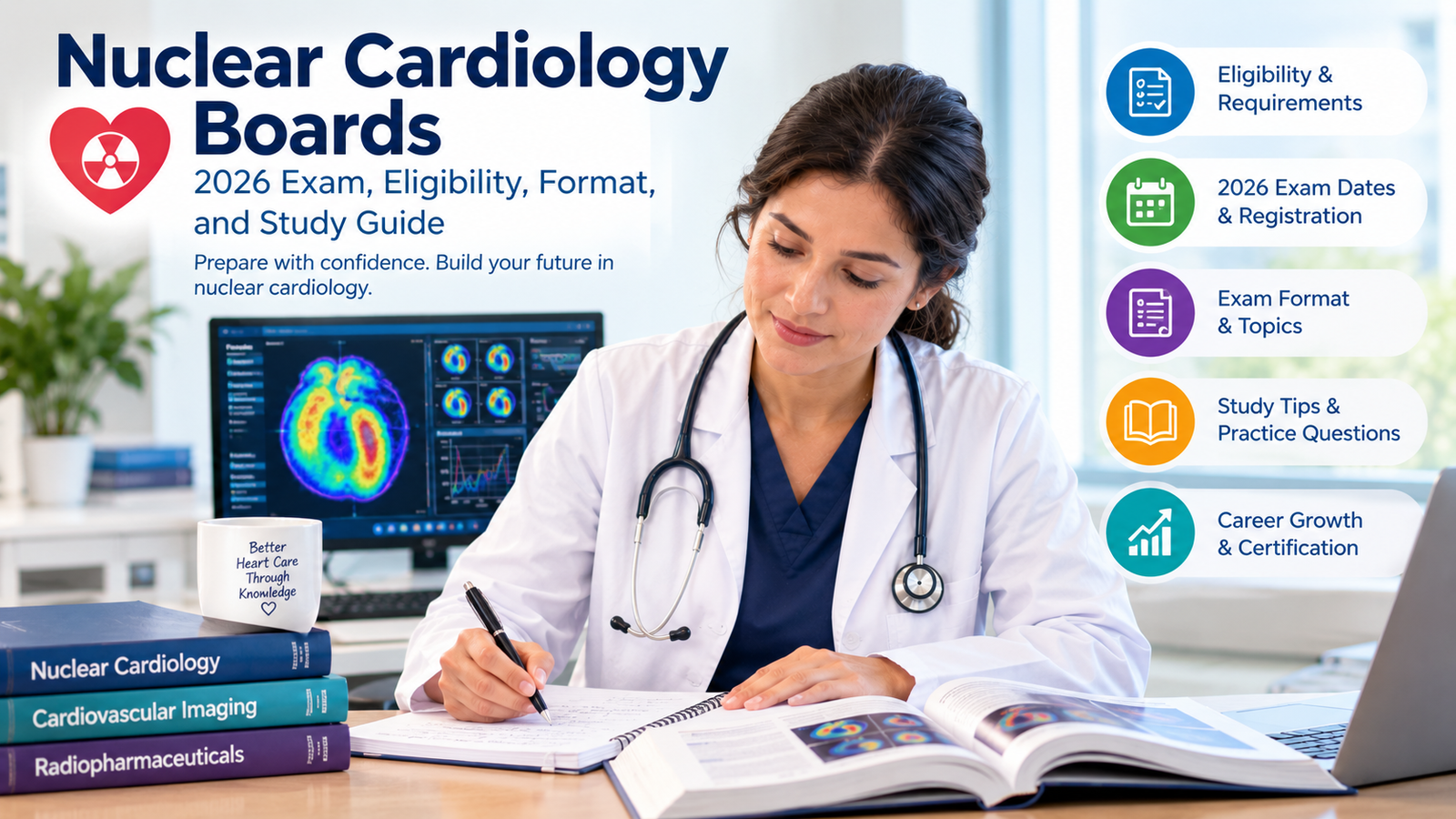

Nuclear cardiology boards are professional certification exams for physicians trained in nuclear cardiology. They test knowledge of imaging, radiopharmaceuticals, safety, and image reading. The CBNC exam helps confirm advanced skills used in nuclear cardiology practice.
Are you preparing for a nuclear cardiology exam and unsure where to start?
Many physicians feel stressed before a specialty board exam.
A clear plan can make the process easier.
The nuclear cardiology boards focus on skills used in daily clinical work.
The main U.S. specialty exam is the CBNC examination.
CBNC means Certification Board of Nuclear Cardiology.
The exam covers nuclear imaging, radiation safety, protocols, and clinical use.
It also tests image interpretation and quality control.
This guide explains the exam in simple terms.
You will learn about eligibility, registration, dates, format, and study planning.
You will also learn how to use practice questions.
The guide covers common mistakes that can slow your progress.
Current 2026 CBNC information shows an application window from June 2 to October 13.
The 2026 exam window runs from November 3 through December 29.
Always check the official exam site before submitting an application.
What Are Nuclear Cardiology Boards?
Nuclear cardiology uses special medicines to create pictures of the heart.
These medicines contain small amounts of radioactive material.
Doctors use nuclear imaging to study blood flow and heart function.
They may use SPECT or PET imaging for this purpose.
The CBNC certification focuses on nuclear cardiology practice.
It assesses knowledge, skills, and clinical judgment.
The exam covers several important areas.
- Nuclear imaging tests
- Radiopharmaceuticals
- Imaging protocols
- Radiation safety
- Image processing
- Image interpretation
- Quality control
- Clinical applications
Radiopharmaceuticals are medicines that contain radioactive substances.
They help doctors create useful images inside the body.
The exam also uses images and videos.
Some questions ask you to interpret these exhibits.
CBNC certification differs from general medical licensure.
It shows specialty knowledge beyond basic permission to practice medicine.
Who Usually Takes This Exam?
The exam is designed for trained physicians.
Eligible U.S. applicants need current board certification.
Accepted primary specialties include cardiology, nuclear medicine, and radiology.
Some trainees can take the exam before primary board certification.
They receive testamur status after passing.
They must complete the remaining certification requirements later.
This pathway can help fellows plan their certification early.
However, all current eligibility rules must be checked before applying.
Eligibility and Training Requirements
Eligibility is one of the first things to confirm.
For 2026 U.S. applicants, CBNC requires Level 2 nuclear cardiology training.
The training must include at least 700 hours.
At least 80 hours must include classroom and laboratory training.
Applicants must complete these requirements before submitting the application.
The training must follow recognized nuclear cardiology training standards.
Level 2 Training
Level 2 training provides advanced nuclear cardiology skills.
Training includes several parts of nuclear imaging practice.
You may learn how to:
- Prepare patients for imaging
- Perform stress testing
- Handle radiopharmaceuticals
- Follow radiation safety rules
- Acquire nuclear images
- Process image data
- Interpret heart images
- Correlate imaging with other tests
The training must occur at an approved training center.
A preceptor must document your nuclear cardiology training.
The preceptor also confirms your training experience.
Radiation safety is another important part of training.
An authorized user may need to verify this part.
Board Certification
U.S. applicants must hold current primary board certification.
Accepted areas include cardiology, nuclear medicine, or radiology.
The certifying board must meet accepted U.S. specialty board standards.
Some residents and fellows can apply as testamurs.
They must complete all requirements within the allowed period.
Requirements can change between examination years.
Always review the current rules before applying.
Nuclear Cardiology Boards: 2026 Dates and Registration
Planning your dates early can reduce application stress.
For 2026, CBNC applications opened on June 2.
The final application deadline is October 13, 2026.
The exam window runs from November 3 through December 29, 2026.
The application deadlines have different fees.
| Deadline | 2026 Date | Certification Fee |
| Regular | August 4, 2026 | $1,195 |
| Late | September 29, 2026 | $1,395 |
| Final | October 13, 2026 | $2,300 |
A $75 fee can apply to incomplete documentation.
A multimodality discount may also apply in some cases.
The refund deadline for 2026 is October 23.
Applications are submitted online through the APCA system.
APCA administers the CBNC examination.
How Registration Works
Start by creating or accessing your online account.
Then complete the application and upload required documents.
Common documents include:
- Board certification evidence
- Training documentation
- Preceptor attestation
- Medical license information
- Required training records
Review every document before submitting your application.
Incomplete information can delay application review.
Do not wait until the final deadline if you can apply earlier.
Early submission gives you more time to fix document problems.
Nuclear Cardiology Boards Exam Format
The CBNC certification exam contains 160 multiple-choice questions.
Candidates receive four hours for the examination.
The exam also includes a short exit survey.
Each question has four answer choices.
Only one answer is correct or best.
Many questions include images or other exhibits.
These exhibits may include:
- Still images
- Videos
- Figures
- Charts
- Grayscale images
- Color images
This format makes image interpretation an important skill.
The exam is computer-based.
It is administered through Pearson VUE testing centers.
What Does the Exam Test?
The exam tests knowledge used in real nuclear cardiology practice.
Important areas include:
| Area | What You Should Know |
| Imaging | Study types, protocols, and image quality |
| Radiopharmaceuticals | Uses, handling, and safety |
| Image Processing | Basic processing and display |
| Interpretation | Recognizing normal and abnormal patterns |
| Safety | Radiation protection and patient safety |
| Quality Control | Checking equipment and study quality |
| Clinical Use | Choosing and applying nuclear studies |
Some questions may be pilot questions.
These questions do not count toward your final score.
The exam uses a standard passing level.
It is not graded on a curve.
The current scoring scale runs from 300 to 700.
A score of 555 or higher is passing.
How to Study for Nuclear Cardiology Boards
Good preparation starts with the exam blueprint.
Do not study every topic with equal time.
First identify your weaker areas.
Then build a study plan around those areas.
Start With Core Concepts
Review the main nuclear cardiology principles first.
Focus on:
- Myocardial perfusion imaging
- Stress testing
- SPECT imaging
- PET imaging
- Radiopharmaceuticals
- Attenuation correction
- Image artifacts
- Radiation safety
- Image interpretation
Learn why each test is used.
Do not only memorize isolated facts.
Try to connect each finding with the clinical setting.
For example, review how stress changes myocardial blood flow.
Then connect that finding with perfusion imaging patterns.
Use Practice Questions
Practice questions can show where you need more work.
After each question, review the explanation.
Ask yourself three things:
- Why is the correct answer right?
- Why are the other answers wrong?
- What clue did the question provide?
This method builds stronger reasoning skills.
Do not memorize recalled examination questions.
Sharing actual exam questions can violate examination rules.
Use approved practice tests and study materials instead.
Practice Image Interpretation
Image review should have a regular place in your study plan.
Look at normal studies before reviewing abnormal studies.
Learn the common patterns seen in:
- Perfusion defects
- Artifacts
- Attenuation
- Ischemia
- Scar
- Wall motion changes
- Poor image quality
Give yourself limited time for each case.
This helps build speed without sacrificing accuracy.
Make a Weekly Study Plan
A simple schedule can keep your preparation steady.
For example:
- Monday: Nuclear imaging basics
- Tuesday: Stress testing
- Wednesday: Radiopharmaceuticals
- Thursday: Image interpretation
- Friday: Radiation safety
- Saturday: Practice questions
- Sunday: Review weak topics
Adjust this schedule around your clinical duties.
Short daily sessions may work better than long weekend sessions.
Common Study Mistakes
Many candidates study hard but use weak study methods.
One common mistake is reading without testing yourself.
Active recall can show what you truly remember.
Another mistake is ignoring image-based questions.
The exam includes image interpretation.
You should practice this skill regularly.
Some candidates also study only their favorite topics.
That can leave major knowledge gaps.
Avoid These Problems
Try to avoid:
- Studying without a schedule
- Ignoring weak subjects
- Skipping image practice
- Using outdated requirements
- Waiting until the deadline
- Memorizing answers without understanding
- Forgetting radiation safety
- Avoiding full-length practice sessions
A balanced plan can help you cover the full exam scope.
What Happens After the Exam?
After the test, candidates receive pass or fail results.
For the 2026 examination, scores become available after the exam process.
Current CBNC information states that scores follow the examination window.
Candidates who pass may receive CBNC certification.
Certification has a defined validity period.
Candidates who do not pass must wait for the next administration.
The official program provides the current retake rules.
Do not assume one exam result defines your clinical ability.
Use the result as feedback about your preparation.
Certification Verification
Hospitals and organizations may need proof of certification.
CBNC provides certification status information for verification.
Always use official verification systems when checking a physician’s credentials.
Certification does not replace a medical license.
It also does not replace ongoing clinical training.
Nuclear Cardiology Boards and Career Growth
Board certification can support professional development in nuclear cardiology.
It may also help document specialty training.
Nuclear cardiology physicians can work in several settings.
These may include:
- Academic medical centers
- Hospitals
- Imaging centers
- Cardiology practices
- Nuclear medicine departments
- Research programs
Some physicians also work with multimodality imaging.
This can include nuclear imaging alongside CT, MRI, or echocardiography.
Training and certification requirements depend on the physician’s career path.
Always confirm local rules with your employer and licensing authority.
When Should You Seek Help With Exam Preparation?
You may benefit from guidance when the material feels difficult.
A fellowship director can help identify training gaps.
A qualified nuclear cardiology mentor can also review study plans.
Consider asking for help if:
- You struggle with image interpretation
- Radiation safety feels unclear
- Practice scores remain low
- You cannot organize your study time
- You are unsure about eligibility
- Your training documents are incomplete
A mentor can help you focus your study time.
You should also check official sources before making application decisions.
A Simple Example
Imagine a fellow preparing for the exam after a busy clinical year.
The fellow understands nuclear imaging but struggles with artifacts.
A mentor may suggest daily image review.
The fellow can then track mistakes and review them each week.
This approach gives the study plan a clear purpose.
Another physician may struggle with registration paperwork.
That physician should check current application requirements early.
Small planning steps can prevent avoidable stress.
Nuclear Cardiology Boards FAQ
Q: What are nuclear cardiology boards?
A: They are specialty certification exams for physicians in nuclear cardiology.
The CBNC exam tests imaging, safety, radiopharmaceuticals, and clinical knowledge.
It also includes image-based questions.
Q: What are the 2026 CBNC exam dates?
A: The 2026 exam window runs from November 3 through December 29.
Applications opened June 2 and close October 13, 2026.
Candidates should confirm dates before registering.
Q: How many questions are on the CBNC exam?
A: The certification exam contains 160 multiple-choice questions.
Candidates have four hours to complete the examination.
Many questions include images or other exhibits.
Q: Who can take the nuclear cardiology boards?
A: Eligible physicians must meet current CBNC training requirements.
U.S. applicants generally need current board certification in an accepted specialty.
Certain trainees may apply under testamur status.
Q: What training is needed for CBNC certification?
A: U.S. applicants need Level 2 nuclear cardiology training.
The 2026 requirements include at least 700 hours of training.
This includes at least 80 classroom and laboratory hours.
Q: What topics should I study for the exam?
A: Study imaging, stress testing, radiopharmaceuticals, safety, and image interpretation.
Also review image processing and quality control.
Practice questions can help identify weak areas.
Q: Can I use nuclear cardiology boards questions from past exams?
A: You should not use or share recalled exam questions.
CBNC rules prohibit discussing specific examination questions and answers.
Use official practice materials and approved study resources instead.
Conclusion
Preparing for a specialty exam takes time and steady work.
Start by checking your eligibility and training requirements.
Then learn the exam format and important content areas.
Practice image interpretation and clinical reasoning every week.
Use official CBNC information for current dates and requirements.
A simple study plan can help reduce last-minute stress.
Remember that certification is only one part of professional growth.
Keep building your clinical skills after the examination.
If you feel unsure about eligibility, ask your program director.
Talk with a qualified nuclear cardiology mentor when needed.
The nuclear cardiology boards can be approached with organized preparation.
Medically reviewed for accuracy. Always consult a licensed cardiologist for personal advice.