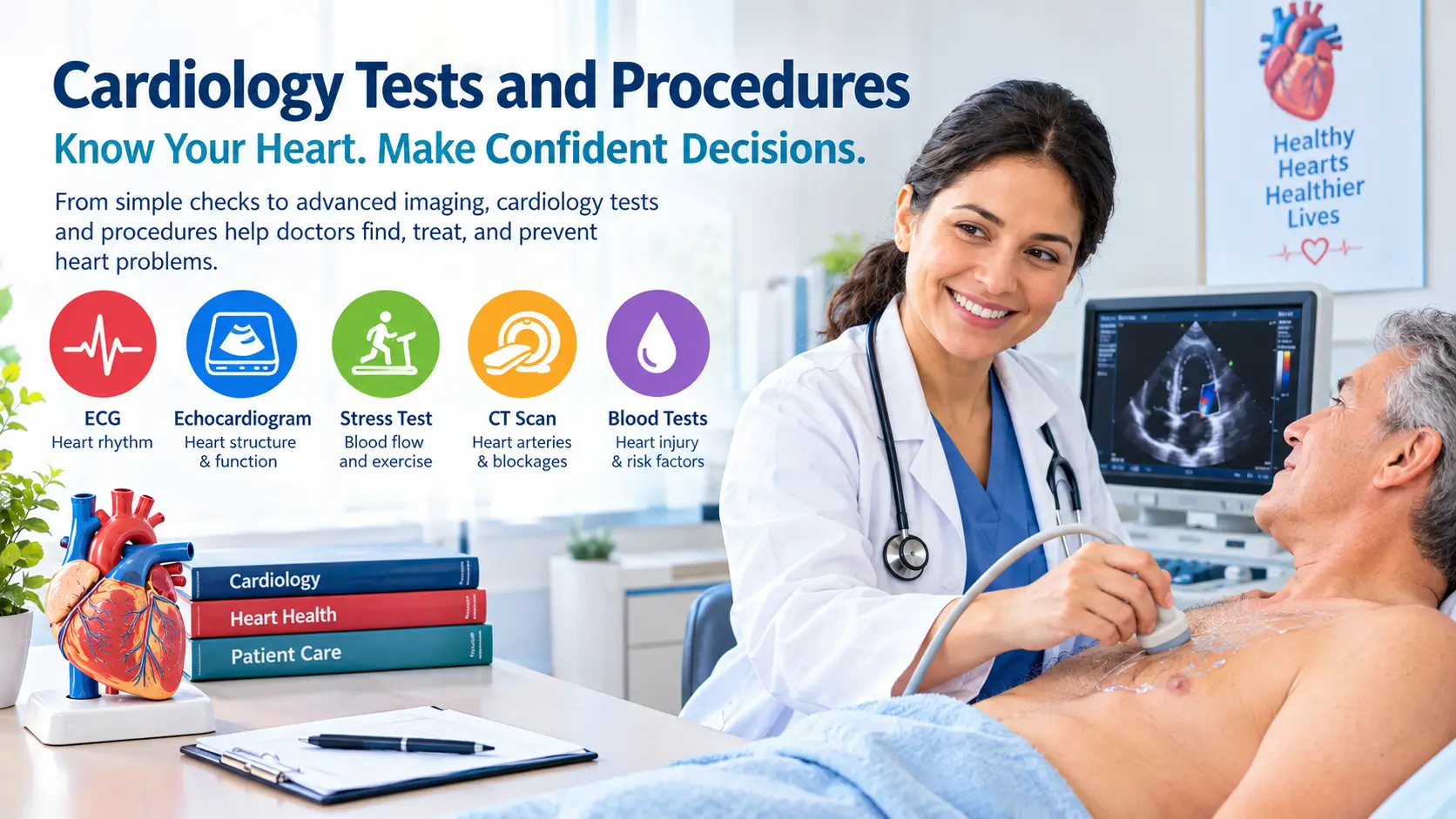

Cardiology tests and procedures help doctors check how your heart works. They can find rhythm problems, poor blood flow, and heart damage. Doctors choose tests based on your symptoms, history, and risk.
❤️ What are cardiology tests and procedures?
Have you ever felt worried before a heart test? You are not alone. Many people feel unsure about what will happen.
Cardiology tests and procedures help doctors learn how your heart works. Some tests check heart rhythm. Others check blood flow, heart structure, or blocked arteries.
Some tests are quick and simple. Others take more time or use special imaging.
A doctor may start with your symptoms and health history. They may also check your blood pressure, pulse, and heart sounds.
Your doctor then chooses tests that fit your needs. You may need one test or several tests.
Heart tests can help find many heart problems. These include rhythm changes, valve problems, weak heart pumping, and artery disease.
Knowing the basic test names can make your visit less stressful. It can also help you ask clear questions.
🩺 Why might a doctor order heart tests?
Doctors may order heart tests for many reasons. Your symptoms may be new, ongoing, or linked to activity.
Common reasons include:
- Chest pain or pressure
- Shortness of breath
- Fast or uneven heartbeats
- Dizziness or fainting
- Swelling in the legs
- Unusual tiredness
- High blood pressure
Doctors also use tests to check known heart conditions. A test may show whether a treatment is helping.
Risk factors can also affect testing. These include smoking, high cholesterol, diabetes, high blood pressure, and age.
A patient named Mark may have chest pressure after climbing stairs. His doctor asks when it starts and how long it lasts. The doctor may then choose tests based on his risk.
The ACC and AHA support risk-based testing for chest pain. Doctors match testing to symptoms and the person’s risk.
This approach can reduce needless testing. It can also help doctors find problems that need more attention.
When symptoms guide the test
The timing of symptoms can give doctors useful clues. Chest pain during exercise may lead to stress testing.
A racing heartbeat may lead to an ECG or heart rhythm monitor. Fainting may also require rhythm testing.
Shortness of breath can have many causes. Heart tests may help check heart pumping and blood flow.
📋 Heart test name list
There are many heart tests, and each one has a different job.
| Test | What it checks | What it may show |
| ECG or EKG | Heart electrical activity | Rhythm and heart attack signs |
| Echocardiogram | Heart structure and movement | Pumping and valve problems |
| Stress test | Heart during activity | Possible blood flow problems |
| Holter monitor | Heart rhythm over time | Intermittent rhythm changes |
| Heart CT | Heart and arteries | Plaque or artery narrowing |
| Heart MRI | Detailed heart images | Structure, muscle, and damage |
| Coronary angiogram | Heart artery blood flow | Narrowed or blocked arteries |
An ECG uses sticky patches on your skin. It records the electrical activity of your heart.
An echocardiogram uses sound waves to make heart pictures. It can show heart structure and movement.
A stress test checks how your heart responds during exercise or medicine. It may help find blood flow problems.
A CT scan uses X-rays to create detailed images. A coronary CT angiogram can show the heart arteries.
A heart MRI uses magnets and radio waves. It can give detailed pictures of heart muscle and structure.
A coronary angiogram uses dye and X-ray images. It can show narrowed or blocked heart arteries.
🔎 What test checks for heart blockage?
No single test fits every person with possible heart blockage. Doctors consider symptoms, risk, and earlier test results.
A coronary CT angiogram can show the heart arteries without placing a catheter inside. It uses X-rays and contrast dye.
A stress test checks how the heart performs when its workload rises. Some stress tests add an echo or nuclear imaging.
A coronary angiogram gives a direct view of the heart arteries. A doctor guides a thin catheter into an artery and injects dye.
The ACC says CCTA can help evaluate stable chest pain. It can help people without known coronary disease. Stress imaging can also assess blood flow and risk.
Mayo Clinic notes that an angiogram can show narrowed or blocked heart blood vessels. Doctors may suggest it after other tests in some cases.
Which test is best for heart blockage?
There is no single best test for everyone. The right choice depends on symptoms, risk, and medical history.
For some stable patients, doctors may use coronary CT angiography. Others may need stress imaging or another test.
Doctors may choose an invasive angiogram when they need a detailed artery view. Treatment can sometimes happen during the same procedure.
A patient named Linda may have stable chest discomfort. Her doctor may first choose a noninvasive test based on her risk.
If results suggest a major problem, more testing may follow. Your doctor should explain why each test is needed.
🧪 What blood test can check heart problems?
Blood tests can provide useful heart information. They do not usually show an artery blockage by themselves.
A cholesterol test measures fats in your blood. High cholesterol can raise the risk of artery disease.
A blood sugar test can check for diabetes or high blood sugar. Diabetes can raise heart disease risk.
Troponin is a protein released when heart muscle becomes injured. Doctors use troponin blood tests when a heart attack is suspected.
The AHA says blood tests are part of heart attack evaluation. Doctors also use ECGs and imaging tests.
Doctors may repeat troponin tests over time. This helps them look for changes in heart muscle injury.
So, a blood test for heart blockage is not usually a direct blockage test. Blood tests instead provide risk or injury information.
❤️ What test is used for a heart attack?
Doctors use several tests when they suspect a heart attack. The first steps often happen quickly in an emergency setting.
An ECG records the heart’s electrical activity. It can show signs that suggest a heart attack.
Doctors also use blood tests for troponin. Rising or falling troponin levels can help show heart muscle injury.
Imaging may also help. An echocardiogram can show heart movement and pumping.
A coronary angiogram can show blocked heart arteries. Doctors may use it when urgent artery treatment is needed.
The AHA lists ECG, blood tests, echo, angiography, CT, MRI, stress testing, and PET among heart attack tests.
The exact test path depends on the person’s condition. Doctors also consider blood pressure, symptoms, exam findings, and ECG results.
Can a home test detect a heart attack?
No home test can safely rule out a heart attack. Home blood pressure devices and watches cannot replace emergency testing.
Some devices can record heart rhythm. They may provide useful information, but they cannot diagnose every heart problem.
If you have possible heart attack symptoms, call 911. Do not drive yourself if emergency help is available.
The AHA lists several warning signs. These include chest discomfort, shortness of breath, sweating, nausea, and pain. Pain may affect the arm, back, jaw, or shoulder.
Women may have less typical symptoms, including unusual tiredness or shortness of breath. Any concerning symptoms need prompt medical attention.
🫀 How do doctors perform heart procedures?
Some heart procedures only check for a problem. Others can treat a problem during the same visit.
A coronary angiogram is an example. A catheter enters a blood vessel and moves toward the heart.
Doctors inject contrast dye through the catheter. X-ray images then show the coronary arteries.
If a major blockage needs treatment, doctors may perform angioplasty. This uses a small balloon to widen a narrowed artery.
Doctors may also place a stent. A stent is a small tube that helps keep an artery open.
Some people may need bypass surgery. This creates a new path for blood to reach heart muscle.
These procedures have risks. Your care team should explain the benefits, risks, and other choices.
Mayo Clinic says coronary angiography can sometimes allow treatment during the same procedure. The team decides based on the findings.
What happens before and after a procedure?
Your team may ask about medicines and allergies. They may also check kidney function before contrast dye.
You may receive medicine to help you relax. The team watches your heart rate and blood pressure.
After catheter procedures, you may need a short recovery period. The team checks the access site for bleeding.
Follow your care team’s instructions after the procedure. Ask when you can drive, work, exercise, and take medicines.
💰 How much do heart tests cost?
Heart test prices can vary widely in the United States. Your location, insurance, facility, and test type all affect cost.
A basic ECG usually costs less than an advanced imaging test. A cardiac MRI or catheter procedure may cost much more.
Insurance may cover part of the cost. Your plan may still have deductibles, copays, or coinsurance.
Hospitals can also have different prices for the same service. Ask for a written estimate when possible.
You can ask these questions before a planned test:
- What is the test’s full price?
- Is the test covered by my insurance?
- What will I pay?
- Do I need prior approval?
- Are there lower-cost locations nearby?
For planned tests, your doctor’s office and insurer can explain expected charges. Ask about financial help if you need it.
✅ How can you prepare for heart testing?
Preparation depends on the test. Some tests need no special preparation.
Your clinic may tell you to avoid food before certain procedures. You may also need to change some medicines.
Do not stop a medicine unless your doctor tells you to do so. Some tests have special rules for caffeine or exercise.
Wear comfortable clothes for exercise testing. Bring your medicine list and insurance information.
Tell the staff if you may be pregnant. Also tell them about kidney problems or past contrast reactions.
Ask what the test will feel like. Knowing the steps can make the visit less stressful.
⚠️ When should you seek urgent heart care?
Some heart symptoms need emergency help. Do not wait for a regular appointment when symptoms are severe or sudden.
Call 911 if you have possible heart attack symptoms. These can include chest pressure, squeezing, or pain.
Other warning signs may include:
- Trouble breathing
- Cold sweating
- Sudden weakness
- Fainting
- Severe dizziness
- Pain in the jaw, back, shoulder, or arm
Symptoms can differ between people. Women and older adults may have less typical signs.
Do not use a home device to decide whether symptoms are safe. Emergency teams can perform the right tests quickly.
The AHA recommends calling 911 for possible heart attack symptoms. Emergency medical teams can begin care during transport.
What if a test result looks abnormal?
An abnormal result does not always mean a serious heart problem. Some results need more testing before doctors know what they mean.
Your doctor may repeat a test or order another type. They may also compare results with your past records.
Ask what the result means in plain language. Ask what the next step will be.
❓ Frequently asked questions
Q: What is the most common heart test?
A: An ECG is one of the most common heart tests. It quickly records the heart’s electrical activity. Doctors may use it when symptoms suggest a rhythm problem or heart attack.
Q: What is the heart test name list I should know?
A: Common names include ECG, echocardiogram, stress test, Holter monitor, CT, MRI, and coronary angiogram. Blood tests can also help check heart injury and risk. Your doctor chooses tests based on your symptoms and health history.
Q: Is there a blood test for heart blockage?
A: No, blood tests usually do not directly show a blocked heart artery. Cholesterol tests can show heart disease risk. Troponin can help detect heart muscle injury during a suspected heart attack.
Q: Which test is best for heart blockage?
A: No single test is best for every person. Doctors may use CCTA, stress imaging, or coronary angiography. The choice depends on symptoms, risk, and earlier results.
Q: Can I take a heart attack test at home?
A: No, a home test cannot safely rule out a heart attack. Watches and home devices may give useful readings, but they cannot replace emergency care. Call 911 for possible heart attack symptoms.
Q: How much does a heart test cost?
A: Heart test prices vary by test, location, insurance, and facility. Ask your insurer and testing center for an estimate. Emergency care should not wait because of cost concerns.
Q: What are the main cardiology tests and procedures?
A: Main tests include ECG, echo, stress testing, CT, MRI, and blood tests. Procedures can include angiography, angioplasty, stents, and bypass surgery. Your doctor chooses the safest option for your situation.
❤️ Final thoughts
Heart tests help doctors understand rhythm, structure, blood flow, and artery health.
No single test works for every person. Doctors choose tests based on symptoms, risk, medical history, and earlier results.
Common tests include ECGs, echocardiograms, stress tests, CT scans, MRIs, and blood tests. Some people also need procedures such as angiography or stent treatment.
Understanding these tests can make a heart visit feel less confusing. It can also help you ask better questions.
Never use a home device to rule out a possible heart attack. Call 911 when serious symptoms appear.
Heart tests can guide care, but results need a trained medical team. Talk to a cardiologist if you have any heart concerns.
Medically reviewed for accuracy. Always consult a licensed cardiologist for personal advice.