
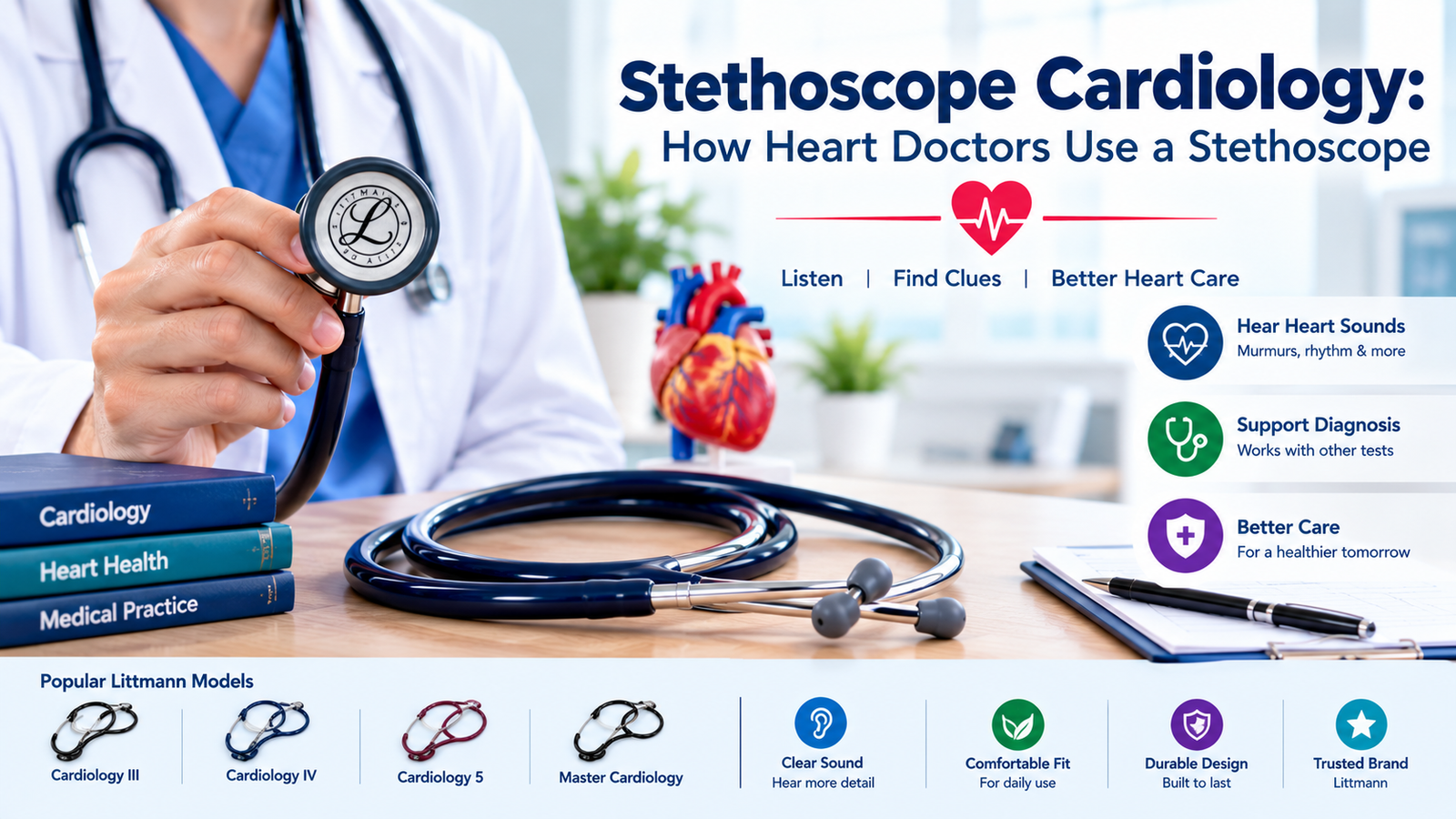

Stethoscope cardiology means using a stethoscope to listen to heart sounds and blood flow. It can help doctors hear murmurs, extra sounds, and rhythm changes. Doctors use these sounds with other exams and tests to understand heart health.
❤️ Have you ever wondered what your doctor hears with a stethoscope?
A quiet room can make each heartbeat easier to hear. Your doctor may listen to several areas of your chest. They may also check your neck and blood vessels.
Stethoscope cardiology is part of the basic heart exam. It helps doctors listen for sounds that may need more testing. These sounds can include murmurs or extra heart sounds.
The stethoscope does not give a complete heart diagnosis. Doctors combine what they hear with your history and other findings. They may also order an ECG or an echocardiogram.
This guide explains how the tool works and what doctors listen for. You will also learn about popular Littmann models. We will cover Cardiology III and Cardiology IV models. We will also discuss the Master Cardiology model.
You will learn what makes a heart stethoscope useful. You will also learn when a heart sound may need more care.
What Is Stethoscope Cardiology? 🩺
Stethoscope cardiology refers to using a stethoscope during a heart exam. The tool sends body sounds through tubes to the doctor’s ears.
A stethoscope has several basic parts. These include earpieces, tubing, and a chestpiece.
The chestpiece touches your skin during an exam. It can pick up sounds from your heart and lungs.
Doctors listen to the heart in several places. Each spot can reveal different sounds.
What Can a Stethoscope Hear?
A normal heartbeat creates two main sounds. Doctors often call these sounds S1 and S2.
S1 happens when some heart valves close. S2 happens when other valves close.
Doctors may also hear an extra sound. They may hear a whooshing sound called a murmur.
A heart murmur does not always mean heart disease. Some murmurs are harmless. Others may need more testing.
Doctors also listen for changes in sound quality. They note the timing, location, and loudness.
These clues can help guide the next step. The doctor may suggest an echocardiogram when needed.
An echocardiogram uses sound waves to create heart pictures. It is often used to check heart valve problems.
Why Does the Tool Matter?
A good stethoscope can make soft sounds easier to hear. It can also reduce outside noise during an exam.
Still, the doctor’s skill matters greatly. Good technique helps the doctor hear useful details.
A stethoscope cannot replace modern heart tests. It works as one part of a larger exam.
How Does a Cardiology Stethoscope Work?
A cardiology stethoscope works through simple sound transfer. The chestpiece picks up vibrations from your body.
The tubing carries those vibrations toward the earpieces. The doctor then hears the sounds more clearly.
Many models use a tunable diaphragm. This surface responds to different pressure levels.
Doctors can change pressure while listening. This may help them hear different sound ranges.
Some stethoscopes also include a bell. The bell can help with lower-frequency sounds.
Where Does the Doctor Listen?
Doctors usually listen across several areas of your chest. They may listen near the upper and lower heart areas.
They may also listen near the sides of your chest. The doctor may ask you to change position.
Your position can change some heart sounds. Breathing can also change what the doctor hears.
A patient named Maria may feel nervous during this exam. Her doctor may ask her to breathe slowly.
That simple step can make the exam easier. It also helps the doctor focus on the heart sounds.
What Makes a Good Cardiology Stethoscope?
A useful heart stethoscope should feel comfortable. It should also give clear sound transmission.
Important features can include:
- Comfortable ear tips
- Strong and flexible tubing
- A quality chestpiece
- Good sound control
- A useful bell or diaphragm
- A comfortable fit around the neck
Doctors also consider weight and daily use. A heavy tool may become tiring during long shifts.
Medical students may choose different features than heart specialists. Nurses may have different needs too.
There is no single stethoscope that fits every user. Skill, comfort, and clinical needs all matter.
Littmann Cardiology Stethoscopes: What Should You Know?
Littmann is a well-known stethoscope brand from 3M. Its product line includes several medical stethoscopes.
People often search for Littmann Cardiology models when choosing a heart stethoscope. The brand offers models for different clinical needs.
3M currently lists the Littmann Cardiology IV among its products. It also lists several colors and finishes.
Cardiology III, IV, and Cardiology 5 Searches
People often search for Littmann Cardiology 3 and Cardiology 4. They may also search for a Littmann Cardiology 5.
Product names can change over time. Current 3M listings show the Cardiology IV model.
For current model information, check the manufacturer’s product listings. This helps avoid outdated product pages.
The Cardiology IV has a dual-sided stainless steel chestpiece. 3M also describes adult and pediatric use.
It has both a diaphragm and bell side. It also has a non-chill bell sleeve.
Littmann Cardiology IV Colors
Color choices can vary by model and finish. Current 3M listings show options such as black and navy blue. Other listed choices include hunter green and plum.
Some versions also use special finishes. Examples include mirror, champagne, and black finishes.
Color does not decide how well a stethoscope fits your work. Sound needs and comfort matter more.
A student may choose based on comfort and budget. A specialist may focus more on sound performance and daily use.
Littmann Master Cardiology
The Master Cardiology is another Littmann model. It is designed for clinical heart and lung assessment.
People often search for the Master Cardiology when comparing advanced stethoscopes. Your work setting should guide the choice.
A cardiology fellow may have different needs than a first-year student. Both users can benefit from good technique.
The best choice depends on your role and daily needs. Price, comfort, warranty, and fit also matter.
How Doctors Use a Stethoscope During Heart Exams
A heart exam usually starts with your symptoms and medical history. The doctor then performs a physical exam.
The doctor may check your pulse and blood pressure. They may also listen to your heart.
During stethoscope cardiology exams, doctors listen for several sound features. They consider timing, pitch, location, and loudness.
A murmur can sound like a whoosh. It may happen when blood moves through the heart.
Some murmurs are harmless. Others can relate to a heart valve problem.
What Happens After an Unusual Sound?
An unusual sound does not automatically mean something serious. Your doctor may first ask more questions.
They may review your symptoms and health history. They may also repeat the heart exam.
If needed, they can order more testing. An echocardiogram can show the heart valves and chambers.
An ECG records the heart’s electrical activity. Other tests may include imaging or a stress test.
The American Heart Association lists these tests for valve evaluation.
Consider a patient named James. His doctor hears a new murmur during a routine visit.
James has no severe symptoms. His doctor may still order an echocardiogram.
That test can help explain what caused the sound. It can also show whether a valve problem exists.
The stethoscope starts the process. It does not finish the evaluation.
Best Cardiology Stethoscope: What Features Matter?
People often search for the best cardiology stethoscope. A better approach is to ask what you need.
Your work setting should guide your choice. Your training level should also influence the decision.
A medical student may need a reliable everyday model. A cardiology specialist may want more advanced sound features.
Features to Compare
| Feature | Why It Matters | Who May Value It |
| Chestpiece | Helps collect body sounds | All clinical users |
| Diaphragm | Helps hear many common sounds | Students and clinicians |
| Bell | Helps hear lower sounds | Advanced users |
| Tubing | Carries sounds to your ears | All users |
| Weight | Affects daily comfort | Long-shift workers |
Comfort can matter more than a long feature list. You may wear the stethoscope for many hours.
The ear tips should fit well without causing pain. The tubing should also feel flexible.
Littmann Cardiology IV Price
The price of a Littmann Cardiology IV can vary by seller and version. Finish, model, and seller can affect the final cost.
3M’s official listings confirm the model and available versions. They do not provide one universal retail price for every seller.
Check trusted medical suppliers before buying. Compare warranty terms and return rules.
Be careful with unusually low prices. Counterfeit medical tools can look very similar to real products.
Buying from an authorized seller can reduce that risk. Always check current product details before purchasing.
How to Use and Care for Your Stethoscope
Good care can help keep your stethoscope ready for use. It can also support good hygiene.
Follow the cleaning directions from the manufacturer. Avoid harsh products that may damage tubing or surfaces.
Keep the stethoscope away from extreme heat. Do not leave it in direct sunlight for long periods.
Store it in a clean, dry place. Keep the ear tips free from dirt and buildup.
Simple Care Steps
- Clean the chestpiece after clinical use.
- Follow the manufacturer’s cleaning instructions.
- Check the tubing for cracks or damage.
- Check the ear tips for wear.
- Replace damaged parts when needed.
- Store the tool in a safe place.
A clean chestpiece can also make patients feel more comfortable. Good hygiene matters in every clinical setting.
Students should practice correct placement during training. A quiet room can help them learn normal heart sounds.
Practice with experienced teachers whenever possible. Real patients can have many different sound patterns.
When Should You See a Doctor? ⚠️
A stethoscope can find sounds that need more review. It cannot tell you when you have a heart emergency.
Seek urgent medical care for severe or sudden symptoms. Do not wait for a routine appointment.
Heart attack warning signs can include chest discomfort. Other signs include shortness of breath, nausea, sweating, and lightheadedness.
Call 911 for possible heart attack symptoms. Fast treatment can matter during a heart emergency.
Signs That Need Medical Attention
Talk with a healthcare professional if you notice:
- New or repeated chest discomfort
- Shortness of breath
- Fainting or near-fainting
- New swelling in your legs
- Fast or irregular heartbeats
- Unusual tiredness with activity
- A new heart murmur found during an exam
These symptoms can have many possible causes. Only a qualified clinician can assess your personal situation.
A patient named David may notice shortness of breath during normal walks. He should not assume the cause himself.
A clinician can review his symptoms and perform an exam. More tests may follow when needed.
A stethoscope can provide useful clues. It cannot confirm the cause by itself.
Frequently Asked Questions
Q: Is a Littmann Cardiology stethoscope good for heart exams?
A: Littmann makes several stethoscopes for clinical use. The Cardiology IV is currently listed by 3M.
It has a dual-sided chestpiece and supports adult and pediatric assessment.
Q: Is there a Littmann Cardiology 5 stethoscope?
A: Current 3M listings show the Littmann Cardiology IV.
Product names can change over time. Check 3M’s current catalog before buying a newer model.
Q: What is the difference between Littmann Cardiology 3 and 4?
A: These names refer to different Littmann product generations. Current 3M listings prominently show the Cardiology IV.
Older models may still appear through retailers and used equipment sellers.
Q: What makes a good cardiology stethoscope?
A: A good model should provide clear sound and feel comfortable. Your clinical role should guide your choice.
Students and specialists may have different needs. Good listening skills also matter.
Q: Is the Littmann Master Cardiology good for medical students?
A: It can be used by trained healthcare learners and professionals. However, students should consider cost and training needs.
A simpler model may meet the needs of some learners. Your school or clinical program may also have recommendations.
Q: What colors does the Littmann Cardiology IV come in?
A: 3M lists several Cardiology IV colors and finishes. Options include black, navy blue, hunter green, and plum.
Available choices can change, so check the current product listing.
Q: Does stethoscope cardiology replace an ECG or echocardiogram?
A: No, a stethoscope cannot replace these tests. It helps doctors collect information during a physical exam.
An ECG checks electrical activity, while an echocardiogram creates heart images.
Conclusion
A stethoscope is a simple tool with an important role in heart care. It helps doctors listen to heart sounds during physical exams.
Stethoscope cardiology can help identify sounds that need closer review. A murmur does not always mean heart disease.
Doctors use your symptoms, history, exam, and test results together. They may order an ECG or echocardiogram when needed.
Littmann offers several clinical stethoscope models. The Cardiology IV remains listed by 3M for medical use.
Your best choice depends on your training, work, comfort, and budget. Always check current product details before buying.
Talk to a cardiologist if you have any heart concerns. Seek emergency help for severe or sudden symptoms.
Medically reviewed for accuracy. Always consult a licensed cardiologist for personal advice.
─────────────────────────────────────────