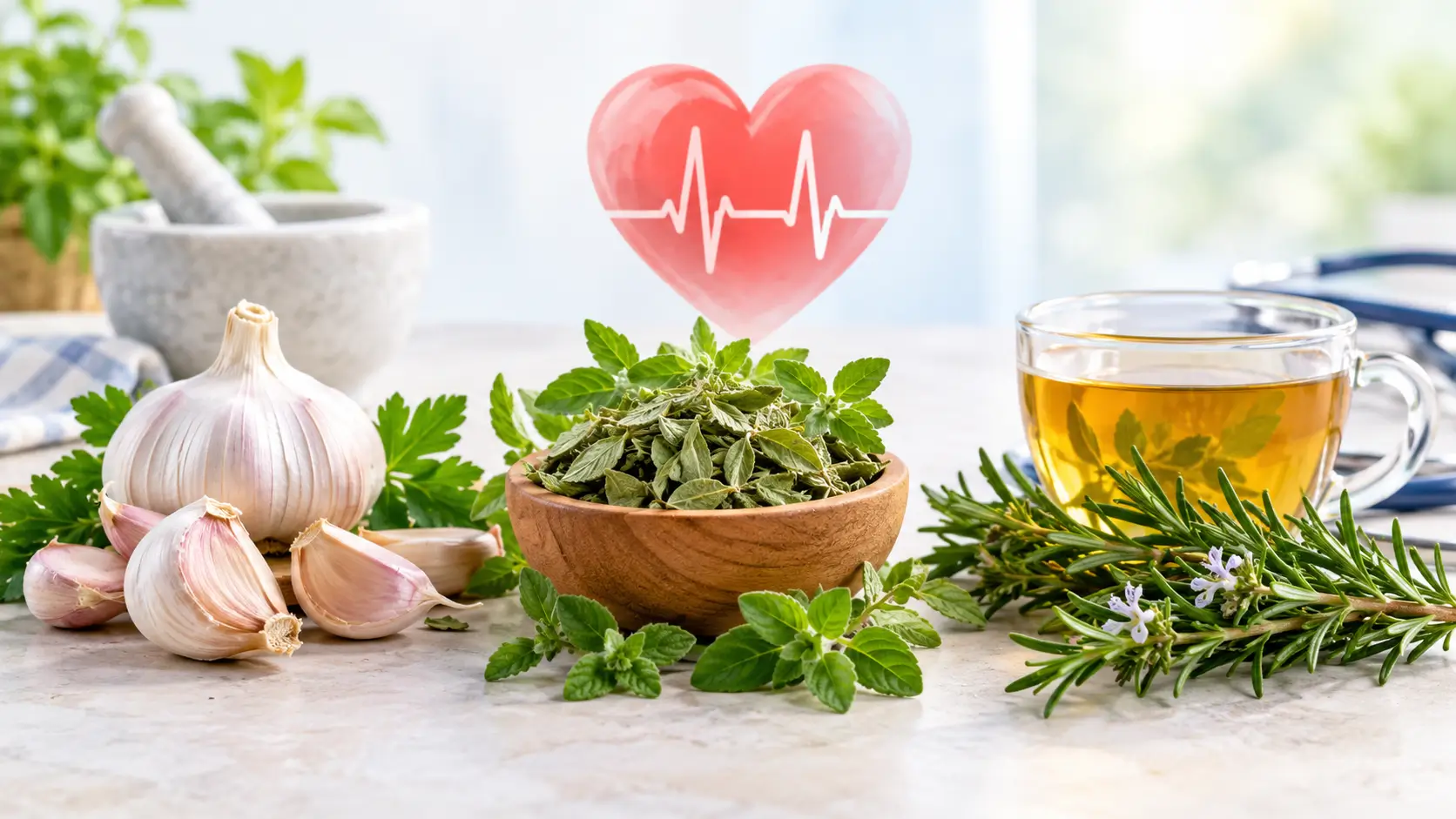

Garlic, hawthorn, and hibiscus are three herbs with the most research for heart health.
Garlic and hibiscus may lower blood pressure a little, and hawthorn has been studied for heart failure symptoms. None replaces medicine, and all can interact with heart drugs, so ask a doctor first.
Interest in herbs for heart health keeps growing, and the list of options is long. Most have thin evidence behind them. A handful, though, have been studied in human trials, and three come up again and again: garlic, hawthorn, and hibiscus.
Here is the key point. Herbs can nudge a lab number or a symptom, but none has been shown to prevent heart attacks or strokes. Some also interact with medicines that people with heart conditions take daily.
This guide covers the 3 best herbs for heart health based on available research. For each, it explains what the herb is, what studies show, where the evidence is weak, and who should be careful.
Later sections cover herbs that deserve extra caution, tips for choosing safe products, and signs that need urgent care.
How to Judge an Herb for Heart Health
“Good for the heart” can mean four different things, and they carry very different weight.
- Correcting a deficiency. Herbs are not vitamins or minerals, so this rarely applies.
- Improving a number or symptom. Some herbs may lower blood pressure or cholesterol slightly, or ease symptoms such as tiredness with exertion.
- Reducing heart attacks, strokes, or deaths. Large, long trials would be needed, and herbs have not passed this test.
- Treating established disease. No herb has replaced standard care such as blood pressure medicine, statins, or blood thinners.
In the United States, herbs are sold as dietary supplements. The FDA does not approve them for safety or effectiveness before sale, so strength and quality vary from brand to brand. Many web pages also overstate results, claiming effects “as strong as medicine.” Studies behind those claims are usually small, short, and uneven.
- Outbound links: No outbound links appear in this page. Add some!
- Internal links: No internal links appear in this page, make sure to add some!
- Keyphrase in introduction: Your keyphrase or its synonyms do not appear in the first paragraph. Make sure the topic is clear immediately.
- Keyphrase density: The keyphrase was found 2 times. That’s less than the recommended minimum of 5 times for a text of this length. Focus on your keyphrase!
- Keyphrase in meta description: The meta description has been specified, but it does not contain the keyphrase.
- Keyphrase in subheading: Use more keyphrases or synonyms in your H2 and H3 subheadings!
- SEO title width: The SEO title is wider than the viewable limit. Try to make it shorter.
The three picks at a glance
| Herb | Possible benefit | Strength of evidence | Biggest caution |
| Garlic | Small drops in blood pressure and LDL cholesterol | Moderate for numbers; none for fewer heart attacks | Extra bleeding risk with blood thinners; some drug interactions |
| Hawthorn | May ease symptoms in mild heart failure | Mixed; benefit on events not shown | Interacts with digoxin, blood pressure drugs, and nitrates |
| Hibiscus | Small drops in blood pressure | Limited, from short and small trials | Can lower pressure too far with medicine; avoid in pregnancy |
These three earn a place because human trials exist, not because they are proven. They fit best as an add-on to food, activity, and prescribed care, not a substitute.
Heart Health Boost Karne Wali Top 3 Herbs
1. Garlic
What it is. Garlic (Allium sativum) is a kitchen staple and a popular supplement. Products range from raw cloves to powders, oils, and aged garlic extract.
What research shows. Reviews of trials suggest garlic supplements may lower blood pressure slightly, mainly in people whose pressure is already high. Small drops in LDL cholesterol also appear in some studies. Effects are modest, and results differ by product.
What remains uncertain. No large trial has shown that garlic prevents heart attacks or strokes. Long-term safety of high-dose supplements is less clear. Raw cloves and capsules are not the same thing, and few studies compare them.
Risks and interactions. Bad breath, body odor, heartburn, and stomach upset are common. Supplements may add to bleeding risk, which matters with warfarin and similar medicines and before surgery. Garlic can also lower blood levels of some HIV medicines, such as saquinavir.
Ask a clinician first if you take blood thinners, face surgery soon, or take HIV medicines.
2. Hawthorn
What it is. Hawthorn (Crataegus species) comes from the leaves, flowers, and berries of a thorny shrub. Many trials use standardized extracts, while teas and tinctures are also sold.
What research shows. Several trials found that extracts may ease symptoms and improve exercise tolerance in people with mild to moderate heart failure who also receive standard care. Small studies hint at slight blood pressure drops.
What remains uncertain. A large trial in heart failure did not show fewer major cardiac events overall. Product strength varies, and most studies use one specific extract, so a cup of tea may not act the same way.
Risks and interactions. Possible side effects include dizziness, nausea, stomach upset, and a fast heartbeat. Because hawthorn may add to the effect of blood pressure medicines, nitrates, and digoxin (a heart failure medicine), dosing and monitoring become a medical matter.
Ask a clinician first if you have heart failure or a rhythm problem, or take any heart medicine. Heart failure needs medical care, and worsening symptoms should never be handled with an herb alone.
3. Hibiscus
What it is. Hibiscus (Hibiscus sabdariffa) is the red flower behind tart hibiscus tea. Extracts and powders are sold too.
What research shows. Small, short trials suggest hibiscus tea or extract may lower blood pressure a little, including in people with mildly to moderately high readings. Results are uneven, and studies differ in dose and quality.
What remains uncertain. Most trials last weeks rather than years. Evidence for fewer heart attacks or strokes is missing, and the best amount is unknown.
Risks and interactions. Since hibiscus can lower blood pressure, it may stack with blood pressure medicine and cause dizziness or fainting. Pregnant people are usually advised to avoid it because safety is not established. Some people notice stomach upset.
Ask a clinician first if you have low blood pressure, take blood pressure pills or water pills, are pregnant, or plan surgery. Checking your pressure regularly helps if you add it to your routine.
Other Herbs: Popular, but Weaker Evidence or Higher Risk
Often mentioned, with less proof for the heart
| Herb | Why people use it | What to know |
| Turmeric (curcumin) | Anti-inflammatory reputation | Heart-specific evidence is limited. High-dose supplements may affect bleeding in people on blood thinners. |
| Ginger | Circulation and cholesterol claims | Small studies show mixed results. Large amounts may add to blood thinner effects. |
| Green tea | Antioxidants; small cholesterol and blood pressure effects in some trials | Brewed tea is generally fine for most adults. Concentrated extracts have been linked to liver problems in rare cases. |
| Cinnamon | Blood sugar claims | Findings are mixed. Some types contain coumarin, which can matter for the liver and with blood thinners at high intake. |
These may fit into a heart-healthy diet as foods and seasonings. Concentrated pills are a different matter, so the same cautions apply as for any supplement.
Use with great care, or avoid
| Herb | Concern |
| Licorice root | Can raise blood pressure, lower potassium, and trigger heart rhythm problems, especially in larger or long-term amounts |
| St. John’s wort | Interacts with many medicines, including warfarin, digoxin, and some statins, and can make them less effective |
| Ephedra (ma huang) | Raises blood pressure and heart rate; the FDA banned it in dietary supplements |
| Yohimbe | Linked to rapid heartbeat and blood pressure spikes |
| Bitter orange (synephrine) | Can raise heart rate and blood pressure, particularly alongside stimulants |
| Foxglove and oleander | Toxic plants that contain digitalis-like compounds; never use them as home remedies |
Products labeled “natural,” “heart support,” or “detox” may still hide stimulants or drug-like ingredients. Anyone with high blood pressure, a rhythm problem, or heart disease should treat weight-loss and energy products with particular suspicion.
Using Herbs Safely
Start with food
Garlic belongs in a heart-healthy kitchen, and hibiscus tea can be one of several drinks in a day. A plant-rich eating pattern, regular activity, no tobacco, and good sleep do far more for the arteries than any herb.
Choose products with care
- Look for third-party testing seals, such as USP or NSF, which check contents and contaminants.
- Read the label for the plant part, the extract type, and the amount per serving.
- Skip products that promise to “clean arteries” or replace medicine.
- Stay within the label dose, since more is not better.
- Buy one product at a time so any side effect is easier to trace.
Tell your care team
Bring every herb, tea, and supplement to appointments, including ones you drink as tea. A pharmacist can check for interactions in minutes. Herbs can change how blood thinners, blood pressure pills, statins, digoxin, and diabetes medicines work. Stop an herb and call a clinician if you notice dizziness, a pounding heartbeat, unusual bruising, or stomach bleeding.
Who should be especially careful
- People taking blood thinners, blood pressure medicines, digoxin, diuretics, or diabetes medicines
- Anyone with heart failure, a rhythm problem, or kidney or liver disease
- Pregnant or breastfeeding people, and children
- Those planning surgery within a couple of weeks, since some herbs affect bleeding
Never stop a prescribed heart medicine in favor of an herb. Herbs have not been shown to replace statins, blood pressure treatment, or blood thinners.
When to Talk to a Doctor
Ask your provider about herbs if you have high blood pressure, high cholesterol, diabetes, heart disease, or a family history of early heart disease. A clinician can check your numbers, review your medicines, and say whether an herb is worth trying.
Get emergency help right away for chest pain or pressure, pain spreading to the arm, jaw, or back, severe shortness of breath, fainting, or signs of a stroke such as face drooping, arm weakness, or trouble speaking. Call your local emergency number (911 in the United States). Do not wait to see whether a tea or capsule helps.
Frequently Asked Questions
What is the best herb for heart health?
No single herb is proven best. Garlic and hibiscus have the most evidence for small blood pressure drops, and hawthorn has been studied for heart failure symptoms. None prevents heart attacks or strokes. Your doctor can tell you whether any of them suits you.
Does garlic lower blood pressure?
Reviews of trials suggest garlic supplements may lower blood pressure slightly, mostly in people with high readings. The drop is modest, and it does not replace medicine. Garlic can raise bleeding risk with blood thinners, so check with a clinician before starting capsules.
Is hawthorn safe for the heart?
Hawthorn is well tolerated by many adults, but it can interact with heart medicines such as digoxin, nitrates, and blood pressure pills. People with heart failure should not self-treat. Medical care and a pharmacist’s review come before any extract.
Can hibiscus tea replace blood pressure medicine?
No. Small trials suggest hibiscus may lower pressure a little, but it has not been shown to replace prescribed treatment. Combining it with medicine can push pressure too low. Check readings regularly and tell your doctor about the tea.
Are herbal supplements regulated?
In the United States, herbs are sold as dietary supplements. The FDA does not approve them for safety or effectiveness before sale, so quality varies. Third-party seals, such as USP or NSF, offer some reassurance about contents, though they do not prove a product works.
Can I take herbs with heart medication?
Sometimes, but not without checking first. Herbs can change how blood thinners, blood pressure pills, statins, and digoxin work. A pharmacist or doctor can review every product you take, including teas, and flag risky combinations.
Key Takeaway
Garlic, hibiscus, and hawthorn lead the research on herbs for heart health, yet none has been shown to prevent heart attacks or strokes. Garlic and hibiscus may trim blood pressure a little. Hawthorn may ease symptoms in mild heart failure.