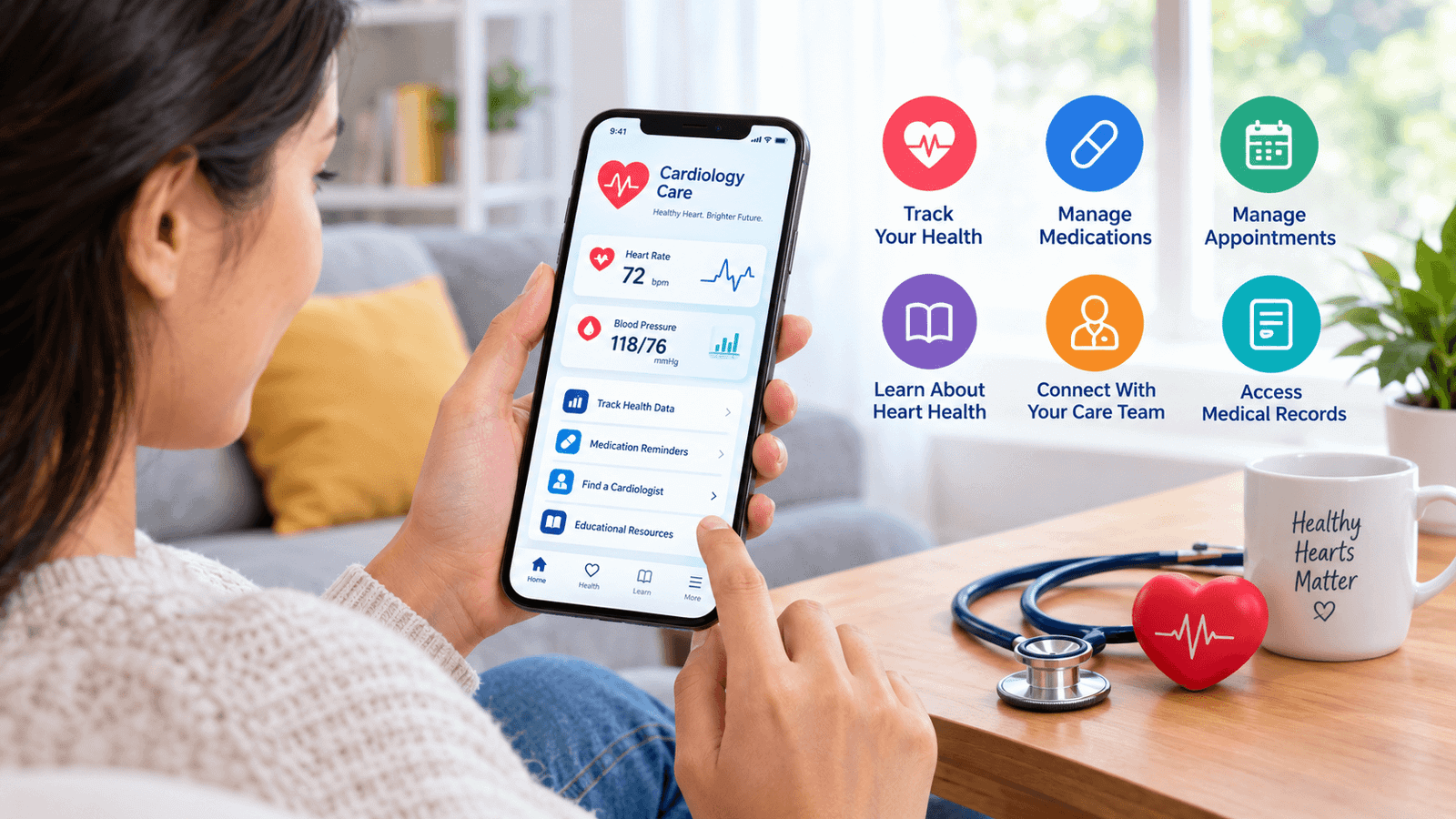

A cardiology app is a mobile tool that supports heart health, patient care, or medical learning. Some apps track health data, while others provide clinical guides, education, or care access.
What Is a Cardiology App? ❤️
Have you ever wished your heart care information was easier to reach? A phone can now help with many daily health tasks. A cardiology app can support patients, caregivers, students, and heart care teams.
Some apps help you track blood pressure, activity, or other health data. Others give doctors quick access to heart care guidelines. Some apps connect patients with their care team or medical records.
The term can also cause confusion. In medical job listings, APP often means advanced practice provider. This usually refers to a nurse practitioner or physician assistant. It does not mean a smartphone application.
For patients, apps can help manage daily health needs. Students can use them to learn and review medical topics. Clinicians can use them to find trusted medical information quickly.
Still, an app should not replace your doctor. A phone tool can support care, but it cannot provide every part of medical care.
The right tool depends on your goal. You may need a tracking app, patient portal, or study app. You may also need a clinical reference tool.
How Do Cardiology Apps Work?
Heart health apps can work in several ways. Most depend on the features built into your phone or connected devices.
Some apps let you enter information by hand. You may record blood pressure, weight, symptoms, or exercise. This creates a record that you can share with your care team.
Other apps connect with devices. These may include blood pressure monitors or fitness trackers. Some software can also work with heart sensors.
The FDA treats mobile medical software based on its function and risk. Some software falls under medical device oversight. Other health apps do not meet that definition.
Common app functions
A heart-focused app may help you:
- 🩺 Record blood pressure readings.
- ❤️ Track exercise and daily activity.
- 📋 Store health notes and questions.
- ⏱️ Remember appointments or medicines.
- 📚 Study heart conditions and treatments.
- 📱 Access medical records or test results.
- 🧑⚕️ Contact your health care team.
The American Heart Association supports home blood pressure monitoring. It recommends an automatic upper-arm cuff for home use.
For example, Maria checks her blood pressure each morning. She records each reading in her phone. Her doctor can review these records during visits.
The app does not decide her treatment. Her health care professional reviews the information.
That difference matters. Digital tools can support care, but they do not replace clinical judgment.
What Are the Main Types of Cardiology Apps?
Not every heart app serves the same purpose. You should first decide what you need.
Patient health and tracking apps
These tools help people record health information. They may track blood pressure, weight, activity, symptoms, or medicines.
Some apps also connect with patient portals. This can make appointments and health records easier to manage.
Mount Sinai, for example, offers the MyMountSinai app. It lets patients manage appointments, view records, review test results, and message providers. It also supports some virtual care services.
Clinical reference apps
These tools mainly support doctors and other health professionals. The ACC Guideline Clinical App provides guideline recommendations and clinical tools. It also includes risk scores, calculators, and algorithms.
Education apps
Students and clinicians can use apps for learning. ACC Learn provides mobile access to selected ACC education products. These include ACCSAP, CathSAP, and EP SAP.
Patient education tools
CardioSmart360 is an ACC tool for discussing heart problems. It uses heart graphics and animations to explain health topics.
The best choice depends on your purpose. A patient may need simple tracking tools. A resident may need case questions and guideline summaries.
What Should You Look For in a Cardiology App?
Choosing a heart health app takes some care. Many apps offer similar features, but quality can vary.
Start by checking who made the app. Look for hospitals, medical groups, universities, or recognized professional organizations.
Next, check how often the content gets updated. Medical guidance can change as new evidence appears.
Privacy also matters. Some apps may handle health information. Read the privacy policy before entering personal data.
Useful features to compare
| Feature | Why It Matters | Who May Benefit |
| Health tracking | Records daily health data | Patients |
| Medical records | Shows test results and visits | Patients |
| Guidelines | Gives clinical reference material | Clinicians |
| Case questions | Supports medical learning | Students and residents |
| Patient education | Explains heart topics | Patients and caregivers |
A cardiology app may also connect with a wearable device. This can help you follow activity over time.
A 2026 American Heart Association review found useful activity gains with apps and wearables. The review included 14 trials and more than 1,000 adults.
Still, results from digital tools can vary. Long-term benefits may also differ between people.
For example, James uses a fitness app after a heart event. He uses it to build more daily activity. His care team still guides his recovery plan.
An app should fit your care plan. It should not create a second, separate treatment plan.
Which Apps Help Cardiology Students and Residents?
Medical learners have different needs from patients. They often need quick facts, cases, guidelines, and practice questions.
ACC provides several mobile learning resources. ACC Learn gives access to selected educational products. ACCSAP covers adult clinical cardiology with case-based questions and learning modules.
ACCSAP includes topics such as arrhythmias, coronary disease, heart failure, and valve disease. It also supports board preparation and continuing education.
The ACC Guideline Clinical App can also help with quick reference. It provides guideline recommendations and interactive tools.
What about a coronary angiography simulator online?
A coronary angiography simulator is different from a simple reference app. It may provide a digital learning setting for studying coronary imaging or procedures.
Students should use these tools as learning aids. They should not treat a simulator as equal to supervised clinical training.
A resident may use a digital case before discussing it with a supervisor. This can help organize questions and review key ideas.
Apps can also support learning outside the hospital. That can make study time more flexible.
Still, learners should check the source behind each tool. Old medical content can lead to poor understanding.
For residents, the best apps often combine updated content, case practice, and clear references.
What Does Cardiology APP Mean in a Job Listing?
The phrase “cardiology APP job” usually has a different meaning. Here, APP means advanced practice provider.
An APP may be a nurse practitioner or physician assistant. These professionals work as part of cardiovascular care teams.
Their duties can vary by role, setting, training, and state rules. They may help with patient visits, follow-up care, education, and treatment plans.
The ACC describes cardiovascular APPs as important members of team-based care. Current ACC resources also focus on education and skill development for these professionals.
Why do cardiology teams use APPs?
Cardiology APPs can support access to care. They may also help with follow-up visits and patient education.
Their exact role depends on the practice. Some work in clinics. Others may work in hospitals or specialty programs.
For example, a patient may meet an APP during a follow-up visit. The APP may review symptoms and medicines. A cardiologist may also be involved based on the patient’s needs.
The team approach can help organize care. Each professional brings different training and responsibilities.
If you search for a “cardiology APP job,” read the full job description. Check the required license, training, setting, and duties.
This meaning is different from a phone application. Context usually tells you which meaning applies.
Are Cardiology Apps Safe and Useful for Patients?
A cardiology app can be useful when it supports good health habits. It can also make information easier to share with your care team.
However, not every app has the same level of medical value. Some only track information. Others provide patient-specific health functions.
The FDA uses a risk-based approach for medical software. Some functions receive regulatory oversight because errors could affect patient safety.
Use health apps with care
Keep these points in mind:
- Check who created the app.
- Look for recent content updates.
- Read the privacy terms.
- Keep your phone and app updated.
- Ask your doctor about unusual readings.
- Do not stop medicine based on an app alert.
- Keep regular medical visits.
One reading does not always tell the whole story. The American Heart Association calls a single blood pressure reading a snapshot. A record over time can give a clearer picture.
Apps can also create worry. A heart rate alert may not always mean a serious problem.
Talk with your health professional about repeated or concerning results. They can help explain what the numbers mean.
A digital tool should make care clearer. It should not make you feel that you must diagnose yourself.
When Should You Stop Using an App and Seek Medical Care? ⚠️
A phone app cannot replace urgent medical care. Some symptoms need quick attention.
Seek emergency help for signs of a possible heart attack. These may include chest pressure, shortness of breath, sweating, or unusual weakness.
Call 911 for severe or sudden symptoms. Do not wait for an app to interpret them.
The same rule applies to severe symptoms with a very high blood pressure reading. The American Heart Association advises emergency action when readings remain above 180/120 with warning symptoms.
Examples of warning signs
Seek urgent help for:
- New or severe chest pain.
- Trouble breathing.
- Fainting or sudden loss of awareness.
- Severe weakness.
- New confusion.
- Sudden trouble speaking.
- Sudden weakness on one side.
- Symptoms that rapidly become worse.
For example, David notices chest pressure while using a heart app. The app does not show an emergency warning. He should still seek urgent care.
The absence of an app alert does not rule out a serious problem.
Likewise, a warning does not always mean you have a dangerous condition. A health professional needs to assess the full situation.
Use apps for support, tracking, learning, and communication. Use medical care when symptoms need professional assessment.
Q: What is the meaning of cardiology app?
A: It usually means a mobile tool related to heart health or cardiology. It may track health data, provide education, or support clinical work. In job listings, “APP” can instead mean advanced practice provider.
Q: What is the best cardiology app?
A: There is no single best app for every person. Patients may need tracking or patient portal tools. Clinicians may prefer guideline and clinical reference tools.
Q: What is the ACC cardiology app?
A: The ACC offers several mobile and web tools for cardiovascular care. Its Guideline Clinical App provides guideline content, calculators, and clinical tools. ACC also offers CardioSmart360 and ACC Learn.
Q: Is CardioSmart an app for patients?
A: CardioSmart is an ACC patient engagement program with heart health tools. CardioSmart360 helps clinicians explain heart problems and treatment options.
Q: Does Mount Sinai have a cardiology app?
A: Mount Sinai offers the MyMountSinai app for patients. It supports appointments, medical records, test results, messages, and some virtual care. It is not limited to cardiology.
Q: What does APP mean in a cardiology job?
A: APP usually means advanced practice provider. This can include nurse practitioners and physician assistants. Cardiology teams may use APPs in team-based care.
Q: Can a cardiology app diagnose a heart problem?
A: Some regulated software can perform specific medical functions. However, an app should not replace a medical evaluation. The FDA reviews certain software functions based on their risk and intended use.
Conclusion
A cardiology app can make heart care information easier to access. Patients can use apps to track health data and manage care tasks. Students and residents can use them for learning and clinical review. Doctors and other care team members can use guideline tools and education resources.
The right app depends on your goal. Check its source, privacy terms, update history, and purpose. Remember that an app does not replace your doctor or emergency care.
The term “APP” can also mean advanced practice provider. This is common in cardiology job listings.
Use digital tools as support for better communication and learning. Talk to a cardiologist if you have any heart concerns.
Medically reviewed for accuracy. Always consult a licensed cardiologist for personal advice.