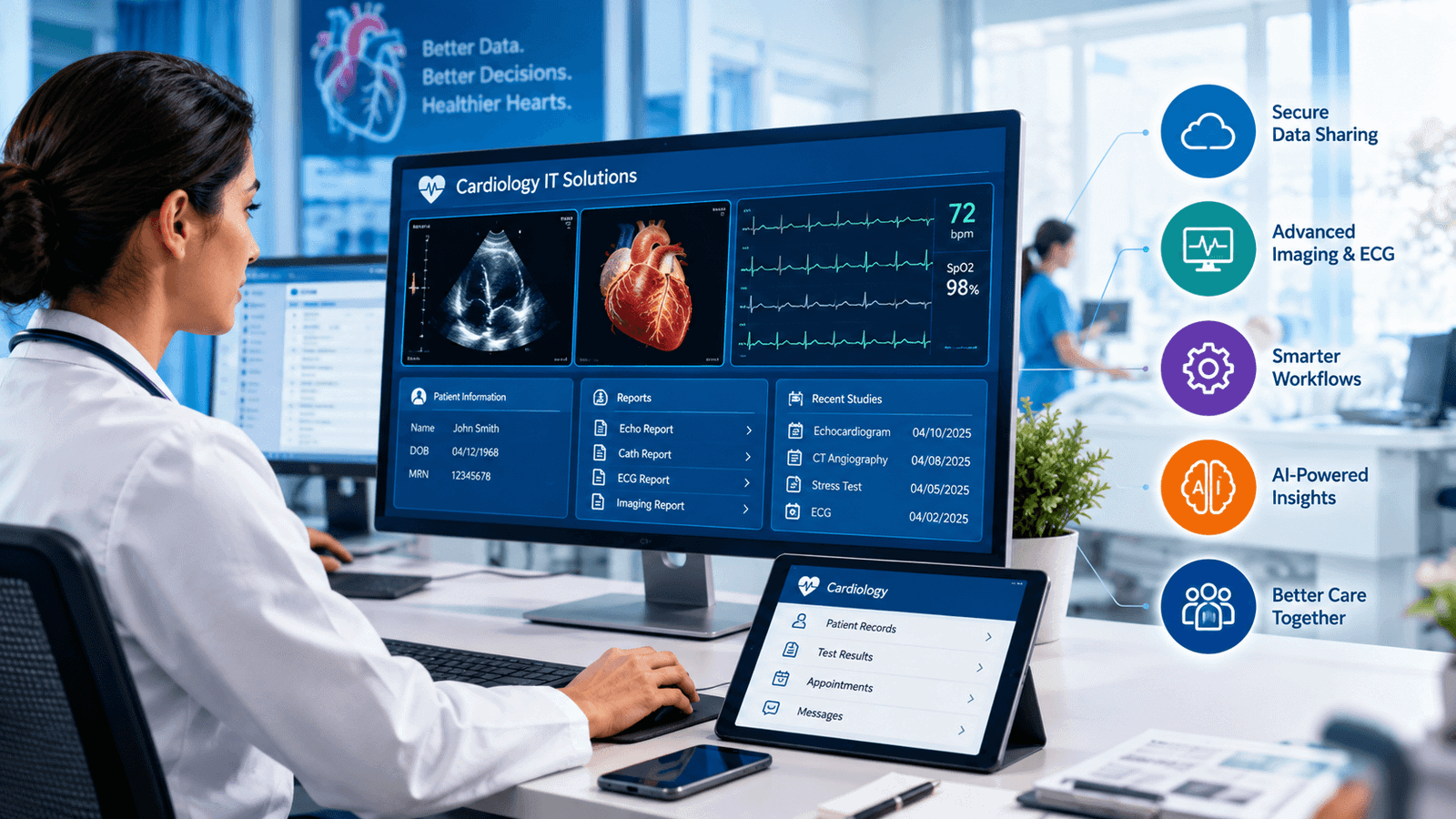

Cardiology IT solutions are digital tools that help heart care teams manage data, images, tests, and reports. They can connect clinical systems, reduce manual work, and support faster access to patient information. Hospitals use these tools to organize cardiac care across many departments and locations.
Imagine a patient arrives with chest pain at a busy hospital. The care team may need an ECG, blood tests, imaging, and past records. These details can come from several systems. Without good technology, finding each piece may take extra time.
Cardiology IT solutions help bring these details into useful digital workflows. This technology does not replace cardiologists or other care teams. Instead, it supports people who review tests and make care decisions.
Patients may not see the software directly. Still, they may feel its effects during testing and follow-up. Better data flow can reduce repeated steps and support smoother visits.
This guide explains cardiology IT in simple terms. It covers PACS, CPACS, ECG systems, imaging tools, AI, and data sharing. You will also learn about Change Healthcare, GE HealthCare, Optum, and Verisound.
Most importantly, you will see how these systems can support patient care.
What Are Cardiology IT Solutions? ❤️
Cardiology IT solutions are technology systems built for heart care. They help teams collect, store, view, share, and report cardiac data.
The term “IT” means information technology. In health care, IT includes computers, software, networks, cloud systems, and data tools.
Cardiology systems have extra needs, such as storing ECG records and heart images. A cardiology department may handle many types of information.
These can include:
- ECG readings
- Echocardiogram images
- CT and MRI heart images
- Stress test results
- Cardiac catheterization records
- Procedure reports
- Patient history
- Follow-up notes
A single patient may have several of these records. A good system helps staff find the right information when needed.
What does a cardiology information system do?
A cardiology information system can organize data from heart tests. It can also support reporting and workflow steps.
For example, an ECG may start on a bedside device. The result can then move into a digital system. A clinician can review the tracing and related patient details.
Some systems also connect with an electronic health record. An electronic health record, or EHR, stores a patient’s wider medical record.
The goal is simple. Teams should have useful information in the right place at the right time.
A patient named Maria may visit a clinic after feeling short of breath. Her doctor orders an ECG and an echocardiogram.
A connected system can help staff manage both studies and their reports. The software does not decide what Maria needs. Her care team still reviews the findings and makes clinical decisions.
How Do Cardiology IT Systems Work? 🩺
Cardiology IT systems move data between devices, software, and clinical records. The exact setup differs by hospital or health system.
A small clinic may use one reporting system. A large hospital may connect many systems across several locations.
PACS and CPACS
PACS means Picture Archiving and Communication System. It stores and helps display medical images.
Cardiology often needs more than image storage. Teams may also need reports, waveforms, measurements, and procedure data.
CPACS means Cardiovascular Picture Archiving and Communication System. It is designed around cardiovascular workflows.
Some CPACS platforms combine imaging, reporting, administration, and waveforms. This can give teams a more unified view of cardiac records.
Change Healthcare Cardiology PACS is now offered through Optum. Its platform uses a single cardiovascular database approach.
It can connect with an EHR and a VNA. A VNA is a system that stores medical images.
The exact features depend on the product and local setup. Hospitals should assess their own workflow before choosing a system.
How does data move through a hospital?
A typical path may look like this:
- A patient completes a heart test.
- The device creates digital data.
- The data moves into a clinical system.
- Staff review and organize the results.
- A clinician creates or approves a report.
- The record may return to the EHR.
This process can reduce manual entry. It can also make records easier to find.
However, connections must work correctly. Poor data links can create delays or duplicate records. Staff training and system support remain important.
What Problems Can Cardiology IT Help Solve? 📋
Cardiology teams handle large amounts of data each day. Problems can appear when data sits in separate systems.
A clinician may need to open several screens for one patient. A technician may enter the same information more than once.
A report may also need manual steps before reaching the medical record. Cardiology IT solutions can help reduce these workflow problems.
They can connect data, reports, images, and devices.
Common workflow problems
| Problem | IT support | Possible benefit |
| Scattered images | Central image access | Easier review |
| Manual reporting | Structured reports | Less repeated entry |
| Separate systems | System integration | Better data flow |
| Large data sets | Search and analytics | Faster information access |
These tools do not remove every problem. Staff still need clear rules and good training.
Security also matters. Cardiac records contain private health information. Health systems need safeguards for access, storage, sharing, and system connections.
A patient named James may have heart tests at two hospitals. If those systems cannot share records, his care team may lack older results.
Better data exchange can help teams find past information when available. Still, data sharing depends on system connections, permissions, and local policies.
A technology platform cannot guarantee that every record will appear.
Why does interoperability matter?
Interoperability means different systems can exchange and use data. It can help reduce information gaps between departments.
For example, an ECG system may need to share data with an EHR. An imaging system may need access to patient details.
When systems connect well, staff may spend less time moving information by hand. This can support a smoother clinical workflow.
What Role Do ECG, Imaging, and AI Play? ⏱️
Cardiology IT connects with many clinical tools. These include ECG systems, ultrasound, CT, MRI, and other imaging tools.
An ECG records the heart’s electrical activity. It can help clinicians assess heart rhythm and other findings.
Digital ECG systems can store results and support review. Some systems can also connect with electronic records.
Cardiac imaging
Heart imaging creates large amounts of digital data. Echocardiograms, CT scans, and MRI scans may produce many images.
A connected workflow can help teams store, review, and report these studies. It can also help clinicians compare findings across time.
GE HealthCare offers cardiology technology across ECG, ultrasound, imaging, software, and AI. Its Verisound platform includes digital and AI tools for ultrasound workflows.
What is Verisound?
Verisound is a GE HealthCare platform for digital and AI ultrasound tools. It supports areas such as cardiology and point-of-care ultrasound.
Its tools include reporting, fleet management, collaboration, and AI features. Product features can differ by system and region.
For example, digital reporting tools can help move ultrasound information into reports. This can reduce some manual work for clinical teams.
What about AI?
AI means software that can analyze data or assist with certain tasks. In cardiology, experts study many possible uses.
AI may support image analysis, ECG review, workflow tasks, or data analysis. It should support clinical judgment rather than replace it.
The American Heart Association has discussed AI use in cardiac imaging, ECGs, monitoring, wearables, and health records.
It also highlights concerns about bias, reliability, privacy, and cybersecurity.
A patient named David may have an echocardiogram during a busy clinic day. Software may help organize measurements or prepare a report.
A trained clinician still reviews the study and final result.
How Can Cardiology IT Improve Patient Care? ❤️
The main goal is better care flow. Technology can help teams find information, share results, and complete tasks.
A well-connected system may help reduce repeated data entry. It may also help staff see prior tests and reports.
Faster access to records
Doctors often need past results to understand current findings. A connected record can make those results easier to locate.
This may help patients who move between clinics. It can also help when several specialists share care.
Better reporting
Structured reporting uses set fields and formats. This can make reports easier to read and compare.
For example, an echocardiogram report may include heart size and pumping function. It may also include information about heart valves.
The clinician still reviews the measurements before signing the report.
Support for remote care
Digital systems can also support care outside the hospital. Some programs use apps, remote monitoring, or connected devices.
The American Heart Association says digital tools may support cardiac rehabilitation. These tools can include internet services, wearables, and mobile apps.
Technology may help patients track goals and share data. Yet not every patient has the same access or comfort.
Support for care teams
Cardiology IT can help staff work across departments. Nurses, technicians, physicians, and IT teams may all use connected systems.
Good design can reduce extra clicks and repeated work. It can also help teams focus more time on patient care.
What about Optum cardiology care?
Optum provides cardiology care in many parts of the United States. Its cardiology services include testing, medicines, lifestyle care, and procedures.
Someone searching for an “Optum cardiologist near me” is usually looking for clinical care. That search differs from looking for cardiology IT software.
Optum also offers technology products for health systems. Its business division presents Change Healthcare cardiology products.
This shows how one company group can serve both care and health technology needs.
What Should Hospitals Look For in Cardiology IT Solutions? 🔎
Choosing a system requires more than checking a list of features. Hospitals should first understand their care needs and workflow.
A useful system should fit the way teams work. It should also connect with other systems used by the organization.
Key features to review
Hospitals may compare systems based on:
- EHR integration
- Image storage and viewing
- ECG data management
- Structured reporting
- User access controls
- Audit logs
- Data backup
- Cybersecurity tools
- Cloud or local deployment
- Vendor support
- Staff training
- Future growth needs
Interoperability is another key point. Different systems should exchange and use data when possible.
A hospital may already have an EHR, VNA, PACS, and billing system. New software should work with the existing setup when possible.
Change Healthcare cardiology support
Change Healthcare cardiology products are now presented through Optum Business.
Its portfolio includes PACS, cath, echo, ECG management, analytics, and other cardiovascular tools.
Its CPACS platform uses a single-database approach for cardiovascular data. The platform can connect with EHR and VNA systems.
Hospitals should confirm current product features with the vendor. Product names and features can change over time.
GE HealthCare cardiology technology
GE HealthCare offers cardiology IT, diagnostic ECG, imaging, ultrasound, and AI solutions.
Its Verisound platform supports digital and AI ultrasound workflows. These tools can help with reporting and device management.
Hospitals should review device compatibility before choosing new software. They should also check training and support options.
What should patients know?
Patients usually do not choose hospital IT systems. However, they can ask how their records are stored and shared.
You can ask whether your care team can access older test results. You can also ask how your health data is protected.
These questions can help you understand how technology supports your care.
When Should Technology Not Delay Heart Care? ⚠️
Technology can support heart care, but it should never delay urgent medical attention. Apps and digital systems cannot replace emergency care.
Seek emergency help for signs such as:
- Severe or new chest pain
- Trouble breathing
- Fainting or sudden severe weakness
- New confusion
- Sudden symptoms with a known heart problem
Call 911 for a possible heart emergency in the United States. Do not wait for an app to assess serious symptoms.
What are the limits of cardiology IT?
Technology can improve workflow, but it also creates new risks. Good planning can help health systems manage them.
Privacy and security
Patient data needs strong protection. Systems may hold names, test results, images, notes, and other private details.
Hospitals should review access controls and security practices. They should also monitor who can view or change records.
Data quality
Technology cannot fix every bad data entry. Incorrect patient details can lead to confusion.
Staff should confirm patient identity and review important results. Automated tools also need human oversight.
System downtime
Even good systems can have outages. A hospital needs backup plans for important clinical work.
Downtime procedures can help staff continue essential care. These plans should be tested before an emergency occurs.
AI limits
AI tools may produce errors or misleading results. Performance can also vary across different patient groups.
The American Heart Association has highlighted concerns about reliability, bias, accountability, and cybersecurity.
Patients can ask who reviews an AI-assisted result. Clinicians should understand what the tool can and cannot do.
Frequently Asked Questions
Q: What is Change Healthcare cardiology web support?
A: Change Healthcare cardiology tools support digital heart care workflows. Optum Business now presents these products and services. They include PACS, ECG management, echo, cath, and analytics tools.
Q: What is Change Healthcare cardiology PACS?
A: It is a cardiovascular image and data management platform. The current product uses a single-database approach for cardiac information. It can connect with EHR and VNA systems.
Q: What does CPACS mean in cardiology?
A: CPACS means Cardiovascular Picture Archiving and Communication System. It supports cardiac images and related clinical data. Some platforms also support reporting, waveforms, and workflow tasks.
Q: What is GE HealthCare diagnostic cardiology technology?
A: GE HealthCare offers digital tools for ECG, imaging, ultrasound, and cardiac workflows. Its portfolio includes cardiology IT and AI-supported solutions.
Q: What is Verisound in cardiology?
A: Verisound is a GE HealthCare platform for digital and AI ultrasound tools. It supports reporting, device management, collaboration, and AI features.
Q: Can cardiology IT solutions help patients directly?
A: Yes, but patients may not use the systems themselves. The tools can support better data flow, reporting, and care team workflows. Their value depends on system design, staff use, and patient needs.
Q: Can cardiology IT solutions replace a cardiologist?
A: No. These systems support clinical work but do not replace trained medical judgment. A cardiologist or other qualified clinician should review important findings.
Conclusion
Cardiology IT solutions help heart care teams manage growing amounts of digital data. They can connect tests, images, reports, and patient records across clinical workflows.
PACS and CPACS can help organize cardiac images and related information. ECG systems can store and share heart test data. AI may also support imaging, review, and workflow tasks.
These tools can help teams work more smoothly. However, they do not replace doctors, nurses, or other trained staff.
Privacy, data quality, security, and backup plans also matter. Patients may benefit when better systems reduce repeated steps and improve access to records.
Still, each hospital uses different tools and workflows. Talk to a cardiologist if you have any heart concerns.
Medically reviewed for accuracy. Always consult a licensed cardiologist for personal advice.