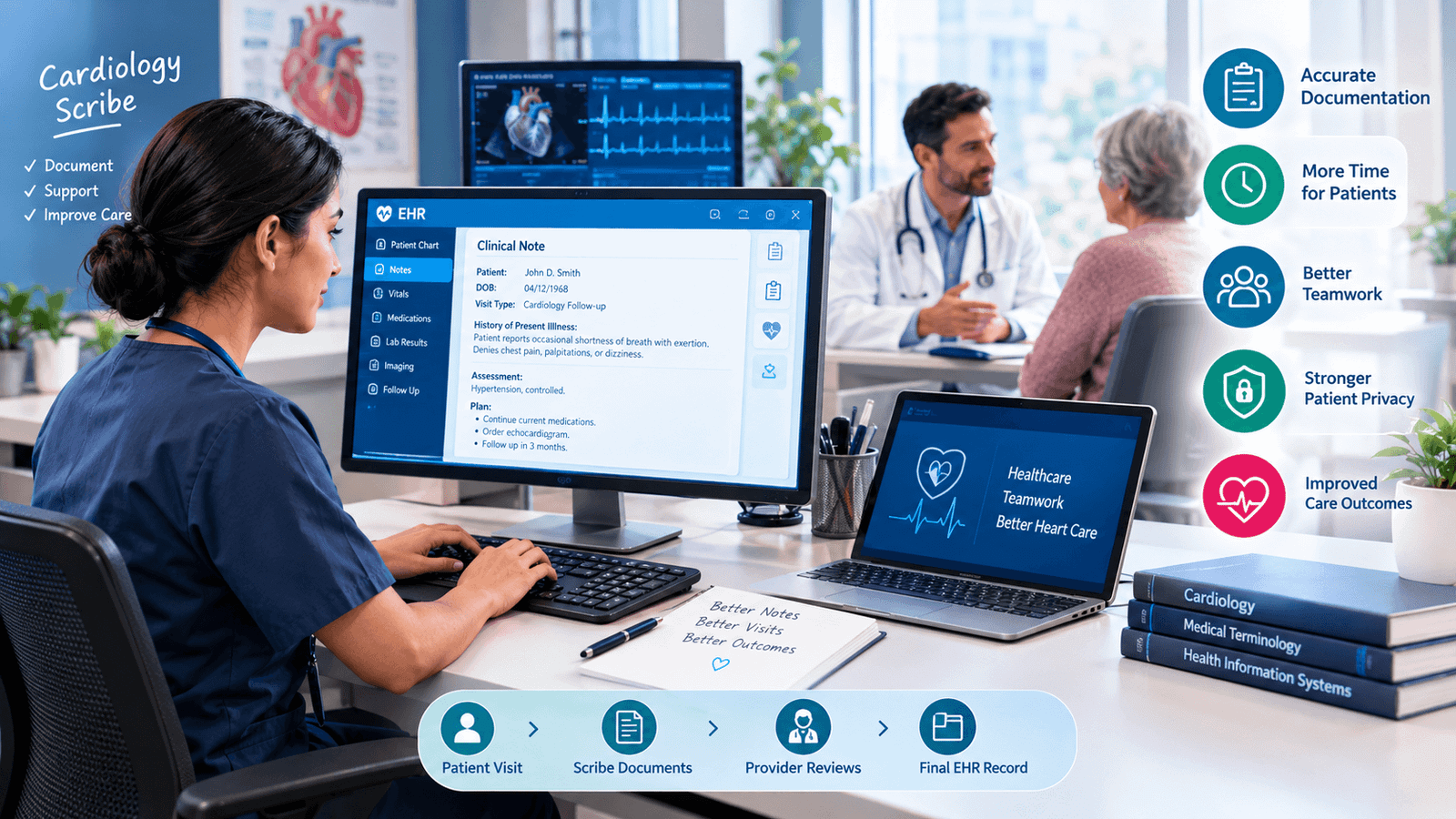

A cardiology scribe helps a heart doctor record patient visits in the electronic health record. The scribe captures the visit while the doctor focuses on the patient. The doctor reviews the note and remains responsible for the final medical record.
Have you ever seen a doctor typing while you explain your health problem? A cardiology scribe can help with that task. The scribe listens during the visit and records key details in the medical chart. This work can help doctors spend more time with patients.
Cardiology scribes may work in clinics, hospitals, or heart care offices. Some work beside doctors in the exam room. Others may support visits from another location.
The role also needs strong medical knowledge. Heart care uses many tests, terms, medicines, and procedures. A scribe must record these details clearly and correctly.
This guide explains the role, daily tasks, skills, training, jobs, and certification options. It also explains how scribes protect patient information. You will learn what patients should expect when a scribe joins their visit.
❤️ What Is a Cardiology Scribe?
A cardiology scribe is a trained documentation worker who supports a heart care provider. The scribe records details from the patient visit in an electronic health record, or EHR.
An EHR is a digital record of a patient’s medical care. It can contain symptoms, medicines, test results, and care plans.
The scribe may listen as the doctor talks with the patient. The scribe then enters relevant details into the chart. The doctor checks the note before final approval.
Scribes do not replace doctors or make medical decisions. Their main role centers on documentation and related office tasks. The Joint Commission says organizations should define scribe duties clearly. Training should match those duties and the person’s role.
What Does a Cardiology Scribe Do?
Daily duties can differ between clinics and employers. Common tasks may include:
- Recording patient history and visit details.
- Entering physical exam findings into the EHR.
- Recording the doctor’s assessment and care plan.
- Adding relevant lab and test information.
- Preparing charts before scheduled visits.
- Organizing information for the doctor.
- Helping track follow-up tasks when allowed.
- Preparing notes for provider review.
Some cardiology settings require knowledge of heart tests. These may include ECGs, echocardiograms, stress tests, and cardiac imaging.
A scribe must know what these terms mean. However, the scribe does not interpret results as a doctor.
A patient may ask why another person sits nearby during an exam. The scribe is usually there to help record the visit. Patients can ask the clinic about the scribe’s role and access.
📋 How Does a Cardiology Scribe Job Work?
The work often starts before the patient enters the exam room. A scribe may review the chart and prepare basic information for the visit.
The doctor then meets with the patient. The scribe listens and records information during the encounter.
After the visit, the scribe may review the note for missing details. The doctor then checks the documentation and makes needed changes.
Typical Daily Workflow
A common workflow may look like this:
| Step | Scribe Task | Provider Role |
| Before visit | Review the chart | Prepare for patient care |
| During visit | Record key details | Examine and talk with patient |
| After visit | Check the draft note | Review and approve the note |
| Follow-up | Complete allowed clerical tasks | Manage patient care |
The exact workflow depends on the employer. Some jobs may include pre-charting or other office support.
A cardiology scribe may also work with different heart specialists. These can include general cardiologists and electrophysiologists.
Electrophysiology is the part of cardiology that studies heart rhythm. It may involve patients with abnormal heart rhythms.
A scribe may hear terms such as atrial fibrillation or heart failure. The scribe needs to spell and record these terms correctly.
The role requires close attention to detail. One wrong word can change the meaning of a medical note.
Patient privacy also matters during every step. Health information must receive proper protection under HIPAA rules. Covered health groups must train workers on privacy practices.
In-Person and Remote Scribes
Some scribes work in person with doctors. They may sit in the exam room or nearby.
Other scribes work remotely. They may listen to visits through approved systems and enter notes from another location.
Remote work still requires strong privacy controls. Clinics must protect patient information and limit improper access.
🩺 What Skills Does a Cardiology Scribe Need?
A good scribe needs more than fast typing. The role requires medical knowledge, careful listening, and strong writing skills.
Medical terminology is one key skill. A scribe should understand common words for body parts, diseases, medicines, and tests.
Basic anatomy also helps. Anatomy means learning the body’s structure. Cardiology scribes need special knowledge of the heart and blood vessels.
Important Skills
Employers may look for skills such as:
- Strong English writing skills.
- Accurate typing and data entry.
- Good listening skills.
- Basic medical terminology.
- Knowledge of anatomy and physiology.
- Familiarity with EHR systems.
- Good time management.
- Strong attention to detail.
- Respect for patient privacy.
- Ability to work under time pressure.
The Joint Commission lists medical terminology, HIPAA, EHR skills, and documentation practices among key training areas.
A scribe also needs to know their limits.They should not give patients medical advice.
A cardiology scribe should not change a doctor’s plan on their own. They should not act as a doctor or nurse unless separately qualified.
Real-World Example
Imagine a patient visiting a cardiologist after feeling short of breath. The doctor asks about symptoms and past health problems.
The scribe records the doctor’s questions and findings. The scribe also records the plan for tests or follow-up.
The doctor later reviews the note. The doctor corrects anything needed before signing it.
This process can help keep the visit focused on the patient.
🔎 How Are Cardiology Scribes Trained and Tested?
Training can differ by employer, school, and job type. There is no single training path for every medical scribe.
Some employers provide training after hiring. Other people complete a scribe course before applying for jobs.
A training program may cover medical terms, anatomy, documentation, EHR use, and privacy rules.
Cardiology-focused programs may add heart anatomy and common cardiac tests. Some programs also use practice patient cases.
Do You Need Certification?
Certification is not one universal requirement for medical scribes. Job rules can differ between employers and locations.
The Association for Healthcare Documentation Integrity notes that medical scribe programs do not have one formal accreditation system. It also describes approved education programs based on a medical scribe model curriculum.
Some organizations offer voluntary scribe credentials. AAPC, for example, offers a Certified Professional Medical Scribe credential.
That credential tests knowledge of medical records, terminology, anatomy, and documentation rules. AAPC currently lists experience requirements for its CPMS exam.
Certification can show extra training. However, employers may set their own hiring rules.
Cardiology Scribe Programs
Cardiology scribe programs may focus on specialty terms and common heart visits. Some courses include practice with real-time documentation.
Topics may include:
- Heart anatomy.
- Common heart conditions.
- ECG documentation.
- Cardiac imaging terms.
- Heart procedures.
- Common cardiac medicines.
- Patient visit scenarios.
- Medical chart structure.
Before choosing a program, check its curriculum and employer value. Look for clear information about training, testing, and course content.
💼 What Are Cardiology Scribe Jobs Like?
Cardiology scribe jobs can appear in hospitals, clinics, private practices, and health groups. Some positions may be full-time. Others may offer part-time or flexible work.
Job duties can vary widely. Some roles focus almost fully on charting. Others include pre-charting and limited office support.
A job listing may ask for medical knowledge and EHR experience. Some employers prefer previous scribe experience.
Common Job Requirements
A cardiology scribe job may ask for:
| Requirement | Why It Matters |
| Medical terms | Helps record visits correctly |
| EHR skills | Supports fast chart entry |
| Heart knowledge | Helps understand cardiac notes |
| Typing skills | Helps with real-time charting |
| Privacy training | Protects patient information |
The Joint Commission recommends role-specific training and ongoing education.
A job may also ask for strong communication skills. Scribes often work closely with doctors and other health workers.
Some employers may prefer students interested in medicine. Others may accept candidates with related education or experience.
Is This a Good Entry Into Health Care?
Scribing can provide exposure to clinical work. It may help students learn how medical visits are documented.
A person may also learn how doctors use medical terms during real visits. This experience can help someone understand the flow of health care.
Still, scribing is not the same as clinical licensure. A scribe does not become a nurse, physician, or other licensed provider through this role.
🤝 How Does a Scribe Service Help Cardiology Practices?
A scribe service provides documentation support to healthcare teams. The service may supply trained scribes for clinics or hospitals.
Some services use in-person workers. Others provide remote scribes.
The main goal is to support documentation. The doctor remains responsible for the medical content of the final note.
A scribe service may handle scheduling, training, quality checks, and worker support. The exact model depends on the company.
Why Do Practices Use Scribe Services?
Doctors often need to document many details during a busy clinic day. A scribe can handle much of the typing and chart work.
This can allow the doctor to focus more closely on the patient. It may also help keep charts organized.
However, quality still matters. AHRQ notes that scribe practices can vary widely. It also highlights differences in training and job duties.
Healthcare groups should define clear responsibilities. They should also provide proper training and supervision.
Patient privacy must remain a key part of the service. HIPAA requires covered groups to protect health information.
Another Patient Example
Consider an older patient with several heart medicines. The patient visits a cardiologist for a follow-up.
The scribe records the medicine list and the doctor’s questions. The doctor then reviews the information and updates the care plan.
The patient can spend more time speaking with the doctor. The scribe supports the record but does not direct the care.
🤖 Can AI Replace a Cardiology Scribe?
AI tools can now help create clinical notes from patient visits. These tools may reduce some manual typing.
However, AI does not remove the need for human review. The AMA says AI should support, not replace, clinical decision-making.
AI-generated notes can contain errors. A doctor must review the note before using it as the final record.
Human scribes also provide context during a visit. They can follow the doctor’s workflow and correct obvious documentation issues.
The best choice may depend on the clinic’s needs. Some practices may use human scribes, AI tools, or both.
Privacy also matters with AI systems. Healthcare groups must protect patient information when using digital tools.
A patient may ask whether AI or a human is recording the visit. The clinic should explain its process clearly.
⚠️ When Should a Scribe Step Back?
A scribe should stay within the role defined by the employer. The scribe should not make independent medical decisions.
The doctor or other qualified provider remains responsible for patient care. The scribe supports documentation rather than treatment.
A scribe should ask for help when information is unclear. Guessing can create errors in a medical record.
The Joint Commission also says organizations should define scribe duties and training.
What Patients Should Know
Patients can ask who the person is and why they are present. They can also ask how their information will be protected.
If a patient feels uncomfortable, they can discuss the concern with the care team. Privacy and trust remain important parts of medical care.
Patients should also remember that scribes do not replace their healthcare provider. Medical questions should go to the doctor or another qualified professional.
Frequently Asked Questions
Q: Are there cardiology scribe jobs for beginners?
A: Yes, some employers hire entry-level candidates. Requirements differ by employer and location. Some jobs provide training after hiring. Medical knowledge and strong typing skills can help.
Q: What are common cardiology scribe requirements?
A: Requirements vary by job. Many roles value medical terminology, EHR skills, accuracy, and privacy training. Some employers may prefer prior scribe or healthcare experience.
Q: What does a cardiology scribe job description usually include?
A: A job description often includes real-time charting and EHR documentation. It may also include chart review, pre-charting, and clerical support. The exact duties depend on the employer.
Q: Are cardiology scribe programs available online?
A: Yes, some programs offer online training. Programs may cover heart anatomy, cardiac tests, medical terms, and charting. Check the course content before enrolling.
Q: Do cardiology scribes need certification?
A: No, one universal certification is not required for every scribe job. Some employers may prefer certification or formal training. Requirements can differ between organizations.
Q: Can an in-person scribe work inside the exam room?
A: Yes, some scribes work inside the exam room. They listen and document the visit for the provider. The clinic should explain the scribe’s role to the patient.
Q: Can AI be used as a cardiology scribe?
A: Yes, some healthcare groups use AI for clinical documentation. A qualified provider should review AI-generated notes before final use. The AMA stresses human oversight and patient safety.
Conclusion
A cardiology scribe supports doctors by recording patient visits and managing documentation tasks. The role can help doctors spend more attention on patients.
Good scribes need strong medical terms, careful listening, and accurate writing. They also need EHR skills and privacy training.
Training paths can differ, and certification may not be required for every job. Some people choose specialty courses to build their cardiac knowledge.
Scribes do not diagnose patients or make treatment decisions. The healthcare provider remains responsible for the final medical record and patient care.
For patients, clear communication and privacy should always come first. Ask questions if you are unsure about a scribe’s role.
Talk to a cardiologist if you have any heart concerns.
Medically reviewed for accuracy. Always consult a licensed cardiologist for personal advice.