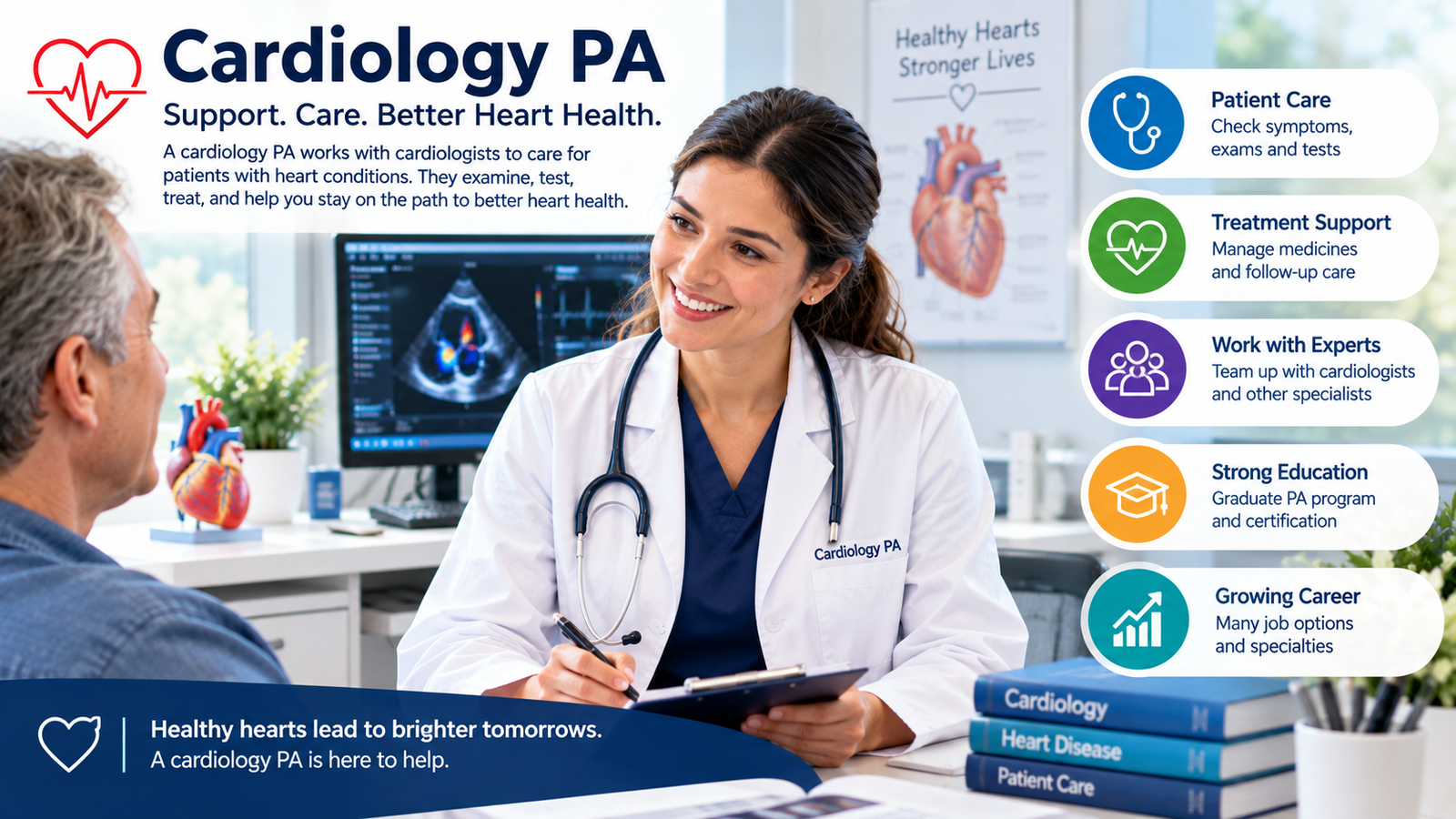

A cardiology PA is a physician assistant who works with patients with heart problems. Cardiology PAs can examine patients, order tests, manage treatment, and provide follow-up care. Their duties depend on training, practice setting, and state law.
Have you ever wondered who helps a cardiologist care for patients each day?
A cardiology PA can play an important role on the heart care team.
PA means physician assistant, or physician associate.
PAs are licensed clinicians who work with physicians and other health professionals.
The American College of Cardiology has published cardiovascular PA competencies.
These skills cover patient care, medical knowledge, and communication.
They also cover heart failure, rhythm problems, and other heart conditions.
This guide explains the role in simple terms.
You will learn about duties, education, salary, jobs, and daily work.
You will also learn what patients may expect during a visit.
If you want this career, you will find a clear path.
If you need heart care, you will learn how PAs may help.
What Is a Cardiology PA?
A cardiology PA is a PA who focuses on cardiovascular care.
Cardiovascular care means care for the heart and blood vessels.
PAs receive broad medical training before choosing a specialty.
They can then build more skills through cardiology work and education.
The exact role can differ between practices.
State laws also affect what a PA may do.
A PA may work with a cardiologist in an office.
Another PA may work in a hospital or heart clinic.
What Does a Cardiology PA Do?
Daily duties can include many parts of heart care.
A PA may:
- Take a medical history
- Perform a physical exam
- Review symptoms
- Order diagnostic tests
- Review test results
- Help create treatment plans
- Prescribe medicines when allowed
- Provide patient education
- Manage follow-up visits
- Coordinate care with other clinicians
- Assist with procedures
The American Academy of PAs lists these among common PA activities.
Specific duties depend on specialty, experience, setting, and state law.
A patient with high blood pressure may need regular follow-up.
The PA can review readings and discuss the treatment plan.
A patient with heart failure may need close monitoring.
The PA can review symptoms, medicines, weight, and test results.
The cardiologist remains part of the care team.
The PA and physician may share care under local practice rules.
Cardiology PA Requirements and Education
Becoming a PA starts with formal PA education.
Students usually complete college prerequisites before entering PA school.
PA programs must meet accreditation standards.
ARC-PA accredits entry-level PA education programs in the United States.
AAPA reports that PA programs commonly take about three academic years.
Students also complete extensive supervised clinical rotations.
PA School
PA education includes classroom learning and clinical training.
Students study subjects such as:
- Anatomy
- Physiology
- Pharmacology
- Pathology
- Physical examination
- Clinical medicine
- Patient care
- Professional practice
Clinical rotations expose students to many medical areas.
Some students complete rotations in cardiology.
After graduation, candidates must meet certification requirements.
Graduates of ARC-PA accredited programs can apply for PANCE.
PANCE means Physician Assistant National Certifying Examination.
Passing PANCE supports NCCPA certification when other requirements are met.
PAs must also meet state licensing rules.
Those rules can vary between states.
Cardiology Training After PA School
There is no single required cardiology PA degree.
Many PAs enter cardiology after general PA training.
They then develop specialty skills through supervised practice and education.
Some programs offer postgraduate cardiovascular PA training.
A cardiology-focused fellowship can provide extra clinical experience.
The ACC also provides cardiovascular competencies for PAs.
These competencies cover 11 clinical areas in adult cardiovascular medicine.
They include:
| Area | Main Focus |
| Heart failure | Symptoms, medicines, and long-term care |
| Arrhythmias | Abnormal heart rhythms and related care |
| Valve disease | Heart valve problems and follow-up |
| Prevention | Risk reduction and healthy habits |
Specialty training can help a PA build deeper skills.
The best path depends on career goals and available programs.
Cardiology PA Jobs and Work Settings
Cardiology PAs work in many clinical settings.
A PA may work in:
- Outpatient cardiology clinics
- Hospitals
- Heart failure clinics
- Electrophysiology clinics
- Preventive cardiology clinics
- Structural heart programs
- Interventional cardiology teams
- Cardiothoracic surgery services
AAPA reports that cardiology is the largest internal medicine subspecialty for PAs.
Its 2025 Salary Report found 3.1% of PAs working in cardiology.
Cardiology duties can include inpatient and outpatient care.
The exact work depends on the practice and specialty.
Common Cardiology PA Jobs
Job titles can vary by employer.
You may see titles such as:
- Cardiology Physician Assistant
- Cardiovascular Physician Assistant
- Heart Failure PA
- Electrophysiology PA
- Interventional Cardiology PA
- Structural Heart PA
- Inpatient Cardiology PA
- Cardiothoracic Surgery PA
The job may include clinic visits and hospital work.
Some PAs also help with procedures.
A PA in electrophysiology may focus on rhythm disorders.
Another PA may work mainly with heart failure patients.
A PA may also review ECGs and monitor reports.
Some cardiology PAs help with stress testing and device care.
One AAPA profile describes a cardiology PA reviewing Holter reports.
The PA also reviewed echocardiograms and stress tests.
The work included heart failure and rhythm disorder care.
Cardiology PA Salary
Salary is one of the most common questions about this career.
There is no single salary for every cardiology PA.
Pay can change by location, experience, employer, and specialty.
AAPA reported median cardiology PA compensation of $131,000 in 2024.
That figure included base compensation and excluded bonuses.
AAPA also reported bonuses among many cardiology PAs.
Among those receiving bonuses, the median bonus was $6,000.
The U.S. Bureau of Labor Statistics provides broader PA wage data.
Its May 2025 median annual wage for all PAs was $135,880.
These numbers are not guaranteed salaries.
Cardiology pay can differ greatly between employers.
What Can Change PA Salary?
Several factors can affect compensation.
| Factor | Possible Effect |
| Experience | More experience may support higher pay |
| Location | Pay differs across states and cities |
| Setting | Hospitals and clinics may use different pay models |
| Specialty | Subspecialty work can affect compensation |
A new graduate may earn less than an experienced PA.
A PA with advanced skills may have different opportunities.
Always compare the complete job offer.
Benefits, retirement plans, paid time off, and call schedules also matter.
How Does a Cardiology PA Work With Doctors?
Patients sometimes ask how a PA differs from a cardiologist.
A cardiologist is a physician who specializes in heart care.
A PA is a licensed medical professional with a different training path.
PAs work as part of medical teams.
Their scope depends on education, training, state law, and practice rules.
The ACC describes PAs as members of cardiovascular care teams.
Its competency framework supports collaborative and patient-centered care.
What Happens During a Visit?
A PA may start by asking about your symptoms.
They may ask about:
- Chest pain
- Shortness of breath
- Dizziness
- Swelling
- Exercise tolerance
- Medicines
- Blood pressure
- Medical history
The PA may then perform a physical exam.
They may order tests based on your clinical situation.
These can include an ECG, echocardiogram, stress test, or blood tests.
The PA may explain the next steps.
The cardiologist may also review the case.
Many patients feel nervous during their first heart visit.
A clear explanation can make the visit easier.
Tests and Procedures a Cardiology PA May Handle
Cardiology PAs can take part in many diagnostic services.
The exact role depends on training and local rules.
Common Tests
A PA may order or review:
- Electrocardiograms
- Echocardiograms
- Stress tests
- Holter monitoring
- Ambulatory rhythm monitoring
- Blood tests
- Cardiac imaging
An ECG records the heart’s electrical activity.
An echocardiogram uses sound waves to create heart images.
A Holter monitor records heart rhythm during daily activity.
The PA may connect test results with your symptoms.
The cardiologist may provide additional review when needed.
Procedures
Some cardiology PAs also assist with procedures.
Their work may include:
- Cardioversion support
- Temporary pacemaker procedures
- Device care
- Pre-procedure assessment
- Post-procedure follow-up
- Hospital discharge planning
AAPA describes cardiology PA roles that include cardiovascular procedures.
Not every PA performs these tasks.
Training, privileges, employer policy, and state rules all matter.
Prevention and Long-Term Heart Care
Cardiology care does not only focus on emergencies.
Prevention can help lower future heart risk.
A PA may discuss:
- Blood pressure control
- Cholesterol levels
- Physical activity
- Healthy eating
- Weight management
- Smoking cessation
- Diabetes care
- Medicine use
A patient may need several small changes.
For example, a patient may have high blood pressure.
The PA may review home readings and medicine use.
The PA can also discuss exercise and food choices.
Follow-up visits help track progress.
The ACC cardiovascular competencies include disease prevention.
They also include ongoing learning and quality improvement.
Patients often benefit from simple explanations.
Clear instructions can make treatment plans easier to follow.
When Should You See a Cardiology PA?
A cardiology PA can help with many heart care needs.
You may see one for routine follow-up.
You may also see one after a hospital stay.
Common reasons include:
- High blood pressure
- High cholesterol
- Heart failure follow-up
- Abnormal heart rhythm
- Valve disease
- Coronary artery disease
- Chest symptoms
- Pre-procedure evaluation
- Medication follow-up
Your care team can decide who should see you.
A PA may manage some visits within the practice structure.
Red Flags Need Urgent Care
Some symptoms need urgent medical attention.
Call 911 for severe or sudden symptoms when appropriate.
Warning signs can include:
- Severe chest pressure
- Trouble breathing
- Fainting
- Sudden severe weakness
- New confusion
- Symptoms that may suggest a heart attack
Do not delay emergency care while waiting for a clinic appointment.
A PA can provide routine care.
Emergency symptoms need prompt medical evaluation.
Career Growth
The field offers many paths for professional growth.
A PA can gain experience in a focused area.
They may later move into leadership, teaching, or research.
Possible areas include:
- Electrophysiology
- Heart failure
- Structural heart care
- Preventive cardiology
- Interventional cardiology
- Cardiothoracic surgery
Continuing education remains important.
NCCPA requires certified PAs to maintain certification.
The current process includes five two-year CME cycles.
PAs must log 100 CME credits during each two-year cycle.
PAs also complete a recertification assessment.
They can use PANRE or PANRE-LA under current rules.
This ongoing learning helps PAs keep medical knowledge current.
Cardiology PA FAQ
Q: What does a cardiology PA do?
A: A cardiology PA provides medical care for people with heart conditions.
They may examine patients, order tests, manage medicines, and provide follow-up.
Their duties depend on training, state law, and practice rules.
Q: What is the cardiology PA abbreviation?
A: PA means physician assistant, or physician associate.
In cardiology, it describes a PA focused on cardiovascular care.
The role is different from that of a cardiologist physician.
Q: How much does a cardiology PA make?
A: AAPA reported median cardiology PA compensation of $131,000 in 2024.
That figure excluded bonuses and reflected reported base compensation.
Actual pay can vary by state, experience, and employer.
Q: What are the requirements to become a cardiology PA?
A: First, complete an ARC-PA accredited PA program.
Then meet NCCPA certification and state licensing requirements.
Additional cardiology training can help build specialty skills.
Q: Are there cardiology PA programs?
A: Most PAs first complete a general PA education program.
Some later choose cardiology-focused postgraduate training.
Clinical experience and continuing education can also build specialty skills.
Q: Are cardiology PA jobs available in hospitals?
A: Yes, cardiology PAs work in hospitals and outpatient settings.
Roles may include inpatient care, procedures, consultations, and discharge planning.
AAPA reports varied cardiology PA work across clinical settings.
Q: Can Reddit help me learn about cardiology PA careers?
A: Reddit can provide personal stories from PAs and students.
Those posts are personal experiences, not official career data.
Use AAPA, NCCPA, ARC-PA, and state boards for important decisions.
Conclusion
A cardiology PA can provide many types of heart care.
The role may include exams, testing, treatment, and follow-up.
PAs also support prevention and patient education.
The career starts with accredited PA education and national certification.
Cardiology training can then build deeper specialty skills.
Salary depends on experience, location, setting, and employer.
AAPA reported a 2024 median cardiology compensation of $131,000.
Patients may see a PA during routine or specialty heart care.
The PA works within a cardiovascular team and local practice rules.
If you have heart concerns, talk with your healthcare team.
A cardiology PA may be part of that team.
Medically reviewed for accuracy. Always consult a licensed cardiologist for personal advice.