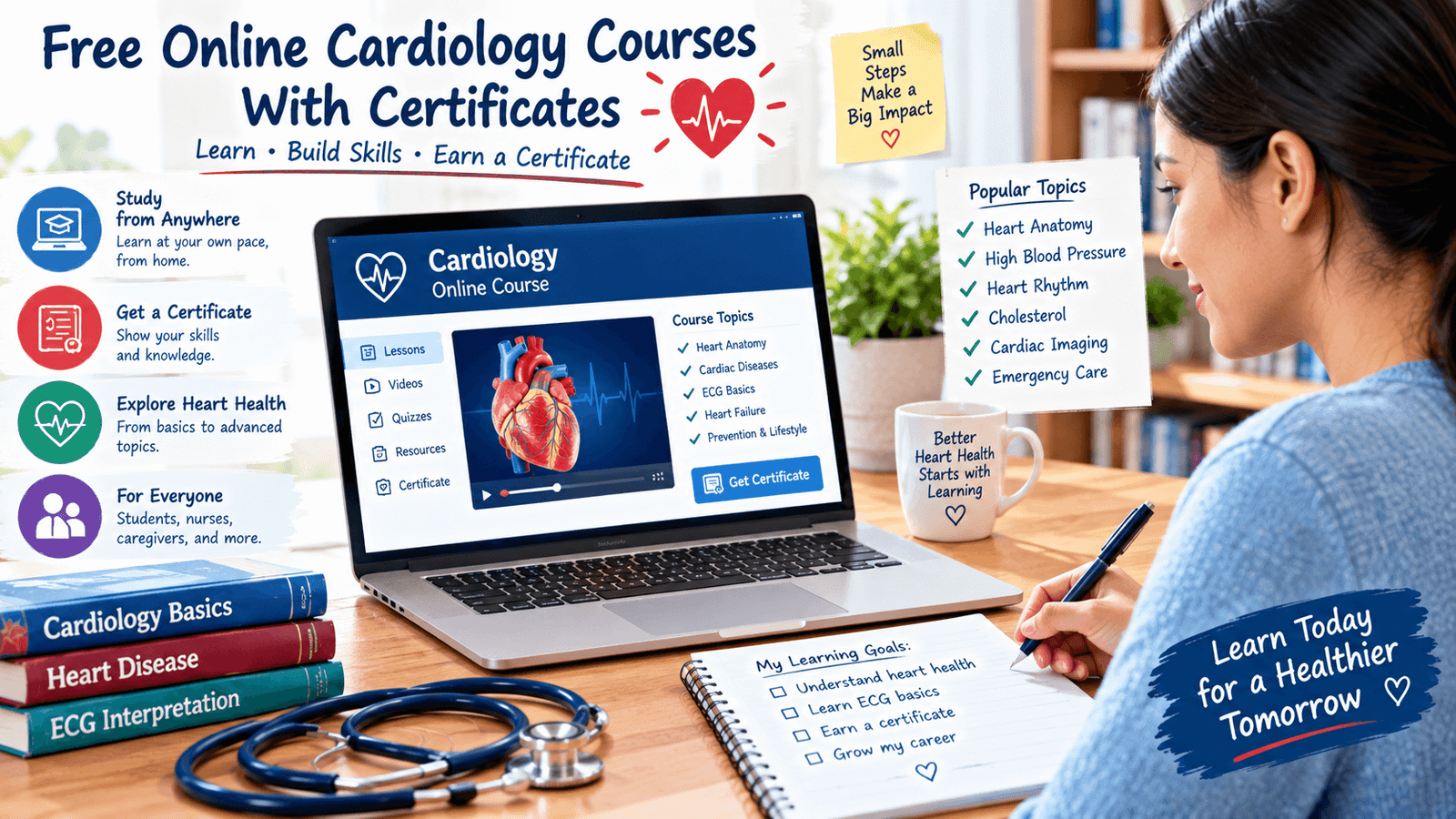
Free online cardiology courses with certificates can help learners study heart health from home. Some offer free certificates, while others offer free learning but charge for certificates.
Have you ever wanted to learn cardiology without joining a full classroom program? Online courses can make that possible from almost anywhere.
Free online cardiology courses with certificates can support students, nurses, caregivers, and curious learners. They can also help health workers refresh basic heart knowledge.
Still, course names can be confusing. A free course may not include a free certificate. Some programs offer CME credit instead of a general completion certificate.
The right choice depends on your goal. You may want basic knowledge, career support, or continuing education credit.
This guide explains what these courses teach and who can use them. It also explains certificates, CME, course quality, and safe learning habits.
You will also learn how to compare course length, content, testing, and proof of completion.
What Are Free Online Cardiology Courses With Certificates?
These courses teach basic or advanced topics about the heart and blood vessels. They use online lessons, videos, quizzes, readings, or case examples.
A certificate usually shows that you completed a course. It does not always prove professional qualification.
Some courses are made for the public. Others are designed for nurses, students, doctors, or health workers.
Course level matters. A beginner course may explain anatomy and blood flow. A professional course may discuss heart failure or ECGs.
Certificate vs CME Credit
A certificate and CME credit are not always the same thing.
A completion certificate may show that you finished the learning activity. CME means continuing medical education.
Healthcare professionals may need CME for professional development. Rules depend on their license and profession.
Some activities provide both a certificate and education credit. Others provide only a completion record.
Always check the course page before starting. Look for “certificate,” “CME,” “CE,” or “credit offered.”
Who Can Take These Courses?
Many online courses accept learners without a medical degree. Some advanced courses require clinical knowledge.
You may find courses for:
- Medical students.
- Nurses and nursing students.
- Physician assistants.
- Other health professionals.
- Caregivers.
- Patients and families.
- General learners.
A caregiver may take a basic course to understand heart terms. A nurse may seek a course that supports continuing education.
A medical student may choose a harder course about ECG interpretation. Each learner needs a different level.
How Do These Courses Work?
Most online cardiology courses follow a simple learning path. You create an account, enroll, study lessons, and complete tasks.
Some courses use short videos. Others use reading material and case questions.
A course may include a quiz after each lesson. A final test may also be required before completion.
Common Course Steps
A typical course may follow these steps:
- Create an account on the learning platform.
- Read the course description and learner requirements.
- Check whether the course is free.
- Check whether the certificate is also free.
- Complete the lessons and learning activities.
- Finish quizzes or a final test.
- Complete any required survey.
- Download or save your certificate.
The process can vary between platforms. Some courses issue certificates automatically.
Other programs require you to claim credit after finishing. Some activities may also expire.
Read the course details before enrolling. This can prevent confusion later.
How Long Do Courses Take?
Course length can range from a short lesson to several hours. Some programs offer many modules.
Short courses can help you learn one focused topic. Longer courses can cover several areas of cardiology.
Do not choose only by course length. A longer course may not fit your goal.
Look at the learning goals instead. They explain what you should know after finishing.
What Topics Can You Learn?
Cardiology covers many parts of heart and blood vessel care. Online courses may focus on one topic or several topics.
Common subjects include:
- Heart anatomy.
- Blood flow.
- Blood pressure.
- Cholesterol.
- Heart failure.
- Heart attack.
- Heart rhythm problems.
- ECG basics.
- Cardiac imaging.
- Lifestyle and prevention.
- Emergency heart care.
A beginner may start with heart anatomy. This helps explain how chambers, valves, and blood vessels work.
An ECG course can teach how electrical signals create heart rhythms. More advanced lessons may discuss abnormal rhythms.
Some courses focus on prevention. These may cover smoking, activity, food, blood pressure, and cholesterol.
Learning About Risk Factors
Heart disease has many risk factors. High blood pressure, high cholesterol, and smoking are important ones.
Diabetes, physical inactivity, excess weight, and unhealthy eating can also raise risk.
Age and family history can affect risk too. Some factors cannot be changed.
Learning these basics can help people understand health advice. It does not replace personal medical care.
Learning Through Case Examples
Case-based learning uses patient examples to explain medical ideas. It can make difficult topics easier to understand.
For example, a course may describe a patient with chest discomfort. The lesson may then explain possible tests.
Another case may discuss an irregular heartbeat. Learners may review an ECG or treatment plan.
These examples can connect facts with clinical situations. They remain learning tools.
What Should You Look For in a Free Course?
Not every free course has the same value. Check the course details before you choose one.
There is no single best free course for every learner. The right course depends on your goal and skill level.
Start with the provider. Medical schools, professional groups, hospitals, and trusted platforms can offer useful programs.
Next, review the learning goals. Good goals explain what you should know after finishing.
Then check the course date. Medical information can change as guidelines and research develop.
Check the Certificate Details
Certificate rules deserve special attention. A course can be free while its certificate costs money.
Some platforms let you study course material for free. They may charge for a verified certificate.
Other professional activities may provide free certificates or CME credit. The exact offer can change over time.
One current example comes from the American College of Cardiology. Its 2026 CCTA training lists free online learning with CME credit.
The course covers coronary CT angiography and includes four self-paced modules. Learners should check current access and credit terms before enrolling.
The American Heart Association also offers online professional education. Its platform includes free courses and paid content.
Some AHA activities provide completion certificates and continuing education. Other complimentary webinars may offer learning without CE credit.
These examples show why you should check each course separately.
Check the Intended Audience
A course may target healthcare professionals rather than beginners. Advanced lessons can feel hard without medical training.
Look for labels such as beginner, intermediate, professional, nurse, student, or physician.
If the course targets clinicians, check its prerequisites. You may need basic anatomy or medical knowledge.
A simple course may suit new learners better. You can study harder topics later.
Are Free Online Cardiology Courses Good for Nurses and Students?
Yes, some courses can support nurses and students. The best fit depends on the learner’s goals and course level.
Nurses may look for online cardiology courses for nurses that provide CE credit. They should confirm that the credit meets their professional requirements.
Medical students may want courses about anatomy, ECGs, or common heart conditions. Case-based learning can also support classroom study.
A student named Alex may struggle with ECG reading. A focused lesson may help Alex review basics.
Alex can then practice with more examples. The course should support school learning, not replace clinical training.
What About Certificate Courses in Cardiology?
The phrase “certificate course in cardiology” can mean different things. Some programs give a simple course certificate.
Others may offer professional education or continuing education credit. A course certificate does not make someone a cardiologist.
Do not confuse a certificate with a medical license. Professional practice requires approved education, training, and licensing.
If a course claims to qualify you for clinical practice, check official rules. State licensing boards can explain professional requirements.
Are There Free Cardiology Courses With CME Online?
Yes, some online cardiology activities can offer free CME. Availability and credit rules can change.
The American College of Cardiology lists free online activities for cardiovascular professionals. Some activities provide CME, MOC, or other professional credit.
For example, an ACC CCTA course currently lists free access and CME credit. It also lists options for several healthcare professions.
The ACC also offers other online educational activities. Some are free, while some larger products have a cost.
The American Heart Association provides professional online education too. Its education platform includes complimentary webinars and other activities.
Who Should Care About CME?
CME is mainly useful for healthcare professionals. It can support ongoing learning and professional requirements.
Doctors may need CME for licensing or board-related requirements. Other health professionals have their own rules.
Patients do not usually need CME. A patient may benefit more from plain-language heart education.
Always check your own licensing organization. Credit rules can differ by profession and state.
How Can You Use These Courses Safely?
Online learning can improve knowledge. It should not replace medical advice or clinical training.
A course may explain symptoms or treatments. That does not support self-diagnosis.
For example, Sam may read about chest pain during a course. Sam should not use the lesson to decide whether chest pain is harmless.
Sudden chest pressure can be an emergency. Other warning signs can include severe breathing trouble or fainting.
Use Trusted Medical Sources
Choose courses from recognized health organizations and established education providers.
Look for clear authorship and medical review. Check whether the course names its learning objectives.
Professional groups may also link lessons to current guidelines. The American Heart Association and American College of Cardiology publish heart care guidance.
Online lessons can become outdated. Check the publication or update date when available.
Do not rely on a course alone for treatment decisions. Talk with a qualified healthcare professional about personal concerns.
How Can You Find Courses Near Me or in the USA?
Online courses do not usually depend on your physical location. You can often study from home across the United States.
Searching “near me” can still help when you want local classes. It may also show hospitals, colleges, or training centers.
For online study, search by topic and learner type. Add terms such as beginner, nurse, student, CME, or certificate.
A Simple Search Method
Try these search ideas:
- Free cardiology courses with certificates.
- Cardiology courses online free.
- Free cardiology CME online.
- Online cardiology courses for nurses.
- Cardiology courses for medical students.
- Certificate course in cardiology.
- Cardiology learning resources.
Then compare the results. Check the provider, course date, certificate rules, and target audience.
Do not trust a course only because its title sounds official. Check the provider’s website first.
How Can These Courses Help With Career Goals?
Online courses can support learning and show continued interest. They may also help you review topics before formal study.
A course certificate can sometimes be added to a personal learning record. Its value depends on who issued it and what it represents.
Students can use courses to explore cardiology before choosing a career path. Nurses can use relevant CE activities.
Healthcare professionals may use CME activities for ongoing learning. They should still follow their licensing rules.
A course alone does not replace a degree or clinical training. It also does not guarantee a job.
Build a Simple Learning Plan
Start with one basic topic. Then add harder topics as your knowledge grows.
A simple plan could look like this:
- Learn heart anatomy.
- Review blood flow.
- Study common heart conditions.
- Learn basic ECG concepts.
- Review prevention and risk factors.
- Try case-based lessons.
- Take a professional course when ready.
Keep notes after each lesson. Write down terms you do not understand.
Use trusted sources to review them. This can make study more useful.
FAQ About Free Online Cardiology Courses
Q: Are free online cardiology courses with certificates really free?
A: Some are, but not all certificates are free. Some platforms offer free lessons but charge for certificates. Always check the certificate price before starting.
Q: Can I find cardiology courses online free in the USA?
A: Yes, many online learning resources are available in the USA. Some are free for everyone, while others target health professionals. Course access and credit rules can vary.
Q: Are there free online cardiology courses with certificates near me?
A: Yes, you can study many courses from home. Location usually does not matter for online learning. Local searches may also find nearby colleges or training centers.
Q: Are there online cardiology courses for nurses?
A: Yes, many courses target nurses and other health professionals. Some activities offer continuing education credit. Nurses should confirm that the credit meets their own requirements.
Q: Can I earn free cardiology CME online?
A: Yes, some professional organizations offer free online CME activities. The ACC lists free cardiovascular education with CME options. Check each activity for eligibility and current credit details.
Q: Is a certificate course in cardiology enough to become a cardiologist?
A: No, a short certificate does not make someone a cardiologist. Becoming a cardiologist requires extensive medical education and clinical training. Professional licensing also applies.
Q: Where can I find good cardiology learning resources?
A: Start with trusted medical organizations, schools, and professional groups. Check the source, update date, learning goals, and intended audience. Use more than one trusted source when studying.
When Should You Talk to a Doctor?
Online courses can teach useful facts. They cannot examine you or review your full medical history.
Do not delay care because of an online lesson. Symptoms can have many causes.
Heart disease may cause chest discomfort, shortness of breath, fatigue, or swelling. Rhythm problems can cause fluttering feelings.
Call 911 for possible heart attack symptoms or other serious emergencies. Fast treatment can improve the chance of recovery.
Learning is helpful, but safety comes first. Use courses to build knowledge, not replace medical care.
Conclusion
Free online cardiology courses can make heart education easier to access. Some courses provide certificates, while others provide CME or completion records.
The main step is checking what each course actually offers. Look at the provider, course level, update date, certificate rules, and credit details.
Students may use courses to build basic knowledge. Nurses and health professionals may choose activities that support continuing education.
Patients and caregivers can also learn useful heart terms. They should use trusted sources and avoid self-diagnosis.
Free online cardiology courses with certificates can be a useful learning option. Still, a certificate does not replace formal medical training.
Choose a course that matches your goal and learning level. Talk to a healthcare professional for personal heart concerns.
Medically reviewed for accuracy. Always consult a licensed cardiologist for personal advice.