
The best cardiology hospitals in the US offer skilled heart teams, advanced tests, and many care options. The right hospital depends on your heart problem, location, insurance, and care needs.
Have you ever searched for a heart hospital after hearing a new diagnosis?
That search can feel hard when every hospital sounds excellent.
The best cardiology hospitals in the US are not the same for everyone.
One person may need fast emergency heart care.
Another person may need a valve or rhythm specialist.
Someone with a rare condition may need a major referral center.
This guide explains what makes a heart hospital worth considering.
It also covers major U.S. centers known for heart care.
You will learn how to compare hospitals without using one list alone.
You will also learn about common heart tests and treatments.
Hospital awards can offer useful clues about quality.
Still, they should not replace advice from your care team.
Insurance, travel time, and appointment access can also matter.
The right choice should fit both your medical needs and daily life.
What Makes the Best Cardiology Hospitals in the US Stand Out?
A strong heart hospital usually offers many heart services.
These may include cardiology, heart surgery, imaging, and rehabilitation.
Some centers also have teams for complex heart problems.
Examples include heart failure, valve disease, and rhythm disorders.
Hospital size alone does not prove better care.
A smaller hospital may provide excellent care for common heart needs.
A large center may offer more specialists for rare conditions.
Your medical needs should guide the choice.
Heart services to look for
Look for services that match your condition and treatment plan.
- General cardiology for common heart concerns.
- Interventional cardiology for catheter-based procedures.
- Electrophysiology for heart rhythm problems.
- Heart failure programs for advanced heart weakness.
- Valve programs for damaged or narrowed valves.
- Cardiac surgery for heart operations.
- Cardiac rehabilitation after certain heart events.
- Preventive cardiology for lowering future risks.
The American Heart Association offers cardiac certifications for hospitals.
These include programs for heart attacks and advanced heart failure.
Such certifications can show that hospitals meet defined care standards.
Major U.S. heart centers
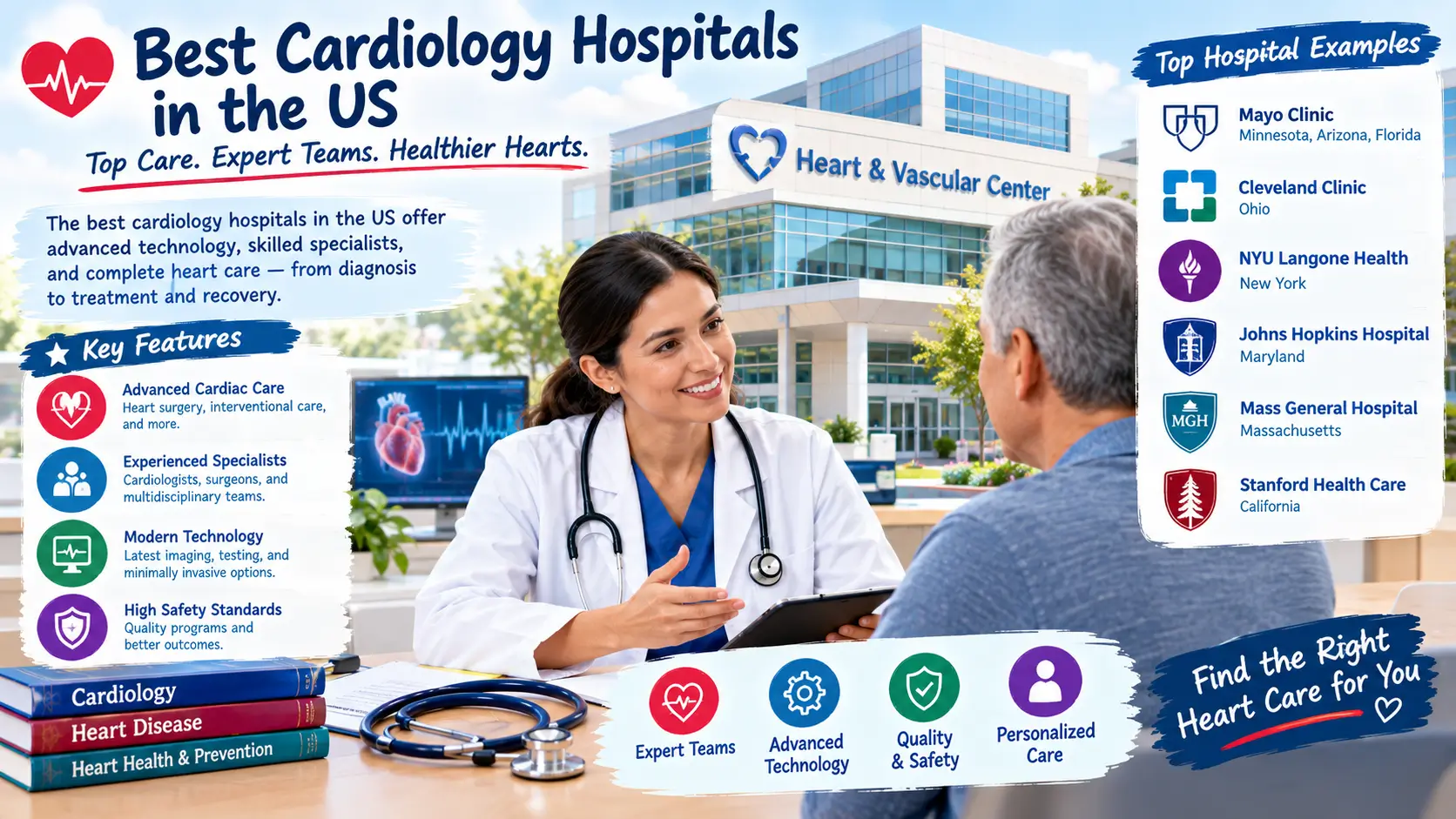
Several U.S. hospitals have large heart programs.
They are examples, not a universal ranking.
| Hospital or center | Location | Heart care examples |
| Mayo Clinic | Minnesota, Arizona, Florida | Cardiology, surgery, imaging |
| Cleveland Clinic | Ohio | Heart, vascular, surgical care |
| NYU Langone Heart | New York | Rhythm, valves, surgery |
| Johns Hopkins Hospital | Maryland | Cardiology, surgery, transplant |
| Mount Sinai Fuster Heart Hospital | New York | Cardiology, surgery, research |
| Mass General Heart Center | Massachusetts | Heart disease, surgery, prevention |
| MedStar Washington Hospital Center | Washington, D.C. | Cardiology, surgery, vascular care |
| Stanford Health Care | California | Cardiology, imaging, procedures |
Mayo Clinic reports more than 240 cardiovascular experts.
Its teams treat common, serious, rare, and complex heart conditions.
Cleveland Clinic also brings heart and vascular specialists together.
Its program includes research, training, and advanced procedures.
NYU Langone reports a No. 1 national U.S. News ranking for 2026.
The ranking covers cardiology, heart, and vascular surgery.
Mount Sinai reports a No. 5 national ranking for 2026–27.
Rankings can change by year, source, and specialty.
How Do Heart Conditions Affect Your Hospital Choice?
Different heart problems need different types of expertise.
Your diagnosis can help narrow the hospital list.
A person with atrial fibrillation may need an electrophysiology team.
A person with blocked arteries may need interventional cardiology.
Someone with valve disease may need a valve center.
A person with advanced heart failure may need specialty services.
Common conditions treated
Heart hospitals may treat many conditions, including:
- Coronary artery disease.
- Heart failure.
- Atrial fibrillation and other rhythm problems.
- Heart valve disease.
- Cardiomyopathy, which means abnormal heart muscle.
- Congenital heart disease, which starts before birth.
- Aortic disease, involving the body’s largest artery.
- High blood pressure and high cholesterol.
- Peripheral artery disease.
Johns Hopkins lists heart failure, arrhythmias, valve surgery, and transplant.
Its heart institute also offers preventive and interventional cardiology.
Mass General uses condition-focused programs within its heart center.
These include valve care, rhythm care, heart failure, and prevention.
A simple patient example
Imagine a patient with repeated fainting and a slow heartbeat.
A cardiologist may order an ECG and heart monitor.
If a rhythm problem appears, an electrophysiology referral may follow.
A large rhythm center may then become useful.
Another patient may have severe valve narrowing.
That person may need imaging and a valve team.
Surgery or another valve procedure may also be needed.
These examples show why one hospital cannot fit every patient.
The right specialty may matter more than general reputation.
What Tests and Services Should a Cardiology Hospital Offer?
Good heart care starts with the right evaluation.
Doctors choose tests based on symptoms, history, and risk.
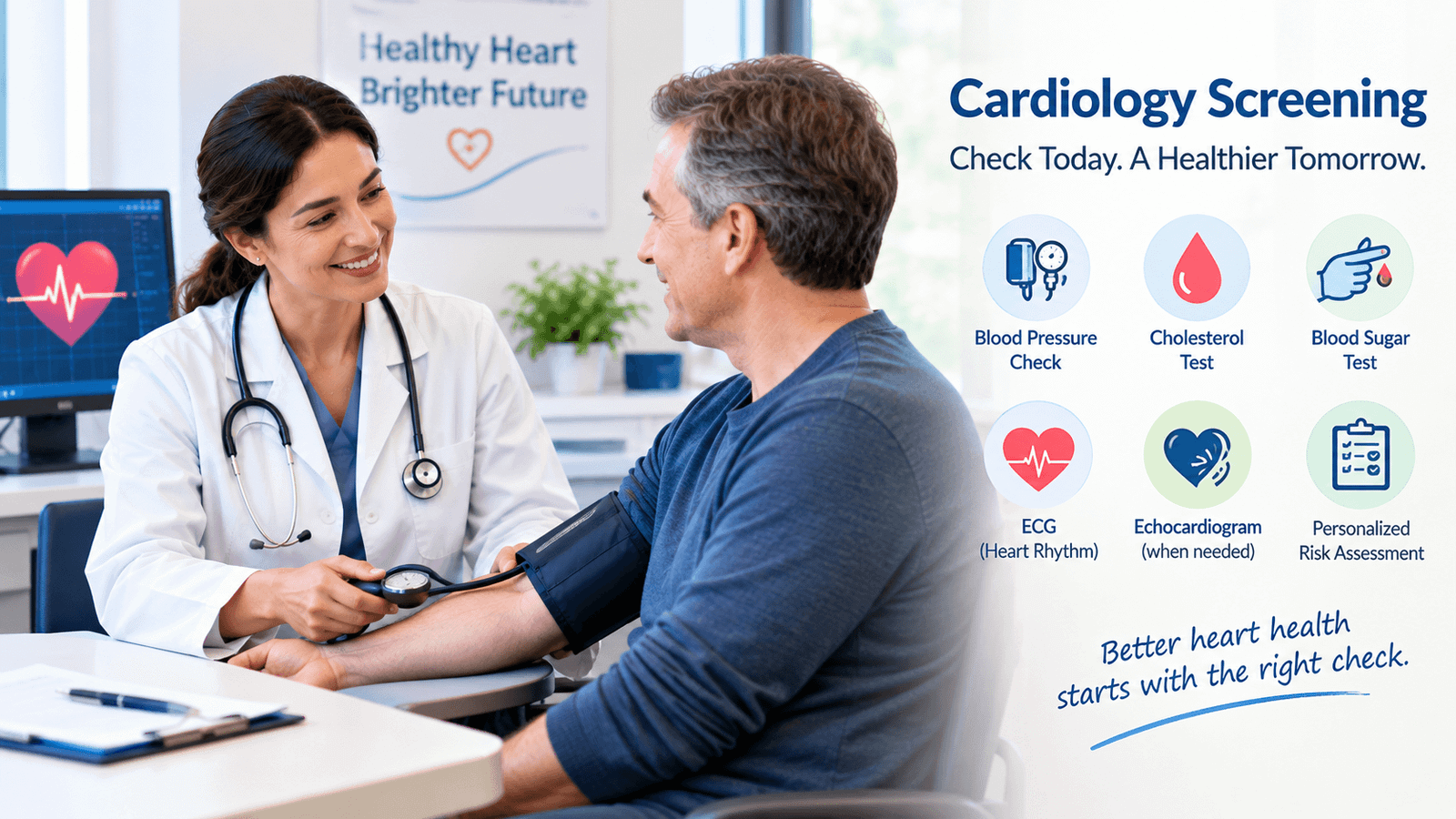
An ECG records the heart’s electrical activity.
It can help find rhythm problems and heart disease.
An echocardiogram uses sound waves to create heart pictures.
It can show heart structure and how well it works.
A stress test checks how the heart responds during activity.
Doctors may use it for certain chest symptoms.
Some patients may need CT, MRI, or cardiac catheterization.
These tests can provide more detail about the heart and blood vessels.
Common heart tests
| Test | What it checks | Common use |
| ECG or EKG | Heart electrical activity | Rhythm problems |
| Echocardiogram | Heart structure and motion | Valves and heart function |
| Stress test | Heart response to activity | Some chest symptoms |
| Holter monitor | Heart rhythm over time | Rhythm problems |
| Cardiac CT or MRI | Detailed heart images | Complex evaluation |
| Cardiac catheterization | Blood flow and arteries | Diagnosis and treatment |
The American Heart Association lists ECG, echo, CT, MRI, and angiography.
Doctors may use several tests when checking a possible heart attack.
A patient may feel nervous before a first heart test.
Most common tests are planned around the person’s medical needs.
Your care team should explain why each test is needed.
What Treatment Can You Expect at a Leading Heart Hospital?
Treatment depends on your condition, test results, and overall health.
Doctors may use medicines, procedures, surgery, or lifestyle care.
Medicines can help control blood pressure and cholesterol.
They may also help manage rhythm problems and heart failure.
Your doctor should explain the reason for each medicine.
Procedures may include stents, ablation, or valve procedures.
Surgery may include bypass surgery or valve repair.
Advanced centers may also offer transplant and mechanical heart support.
Team-based heart care
Complex heart care often involves several specialists.
A cardiologist may work with a surgeon and imaging doctor.
Nurses and pharmacists may also support the care plan.
Mayo Clinic describes a team approach for complex heart care.
Its cardiovascular department includes many specialty groups and treatment programs.
The ACC and AHA publish guidelines for many heart conditions.
Heart failure guidelines support evidence-based, guideline-directed treatment.
Doctors still tailor treatment to each person’s needs.
When a second opinion may help
A second opinion can help before some major procedures.
It can help you understand other treatment choices.
It may also confirm that the suggested plan fits your condition.
Mass General offers second opinion visits through its heart center.
Patients can review cases and proposed treatment plans.
A second opinion does not mean your first doctor was wrong.
It can simply give you more information before major care.
How Can You Compare Hospitals Before Choosing One?
Finding the best cardiology hospitals in the US takes more than one ranking.
Start with your condition and the care you may need.
Then compare heart services, doctors, quality data, and access.
Travel distance also matters when follow-up visits are needed.
Factors worth checking
1. Specialty match
Choose a center with experience in your specific heart problem.
2. Emergency care
Check whether the hospital provides emergency heart services.
Some centers have systems for rapid heart attack treatment.
3. Quality information
Medicare Care Compare provides hospital quality information.
Its measures include mortality, safety, readmissions, and patient experience.
4. Specialist access
Check whether you can see the needed heart specialist.
Ask about referrals and appointment wait times.
5. Insurance
Confirm that the hospital and doctor accept your insurance.
Ask about out-of-network costs before planned care.
6. Location
Think about travel time, parking, lodging, and family support.
These details can matter during long treatment plans.
7. Communication
Look for clear answers from doctors and staff.
Good communication can make complex care easier to understand.
Top 10 heart hospitals in the United States
Search results often show lists of the top 10 heart hospitals.
However, exact lists vary by source and year.
Different rankings also measure different factors.
A better approach is to compare recognized centers.
Examples include Mayo Clinic, Cleveland Clinic, NYU Langone, and Johns Hopkins.
Other major programs include Mount Sinai and Mass General.
MedStar Washington and Stanford also provide specialized heart services.
MedStar Washington reports national recognition for heart care.
Its program includes cardiology, cardiac surgery, and vascular services.
Johns Hopkins reports strong regional recognition for heart care.
Its 2026–27 U.S. News recognition covers Maryland and Baltimore.
These examples are not a medical ranking.
They simply give patients several established centers to research.
When Should You See a Cardiologist or Seek Emergency Care?
A cardiologist can help when symptoms suggest a heart problem.
You may need a referral based on your insurance plan.
Common reasons include chest discomfort, palpitations, and shortness of breath.
Other reasons include fainting, swelling, or abnormal test results.
When emergency care matters
Do not wait for a routine visit if you may have a heart attack.
The American Heart Association says to call 911 for warning signs.
Signs can include chest pressure or upper-body discomfort.
Shortness of breath can also occur with or without chest discomfort.
Other signs include sweating, nausea, or lightheadedness.
Call 911 rather than driving yourself when these symptoms appear.
Emergency teams can begin care during transport.
A simple patient example
Imagine someone develops chest pressure while walking.
The person also feels short of breath and sweaty.
That situation needs emergency attention, not hospital rankings.
The safest step is to call 911 and follow emergency instructions.
The nearest suitable emergency hospital can begin urgent evaluation.
For less urgent symptoms, schedule a medical visit.
A cardiologist can review symptoms and decide about testing.
FAQ
Q: What are the best cardiology hospitals in the US?
A: No single hospital fits every heart problem.
Mayo Clinic, Cleveland Clinic, NYU Langone, and Johns Hopkins have major programs.
Other recognized centers include Mount Sinai, Mass General, and MedStar Washington.
Q: What is the best hospital for heart problems near me?
A: The right local choice depends on your condition and needs.
For urgent symptoms, use the nearest appropriate emergency service.
For planned care, compare specialty services, quality, insurance, and access.
Q: What are the top 10 heart hospitals in the United States?
A: Lists vary by source, year, and scoring method.
Several major programs include Mayo Clinic, Cleveland Clinic, NYU Langone, and Johns Hopkins.
Mount Sinai, Mass General, MedStar Washington, and Stanford are also established programs.
Q: What is the best cardiology hospital in NYC?
A: New York has several major heart programs.
NYU Langone and Mount Sinai provide advanced cardiovascular services.
Your condition should guide the hospital choice.
Q: Are the best cardiology hospitals in the US always large hospitals?
A: No. Hospital size alone does not define care quality.
A smaller center may meet your needs well.
A large center may help more with rare conditions.
Q: Can I get a second opinion from a heart hospital?
A: Yes, many major heart centers offer second opinions.
A second opinion can help you understand treatment choices.
Ask your doctor for records and test results before the visit.
Q: Should I choose a hospital based only on its ranking?
A: No. Rankings are only one source of information.
Check specialty match, quality data, insurance, location, and access.
Your cardiologist can also help review your options.
Conclusion
Choosing among the best cardiology hospitals in the US starts with your health needs.
A hospital with the right specialty can matter more than one ranking.
Look for strong heart services, experienced teams, and quality information.
Medicare Care Compare can help you review hospital quality measures.
Hospital websites can show available specialties and treatment programs.
Your cardiologist can help you decide where to seek planned care.
For major procedures, a second opinion may provide more peace of mind.
For sudden chest pressure or heart attack signs, call 911 right away.
Do not delay emergency care while comparing hospitals online.
The goal is informed care that fits your condition and needs.
Talk to a cardiologist if you have ongoing heart concerns.
Medically reviewed for accuracy. Always consult a licensed cardiologist for personal advice.