
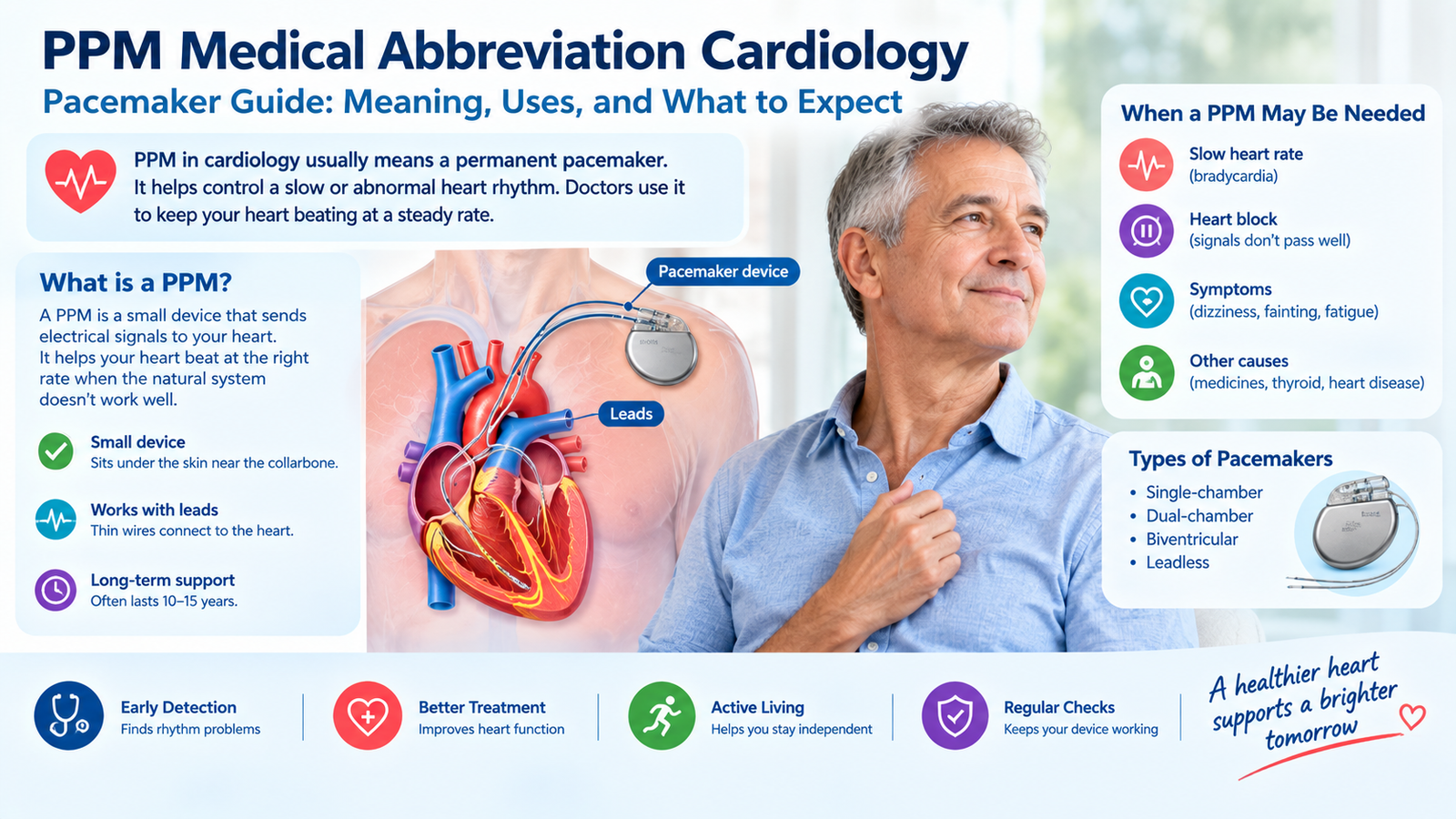

PPM medical abbreviation cardiology usually means permanent pacemaker. It is a small device that helps control a slow or abnormal heart rhythm. Doctors may use a PPM when the heart’s electrical system cannot keep a steady rate.
Have you ever seen “PPM” in a heart report and wondered what it means?
The term can look confusing when you read a medical note. In cardiology, PPM usually means a permanent pacemaker. A pacemaker helps support the heart when its rhythm becomes too slow.
A slow heart rate can happen for many reasons. Aging can affect the heart’s natural electrical system. Certain medicines can also slow the heart. Heart disease may affect the electrical signals that control each beat.
This guide explains what PPM means and why doctors may recommend one. You will learn about symptoms, tests, treatment, and device types. You will also learn how people live with a pacemaker.
The term can have other meanings outside cardiology. Context helps determine the correct meaning. For example, lowercase “ppm” often means parts per million.
Understanding the term can make your medical records easier to read. It can also help you ask better questions during your heart care visits.
What Does PPM Mean in Cardiology? ❤️
In cardiology, PPM commonly means permanent pacemaker. A pacemaker is a small device that helps control the heartbeat. It can send tiny electrical signals when the heart beats too slowly.
The device usually sits under the skin near the collarbone. Traditional pacemakers have a pulse generator and one or more leads. Leads are thin wires that connect the device with the heart.
The heart has its own natural pacemaker. This area is called the sinus node. It creates electrical signals that start each heartbeat.
Sometimes those signals become too slow or irregular. Signals may also have trouble moving through the heart. These problems can cause bradycardia or heart block.
What does a PPM do?
A PPM watches the heart rhythm. It sends an electrical signal when pacing becomes necessary.
Most pacemakers work only when needed. This type is called a demand pacemaker. It senses the heart’s activity and responds when the rate drops.
A pacemaker does not replace every part of the heart. It mainly supports the heart’s electrical timing.
Doctors may consider a PPM for certain rhythm problems. The decision depends on the rhythm, symptoms, test results, and overall health.
The ACC, AHA, and HRS support shared decisions for pacemaker treatment. This means doctors should discuss benefits, risks, and patient preferences.
PPM versus temporary pacing
A permanent pacemaker provides long-term rhythm support. Temporary pacing usually provides short-term support during urgent care.
For example, some people may need temporary pacing after certain heart problems. Doctors may later decide whether long-term pacing remains needed.
The word “permanent” describes the planned long-term role of the device. It does not mean the device can never be removed.
Why Might Someone Need a PPM?
A PPM can help when the heart beats too slowly. Doctors may also consider one when electrical signals cannot move normally.
Common heart rhythm problems
Several conditions can lead to slow heart rhythms.
| Condition | What happens | Possible role of PPM |
| Sinus node dysfunction | The natural pacemaker works poorly | May support the heart rate |
| AV block | Signals struggle to reach lower chambers | May help maintain regular beats |
| High-grade AV block | Many signals fail to reach the lower chambers | Permanent pacing may be recommended |
| Third-degree AV block | Signals cannot pass normally | A pacemaker may provide needed pacing |
Sinus node dysfunction can cause slow beats or pauses. It often develops as the heart’s electrical tissue changes with age.
AV block affects the electrical path between the upper and lower heart chambers. Some forms need closer treatment than others.
The 2018 ACC/AHA/HRS guideline gives specific pacing guidance. It recommends permanent pacing for certain serious AV blocks.
Other possible causes
Slow heart rhythms can have many causes. These include heart disease, heart attacks, and certain medicines. Low thyroid levels can also slow the heart.
Sleep apnea can also relate to nighttime slow heart rhythms. However, nighttime bradycardia alone does not always require a pacemaker.
Doctors first look for causes that they can treat or change. For example, they may review medicines that slow the heart.
Patient example:
Maria feels dizzy several times each week. Her pulse becomes very slow during these episodes. Her doctor orders heart monitoring and finds significant pauses. The team discusses whether permanent pacing fits her condition.
This example shows why symptoms and rhythm findings matter together.
Symptoms and Signs That May Lead to a PPM
A slow heartbeat does not always cause symptoms. Some healthy people have slower rates during sleep. Athletes may also have lower resting heart rates.
Problems become more concerning when a slow rhythm affects blood flow. The brain and muscles may then receive less oxygen-rich blood.
Common symptoms can include:
- Dizziness or lightheadedness
- Fainting or near-fainting
- Unusual tiredness
- Weakness
- Shortness of breath
- Trouble with exercise
- Confusion
- Chest discomfort
The American Heart Association lists these symptoms among possible signs of bradycardia.
Symptoms can come and go
Some rhythm problems happen only at certain times. A person may feel fine during a clinic visit. Their rhythm may change later at home.
This makes longer heart monitoring useful in some cases. A Holter monitor can record heart rhythms during normal daily activities.
Patient example:
John reports fainting once every few weeks. His office ECG looks normal. His doctor orders longer rhythm monitoring. The monitor later captures an abnormal slow rhythm during symptoms.
This kind of timing can help doctors connect symptoms with heart rhythm changes.
Do all slow heart rates need a pacemaker?
No. A slow heart rate does not automatically mean someone needs a PPM.
Doctors consider the cause, symptoms, rhythm pattern, and health history. They also look for reversible causes.
The ACC/AHA/HRS guideline stresses symptom and rhythm correlation for sinus node problems. There is no single heart rate cutoff for every patient.
This is why patients should not decide on pacemaker treatment from one pulse reading.
How Doctors Diagnose a PPM Condition 📋
Doctors do not diagnose the need for a PPM from the abbreviation itself. They first identify the heart rhythm problem.
An ECG is often the first major test. An ECG records the heart’s electrical activity. It can show slow rates, pauses, or conduction problems.
Common tests
| Test | What it checks | Why doctors use it |
| ECG or EKG | Heart electrical activity | Finds rhythm and conduction problems |
| Holter monitor | Rhythm over daily activities | Finds problems that come and go |
| Blood tests | Thyroid and blood chemicals | Looks for reversible causes |
| Echocardiogram | Heart structure and function | Looks for structural heart disease |
Doctors may also use longer monitors when symptoms happen rarely. These tools can record rhythm outside the clinic.
Blood tests may check potassium and other electrolytes. They may also check thyroid hormone levels. These tests can help identify causes of slow heart rhythms.
An echocardiogram uses sound waves to create heart images. It can help doctors assess heart structure and pumping function.
The ACC/AHA/HRS guideline notes that echocardiography can screen for structural heart disease. This can be especially useful when an ECG shows certain conduction changes.
What does “PPM check” mean?
If you already have a pacemaker, “PPM check” usually means device testing. Doctors check the battery and lead function during these visits.
The American Heart Association says pacemakers need regular checks. These visits may happen every six months or yearly.
The exact schedule depends on your device and care plan.
PPM Treatment, Implantation, and Device Types 🩺
When doctors recommend a PPM, they first discuss the reason for pacing. They also consider the type of device that best fits the rhythm problem.
A traditional pacemaker has a generator and leads. The generator contains the battery and electronic parts. The leads carry electrical signals to the heart.
Common pacemaker types
| Type | Main feature | Typical setup |
| Single-chamber | Uses one lead | Usually supports one heart chamber |
| Dual-chamber | Uses two leads | Supports the upper and lower chambers |
| Biventricular | Uses multiple leads | Helps coordinate both lower chambers |
| Leadless | No traditional lead | Small device placed inside the heart |
A leadless pacemaker combines the generator and pacing parts into one small device. Doctors place it through a vein using a catheter.
Biventricular pacing can also form part of cardiac resynchronization therapy. This approach can help coordinate contractions in selected patients.
What happens during implantation?
Doctors usually place a traditional pacemaker under the skin. They guide the leads through a blood vessel toward the heart.
The medical team checks the device before finishing the procedure. They confirm that the system can sense and pace correctly.
The exact process depends on the device type and patient needs.
What happens after implantation?
Patients usually receive instructions about wound care and activity. The care team also explains device follow-up.
A patient should keep the pacemaker identification card available. It tells healthcare workers about the implanted device.
Patient example:
David receives a pacemaker after doctors identify a serious conduction problem. His team explains how the device works. They also schedule regular device checks.
Follow-up helps the team monitor the battery and leads over time.
Living With a Permanent Pacemaker
Many people return to regular daily activities after recovery. Your care team will give instructions based on your device and health.
Pacemakers need ongoing checks. These checks help doctors monitor battery strength and lead function.
Pacemaker batteries often last many years. The American Heart Association reports a typical range of about 10 to 15 years.
The exact battery life varies. It depends on the device and how often pacing occurs.
Daily life and safety
People with pacemakers should tell healthcare workers about the device. This includes doctors, dentists, and emergency teams.
Ask your healthcare team about MRI scans before having one. Some pacemakers can work safely with certain MRI systems. Others require special planning.
You should also follow the device maker’s safety instructions.
Do not ignore new symptoms after implantation. Report fainting, chest pain, breathing trouble, or new swelling.
Your doctor can explain which activities fit your recovery stage.
Can You Prevent the Need for a PPM? ✅
Not every pacemaker need can be prevented. Some electrical problems develop with age or heart disease.
Still, healthy habits can support overall heart health. They may also reduce some risks linked with heart disease.
Helpful habits include:
- Follow a heart-healthy eating plan.
- Stay active within your doctor’s limits.
- Avoid tobacco products.
- Take prescribed medicines correctly.
- Keep blood pressure under control.
- Manage diabetes when present.
- Keep cholesterol at a healthy level.
- Attend regular medical visits.
Doctors may also review medicines when a slow heart rate develops. Some medicines can lower heart rate. A doctor may adjust them when appropriate.
Do not stop a prescribed medicine on your own.
Sleep problems can also matter. The ACC/AHA/HRS guideline recommends considering sleep apnea when nighttime bradycardia occurs.
Treating an underlying problem may sometimes improve the rhythm. However, the right approach depends on the cause.
When Should You See a Doctor? ⚠️
Talk with a healthcare professional if you have repeated rhythm symptoms.
You should seek prompt medical care for fainting, severe dizziness, or new breathing trouble. Chest pain also needs urgent medical attention.
Call 911 for severe chest pain, severe breathing trouble, fainting with serious symptoms, or signs of a medical emergency.
If you already have a pacemaker, contact your care team for new symptoms. The American Heart Association lists breathing trouble, chest pain, fainting, and swelling as warning signs.
Do not diagnose yourself from PPM
Seeing PPM in a medical record does not always tell the full story.
The surrounding words provide important context. For example, “PPM implanted” means something different from “consider PPM.”
Ask your doctor what the abbreviation means in your specific record.
A medical note may also contain other abbreviations. Some can have different meanings across specialties.
This matters because PPM can mean different things outside cardiology.
For example, lowercase “ppm” often means parts per million. That term describes a small concentration of a substance.
In some laboratory settings, PPM can have another meaning. The record type and nearby words help clarify the intended meaning.
Frequently Asked Questions
Q: What does PPM medical abbreviation cardiology mean?
A: In cardiology, PPM usually means permanent pacemaker. It is an implanted device that supports certain slow heart rhythms. Your doctor can confirm the meaning in your specific medical record.
Q: Is PPM the same as a pacemaker?
A: Yes, in many cardiology records, PPM means permanent pacemaker. The term describes a long-term implanted pacing device. Temporary pacing serves a different, short-term purpose.
Q: What does PPM diagnosis mean?
A: PPM diagnosis usually relates to a condition requiring or involving a permanent pacemaker. Doctors first diagnose the rhythm problem itself. They may use ECGs, heart monitors, and other tests.
Q: What does PPM check mean in medical records?
A: A PPM check usually means a pacemaker device check. Doctors review battery status, sensing, pacing, and lead function. Regular checks help monitor the device over time.
Q: Can PPM mean something besides permanent pacemaker?
A: Yes, PPM can have other medical meanings. Lowercase “ppm” often means parts per million. The correct meaning depends on the document and nearby terms.
Q: What is DC PPM in cardiology?
A: DC PPM commonly means dual-chamber permanent pacemaker. It uses two pacing leads in different heart chambers. The exact device choice depends on the patient’s rhythm problem.
Q: How long can a permanent pacemaker last?
A: A pacemaker battery often lasts about 10 to 15 years. Battery life varies with the device and pacing needs. Regular checks help doctors know when replacement may be needed.
Conclusion
The PPM medical abbreviation cardiology usually means permanent pacemaker. This small device helps support certain slow or blocked heart rhythms.
Doctors may consider pacing when electrical signals do not move normally. Symptoms, ECG findings, heart monitoring, and the underlying cause all matter.
A PPM can use one or more leads. Some newer devices use a leadless design. Regular follow-up helps doctors check battery and device function.
Seeing PPM in a report does not tell the whole story. The nearby words and test results provide more context.
If you see PPM in your medical record, ask your healthcare team what it means. Talk to a cardiologist if you have heart rhythm concerns.
Medically reviewed for accuracy. Always consult a licensed cardiologist for personal advice.